
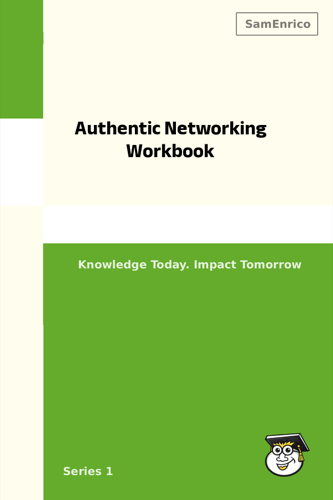
Authentic Networking Workbook eBook
Build real professional relationships without mani
by Bell Raquel
Build real professional relationships without manipulation or transactional thinking.
Formats
Free sample
Chapter 1: The Mirror Test--–- You are about to do something most people never do: you are going to look directly at your own networking habits without flinching. This will not feel good at first. In fact, if you do the exercises in this chapter honestly, you will likely feel uncomfortable, embarrassed, or even defensive. That is not a sign that something is wrong. That is the signal that you have finally stopped lying to yourself.Most professionals never complete the exercise you are about to begin.
They skim past self-assessments, nod along with general advice, and close the book feeling vaguely inspired but fundamentally unchanged. This workbook is not for them. This workbook is for the person who is tired of feeling fake at networking events, tired of collecting business cards that lead nowhere, and tired of the quiet voice in the back of their mind that whispers, “You are using these people, and you hate yourself for it.”The good news is that you cannot fix what you refuse to see. The bad news is that what you are about to see may challenge the way you have thought about professional relationships for your entire career. That is the point.
Transformation begins at the end of your comfort zone. And the end of your comfort zone starts with a mirror.The Lie You Have Been Told Every popular networking book, every Linked In influencer, every career coach who tells you to “work the room” or “never eat alone” has sold you the same lie: that networking is a numbers game, that relationships are leverage, and that your network is your net worth. This lie is seductive because it offers a simple, measurable path to success. Collect more contacts. Send more connection requests.
Follow up more aggressively. Treat every human being as a potential stepping stone.The problem is not that this approach fails. The problem is that it works just well enough to keep you trapped.You have probably experienced this firsthand. You attend a conference, force yourself to approach strangers, exchange cards with twenty people, and send follow-up emails the next day. Maybe one or two reply.
Maybe one leads to a coffee meeting. Maybe that coffee meeting leads to a useful introduction. You tell yourself this is success. And in a narrow, transactional sense, it is. You extracted value from the interaction.
You got what you wanted.But somewhere along the way, you lost something you cannot quantify. You lost the ability to walk into a room without calculating. You lost the ease of genuine curiosity. You started measuring people by their usefulness rather than their humanity. You began to feel like a fraud—not because you are incompetent, but because you are performing.
And the performance is exhausting.This chapter is the antidote to that exhaustion. It will not teach you how to be a better performer. It will teach you how to stop performing entirely.The Authenticity Baseline: What It Is and Why You Need It Before you can build authentic relationships with others, you must establish an “Authenticity Baseline” with yourself. This is a diagnostic tool that measures your current networking orientation on a spectrum from scarcity to abundance.A scarcity mindset treats relationships as finite resources. If you help someone, you have less to give.
If someone succeeds, you have lost an opportunity. Every interaction is a negotiation. Every favor is a debt to be collected. People with a scarcity mindset keep mental ledgers: who owes whom, who is useful, who can be ignored.An abundance mindset treats relationships as infinite possibilities. If you help someone, the pie grows larger for everyone.
If someone succeeds, you celebrate because their success creates new opportunities. Every interaction is a collaboration. Every favor is a gift with no strings attached. People with an abundance mindset keep mental gardens: who needs water, who is blooming, who is ready for harvest season.You might believe you have an abundance mindset. Most people do.
But your behavior tells a different story. The assessment below will reveal the gap between your intentions and your actions.Exercise 1.1: The Three-Question Reckoning Take out a notebook or open a new document. Answer each question honestly. Do not write what you wish were true. Write what actually happened.Question One: Think back to your last three professional interactions—a coffee meeting, a conference conversation, a Slack exchange, a Linked In message.
For each interaction, answer: Did I expect something in return? Be specific. Did you expect a favor, an introduction, information, or goodwill that you could later convert into something tangible? Write down the expectation next to each interaction.Question Two: For each of those three interactions, did you mentally categorize the person as “useful,” “not useful,” or “maybe useful later”? Do not filter yourself.
Your brain made these calculations automatically, whether you admitted it or not. Write down the category.Question Three: For each of those three interactions, did you follow up? If yes, was the follow-up motivated by genuine care for the person or by the possibility that they might help you someday? If you followed up with everyone, that is one answer. If you only followed up with the people you categorized as “useful,” that is a different answer.
Write down the truth.Now review your answers. What patterns do you see? Most people discover that 70 to 90 percent of their professional interactions are driven by some form of expectation. This is not because you are a bad person. It is because you have been trained by a culture that treats relationships as transactions.
The first step toward authenticity is simply noticing the training.The Sponsorship Trap: Why Mentoring Is Not Enough The original version of this workbook included a sponsorship versus mentorship self-test in this chapter. After careful revision, that material has been moved to Chapter 11, where it belongs. Sponsorship is an advanced practice that requires a foundation of self-awareness and generosity. Introducing it in Chapter 1 was premature and risked overwhelming readers before they had done the inner work.For now, all you need to know is this: most professionals mistake mentoring for authentic relationship-building. Mentoring feels good.
It makes you feel wise, helpful, and generous. But mentoring rarely changes outcomes because mentoring costs nothing but time. Sponsorship—actively using your influence to open doors for others when you are not in the room—is the practice that actually moves careers forward. However, you cannot become a sponsor until you have stopped keeping score. And you cannot stop keeping score until you complete this chapter.So put sponsorship aside for now.
It will be waiting for you in Chapter 11. Your only job in this chapter is to look in the mirror.The Values Clarification: Your Non-Negotiable Three Authenticity is not a personality trait. It is a practice of alignment between your actions and your values. Most people cannot name their top three professional values without pausing to think. That is a problem.
If you do not know what you stand for, you will stand for anything—or worse, you will stand for nothing while performing everything.Below is a list of common professional values. Read through it slowly. Circle or highlight the…
This is the end of the free sample. Get the eBook to keep going. Buy now
About this book
Details
- Author
- Bell Raquel
- Publisher
- SamEnrico
- Language
- English
- Genre
- Non-Fiction, Self-Help
- Released
- 2026-06-06
- Pages (approx.)
- 132
- Available as
- eBook, Audiobook

Read better in the ZLOADR app
Your eBooks on your phone or tablet. Sign in with your SamEnrico account and start reading.
More by Bell Raquel
 Shift Work for EMS GuideBell Raquel$11.99
 Body Image for Swimmers CourseBell Raquel$11.99
 Pantothenic Acid For EnergyBell Raquel$11.99
 Self Esteem and Partner's SuccessBell Raquel$11.99
 Frozen Shadows: The Arctic’s Forgotten Congo ExpeditionBell Raquel$11.99
 Understanding Esophageal Atresia Coloboma TalipesBell Raquel$17.99
 Silicon Shadows: The Unseen War for AI SupremacyBell Raquel$11.99
 How to Start a Dance Studio BusinessBell Raquel$11.99
 Prohibited Content ToS ClauseBell Raquel$12.99
 Military Transition CV ServiceBell Raquel$12.99
 Marine MechanicBell Raquel$11.99
You may also like
 Hong Kong Handover 1997Dunn Johnnie$11.99
 Zumba For Postnatal Recovery CourseNeal Christian$11.99
 Zumba for BeginnersLadner Nikia$11.99
 YouTube Comment Mining GuideHumes Pandora$12.99
 Worry Box MeditationCarlin Rudy$11.99
 Workplace Stress MeditationNguyen Lynn$11.99
 Workplace Stress and Sleep RepairHawley Ivory$11.99
 Workplace Perfectionism CureDelaney Jeffry$11.99
 Workplace Injustice Anger GuideWallen Isabelle$11.99
 Work Addiction and Burnout LinkGreenwood Ester$11.99
 Women in Yoga and WellnessBeattie Galina$11.99
 Women in Stand Up ComedyChun Evangeline$11.99