
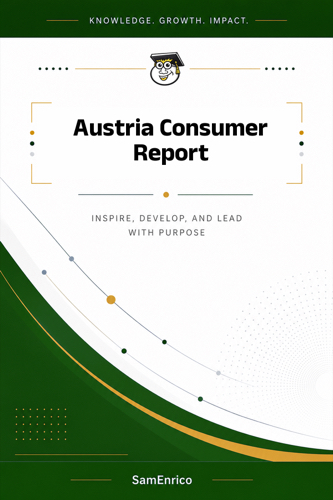
Non-FictionForecast & OutlookAustria
Austria Consumer Report eBook
Analyze spending in the Alpine nation as a bellwet
Analyze spending in the Alpine nation as a bellwether for Central Europe.
Formats
Free sample
Chapter 1: The Reluctant Rebound...--–- The first thing you need to know about Austria is that it never really recovered from the last crisis before it walked straight into the next one. That is not a metaphor. It is a mathematical fact. Between 2024 and 2025, the Alpine nation endured a shallow but painfully prolonged recession—two full years of negative or stagnant growth that left economists scratching their heads and consumers clutching their wallets. While Germany stumbled loudly, making headlines with factory closures and energy panics, Austria simply...
faded. No dramatic collapse. No banking meltdown. Just a slow, grinding erosion of confidence that felt less like a crash and more like a long, grey winter.But here is the twist that every investor, retailer, and policymaker in Central Europe needs to understand. In 2026, Austria is projected to return to positive growth.
Not a boom—roughly one percent. But that tiny, almost pathetic number is actually the most important economic signal on the continent. Because unlike previous recoveries, which were driven by German demand for Austrian machinery and steel, this rebound is being driven by something far more fragile and far more revealing: private consumption. Austrians are starting to spend again. And when Austrians spend, Central Europe follows.The Geography of the Bellwether Why does a nation of nine million people—smaller than New York City's metropolitan area—matter so much?
The answer lies in Austria's peculiar position at the crossroads of Western and Central Europe. To the west lies Germany, the continent's former engine, now sputtering through deindustrialization and political paralysis. To the east lie the Visegrád states—Poland, Czechia, Hungary, and Slovakia—ambitious, hungry, but volatile, with currencies that dance to the ECB's tune without enjoying the euro's full protection. Austria sits exactly in the middle. Not quite Western Europe anymore.
Not quite Eastern Europe yet. It is the economic equivalent of a border town: neither here nor there, but watching both directions.This geographic limbo has produced a consumer psychology unlike any other. Austrians have the wealth of Western Europeans—per capita GDP hovers around €54,000, comfortably above the EU average. But they have the caution of Eastern Europeans, having lived through the hyperinflation of the 1920s, the Anschluss, the postwar occupation, and the painful transition of the 1990s when Austrian banks overextended into former communist states and paid the price. That memory does not fade.
It becomes cultural DNA.What makes Austria a bellwether is not its size but its position as the first consumer market where real disposable income turns positive after a regional downturn. Because Austria has a larger social safety net than Hungary or Romania—automatic wage indexation, strong collective bargaining, and a generous unemployment system—its consumers feel comfortable spending sooner than their neighbors. When Austrian real wages rise, Viennese shoppers return to the stores. Six months later, shoppers in Prague and Budapest do the same. This four-to-six-month lead time is the single most reliable predictive window in Central European economics.Anatomy of a Recession That Wasn't Supposed to Happen Let us rewind to 2024.
The consensus among economists was that Austria would dodge a recession. The country had low public debt by European standards, a world-class tourism sector, and a banking system that had learned its lessons from the 2008 disaster. But consensus is often just groupthink with better haircuts. What actually happened was a perfect storm of external shocks and internal rigidities.First, German industrial demand collapsed. Austria's export sector is heavily oriented toward supplying machinery, auto parts, and specialized tools to German manufacturers.
When Germany's energy crisis and Chinese competition hammered its industrial base, Austrian factories felt the pain immediately. Orders dried up. Short-time work schemes expanded. And for the first time since the euro crisis, Austrian exports contracted for four consecutive quarters.Second, inflation refused to behave. While the Eurozone average inflation fell to around 2.5 percent in 2024, Austrian inflation stayed stubbornly above 4 percent.
The reasons were structural. Austrian collective bargaining agreements—the famous Kollektivverträge—locked in wage increases for tourism and service workers, who then spent those higher wages, keeping prices elevated. Meanwhile, Austria had been slower than Germany to replace Russian natural gas, meaning energy costs remained higher for longer. The result was a classic wage-price spiral, mild but persistent, that eroded purchasing power even as headline inflation fell elsewhere.Third, and most important for our purposes, Austrian consumers reacted not with panic but with paralysis. The savings rate—the percentage of disposable income that households stash away rather than spend—jumped from a pre-pandemic level of around 8 percent to nearly 12 percent by late 2024.
This was not the frantic hoarding of a nation in crisis. It was the cold, calculated withdrawal of a nation that had seen this movie before. Austrians did not stop spending because they were poor. They stopped spending because they were uncertain. And uncertainty, for a consumer, is more paralyzing than actual poverty.The Consumption-Led Recovery That Almost Didn't Happen By early 2025, most forecasters had given up on a quick recovery.
The European Central Bank kept interest rates high to fight lingering inflation. German factories showed no signs of waking up. And Austrian consumers, sitting on their growing piles of cash, showed no interest in spending it.Then two things changed. The first was the ECB's signal in late 2025 that rate cuts were coming. The second, more important factor was automatic wage indexation—a feature of the Austrian social contract that is almost unknown in the United States and increasingly rare in Europe.
Every year, Austrian collective bargaining agreements automatically adjust wages for inflation. In 2024, that meant raises of roughly 5 percent for millions of workers. Real disposable income, adjusted for inflation, grew by approximately 3 percent that year. The money went into bank accounts, not cash registers. But it was there, waiting.By the first quarter of 2026, the waiting stopped.
Not dramatically. Not with the fireworks of a consumer spending boom. But with the quiet, almost reluctant return of Austrian shoppers to grocery stores, restaurants, and—eventually—retail parks and furniture showrooms. The savings rate began to edge down from its peak of nearly 12 percent to around 10.5 percent. Still high by historical standards.
But moving in the right direction.This is the "reluctant rebound" that gives the chapter its name. Austrians are not spending because they are confident. They are spending because the alternative—sitting on cash while inflation slowly eats it—has become untenable. They are spending because interest rates are finally falling, making saving less attractive. They are spending because a year of wage increases has made their bank accounts uncomfortably full.
But they are not spending with joy. They are spending with calculation. And that calculation is the most important data point for anyone trying to forecast Central European consumption.The Austrian Consumer Confidence Index: Your New Favorite Indicator If you take only one number from this chapter, make it the Austrian Consumer Confidence Index (ACI). Compiled monthly by the European Commission based on surveys of Austrian households, the ACI asks four simple questions: How has your financial situation changed? How do you expect it to change in the next twelve months?
Is now a good time to make major purchases? How much money will you save in the coming year?The answers…
This is the end of the free sample. Get the eBook to keep going. Buy now
About this book
Details
- Author
- Sisk Brittaney
- Publisher
- SamEnrico
- Language
- English
- Genre
- Non-Fiction, Forecast & Outlook, Austria
- Released
- 2026-06-09
- Pages (approx.)
- 136
- Available as
- eBook, Audiobook

Read better in the ZLOADR app
Your eBooks on your phone or tablet. Sign in with your SamEnrico account and start reading.
More by Sisk Brittaney
 Affirmations For Grief HandbookSisk Brittaney$11.99
 Stress And Bone DensitySisk Brittaney$11.99
 Estate Planning for Retirement AccountsSisk Brittaney$11.99
 DBT for Borderline Personality DisorderSisk Brittaney$11.99
 Conan the Barbarian: The Sumo Warrior Who Conquered AmericaSisk Brittaney$11.99
 Content Authority Building in Niche MarketsSisk Brittaney$11.99
 Vlad Tenev GuideSisk Brittaney$12.99
 Campaign Pause and Restart GuideSisk Brittaney$12.99
 Understanding Palsy CerebralSisk Brittaney$17.99
 How to Start a Perry Business (Beginners Guide)Sisk Brittaney$11.99
You may also like
 Hong Kong Handover 1997Dunn Johnnie$11.99
 Zumba For Postnatal Recovery CourseNeal Christian$11.99
 Zumba for BeginnersLadner Nikia$11.99
 YouTube Comment Mining GuideHumes Pandora$12.99
 Worry Box MeditationCarlin Rudy$11.99
 Workplace Stress MeditationNguyen Lynn$11.99
 Workplace Stress and Sleep RepairHawley Ivory$11.99
 Workplace Perfectionism CureDelaney Jeffry$11.99
 Workplace Injustice Anger GuideWallen Isabelle$11.99
 Work Addiction and Burnout LinkGreenwood Ester$11.99
 Women in Yoga and WellnessBeattie Galina$11.99
 Women in Stand Up ComedyChun Evangeline$11.99