

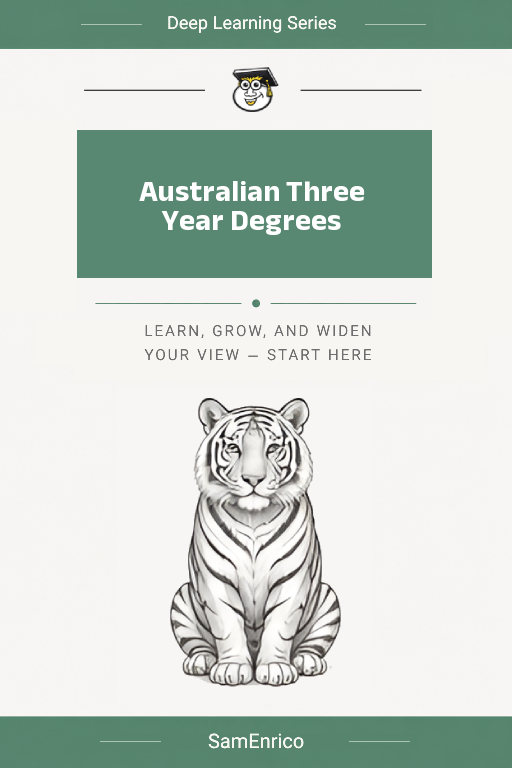
Australian Three Year Degrees eBook
Compare standard three-year bachelor's with honors
Compare standard three-year bachelor's with honors fourth year options.
Formats
Free sample
Chapter 1: The Three-Year Question...--–- Every year, thousands of students across Australia find themselves standing at a crossroads they didn't even know existed. They have completed three years of university study. They have attended lectures, submitted essays, sat through exams, and earned a bachelor's degree. They assume this is the end of the road—the natural conclusion of their undergraduate journey. But for many, the most important decision of their academic lives is only now beginning to reveal itself.The question that catches most students off guard is deceptively simple: Should you stay for a fourth year?In the Australian higher education system, this question carries weight that prospective students rarely appreciate when they first enrol.
The standard three-year bachelor's degree is a remarkable achievement—a qualification recognized around the world as a mark of discipline-specific knowledge and intellectual capability. Yet lurking beneath this straightforward pathway is a parallel universe of opportunity, competition, and strategic decision-making that separates those who simply complete a degree from those who leverage it into advanced careers, research positions, and doctoral pathways.This book is about that choice. It is about understanding what a three-year degree actually delivers, what a fourth-year Honours program adds, and how to decide which path aligns with your goals, your financial reality, and your tolerance for the unique pressures of advanced academic work.But before we can navigate that decision, we must first understand a more fundamental question—one that international students, parents, and even many domestic students ask with genuine bewilderment: Why is the Australian bachelor's degree only three years long?The Global Puzzle of the Three-Year Degree For students and families accustomed to the American system—where a bachelor's degree almost always requires four years and includes two years of general education requirements in subjects like history, literature, mathematics, and natural sciences—the Australian model can appear truncated, even suspiciously brief. How, they wonder, can a student master a discipline in three years when their American counterparts need four?The answer lies not in the quality or intensity of Australian education, but in a fundamentally different philosophical approach to what an undergraduate degree should accomplish.The Australian system, like its British predecessor, operates on a principle of early specialization. Students applying to Australian universities typically declare a major—or at least a broad field of study—at the point of admission.
A student entering a Bachelor of Commerce knows they will study commerce. A student entering a Bachelor of Science knows they will focus on scientific disciplines. There is no expectation that a first-year student will spend time sampling poetry, ancient history, or introductory psychology before committing to their chosen path.This stands in stark contrast to the American liberal arts model, which deliberately postpones specialization. American students typically spend their first two years completing "distribution requirements" across the humanities, social sciences, natural sciences, and mathematics. Only in their third year do they begin deep work in their major.
The fourth year completes that specialization. The result is a four-year degree that produces graduates with broad exposure to multiple ways of thinking but less depth in any single discipline.The United Kingdom, like Australia, operates on the three-year model, though with even earlier specialization. Scottish universities, following a different tradition, often offer four-year degrees that more closely resemble the American structure. But throughout most of the English-speaking world outside North America, the three-year degree is the norm.Understanding this distinction is not merely an academic exercise. It has profound implications for how Australian graduates compete in global job markets, how they transition into postgraduate study, and how they are perceived by employers who may be unfamiliar with the Australian system.The Historical Roots of the Australian Model To understand why Australian universities settled on three years, we must briefly examine the history of higher education in the country.
The first Australian universities—the University of Sydney (1850) and the University of Melbourne (1853)—were explicitly modeled on the British collegiate system, particularly the universities of Oxford, Cambridge, and London. These institutions were designed to educate the children of the colonial elite for careers in law, medicine, the clergy, and public service.The British model at that time placed heavy emphasis on examinations and external oversight. Students were expected to master a prescribed curriculum, and the degree was largely a matter of demonstrating competence through rigorous testing. There was no American-style elective system, no "cafeteria-style" education where students could design their own intellectual journeys. You studied what the university required, and you studied it intensely.This examination-focused culture persisted well into the twentieth century.
Even as Australian universities expanded after World War II—admitting students from broader social and economic backgrounds—the underlying structure remained remarkably stable. A three-year bachelor's degree, followed by an optional fourth-year Honours year for the most capable students, became the standard pathway.The Honours year itself deserves special attention. In the British and Australian systems, Honours was never merely a "fourth year" attached to a three-year degree. Historically, the bachelor's degree was considered incomplete without Honours. The "pass degree"—the three-year version—was seen as a terminal qualification for students who did not intend to pursue advanced study.
The Honours year, by contrast, was the gateway to graduate work, research positions, and academic careers.This distinction has blurred over time, but it has never disappeared. Today, as we will explore throughout this book, the choice between a three-year pass degree and a four-year Honours degree remains one of the most consequential decisions an Australian undergraduate can make.The Vocational Reality: What Three Years Actually Deliver Let us be direct about what a three-year Australian bachelor's degree provides—and what it does not.First, the three-year degree provides discipline-specific knowledge at a level of depth that compares favorably with the final two years of an American degree. Because Australian students are not required to spend time on general education requirements, they can devote more credits to their major field. By the time an Australian commerce student graduates, they have typically completed the equivalent of a full American major plus substantial coursework in related business disciplines.Second, the three-year degree signals to employers that the graduate possesses foundational competence in their field. A Bachelor of Information Technology tells an employer that the candidate understands programming principles, database design, and systems architecture.
A Bachelor of Arts in History tells an employer that the candidate can analyze complex texts, construct evidence-based arguments, and write clearly. These are valuable signals, and for many careers, they are sufficient.Third—and this is crucial—the three-year degree is explicitly designed for workforce entry. Unlike systems where a bachelor's degree is seen as preparation for further study, the Australian three-year degree is intended to produce graduates who can step directly into professional roles. This is why professional degrees in fields like accounting, nursing, and teaching are offered at the bachelor's level in Australia, whereas in the United States they often require graduate study.However, the three-year degree has limitations that students must understand before they make decisions about their futures.The most significant limitation is that a three-year pass degree does not, by itself, qualify a student for doctoral study anywhere in the world. Ph D programs in…
This is the end of the free sample. Get the eBook to keep going. Buy now
About this book
Details
- Author
- Thibodeau Bradly
- Publisher
- SamEnrico
- Language
- English
- Genre
- Non-Fiction, Student's Shortcut
- Released
- 2026-06-01
- Pages (approx.)
- 154
- Available as
- eBook, Audiobook

Read better in the ZLOADR app
Your eBooks on your phone or tablet. Sign in with your SamEnrico account and start reading.
More by Thibodeau Bradly
 WhatsApp Business AutomationThibodeau Bradly$11.99
 Beautiful AI Templates GuideThibodeau Bradly$11.99
 The Thirty Day Beginner ChallengeThibodeau Bradly$11.99
 The Nun Who Fasted for PeaceThibodeau Bradly$11.99
 Strength Training For Back PainThibodeau Bradly$11.99
 Assertiveness For Job SeekersThibodeau Bradly$11.99
 Appetite Loss Before DeathThibodeau Bradly$11.99
 Growing Up in a Trailer ParkThibodeau Bradly$11.99
 Nightmare and Heart DiseaseThibodeau Bradly$11.99
 Apple Product Launch FeverThibodeau Bradly$11.99
 The Iron Spine of Europe: The Visionaries Behind the Suez and Panama CanalsThibodeau Bradly$11.99
 Frozen in Time: The Lost Expedition of the *USS Polar Star*Thibodeau Bradly$11.99
You may also like
 Hong Kong Handover 1997Dunn Johnnie$11.99
 Zumba For Postnatal Recovery CourseNeal Christian$11.99
 Zumba for BeginnersLadner Nikia$11.99
 YouTube Comment Mining GuideHumes Pandora$12.99
 Worry Box MeditationCarlin Rudy$11.99
 Workplace Stress MeditationNguyen Lynn$11.99
 Workplace Stress and Sleep RepairHawley Ivory$11.99
 Workplace Perfectionism CureDelaney Jeffry$11.99
 Workplace Injustice Anger GuideWallen Isabelle$11.99
 Work Addiction and Burnout LinkGreenwood Ester$11.99
 Women in Yoga and WellnessBeattie Galina$11.99
 Women in Stand Up ComedyChun Evangeline$11.99