

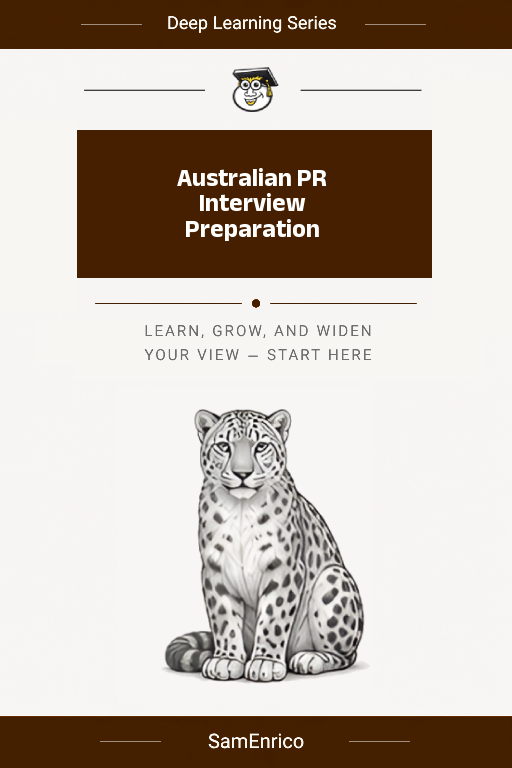
Non-FictionStudent's ShortcutInterview Prep
Australian PR Interview Preparation eBook
Prepare for possible Department interview question
Prepare for possible Department interview questions. This workbook covers common queries and response strategies for student residency applicants.
Formats
Free sample
Chapter 1: The Credibility Audit--–- You have twenty minutes. A Department of Home Affairs officer sits across from you, a thick file on the desk, a laptop screen glowing between you. They have already read your application. They have already checked your attendance records, your bank statements, and your visa history. They know more about you than you think they do.
The first question comes not as a greeting but as a test: "Tell me about yourself." In that moment, everything you have prepared – or failed to prepare – begins to surface.This chapter is about understanding what that officer is actually looking for. Not the surface question, but the hidden audit. Because here is the truth that most applicants never realize: the Department interview is not an interrogation designed to catch you in a lie. It is a due diligence audit. The officer is not your enemy.
They are a fact-checker. Their job is to verify that the person sitting in front of them matches the person described in the application documents. That is all. And yet, this simple fact eludes most applicants, who arrive defensive, over-prepared with memorized lines, and utterly unable to answer the simplest follow-up question when it deviates from their script.This book exists because the gap between "paper applicant" and "real person" is where visas are won or lost. The officer is trained to look for credibility gaps – inconsistencies between what you declared and what you now say, between your stated intentions and your actual behavior, between your documents and your demeanor.
The March 2024 replacement of the Genuine Temporary Entrant (GTE) requirement with the Genuine Student (GS) criteria has only sharpened this focus. Under the old system, officers spent considerable energy trying to determine if you secretly intended to stay in Australia permanently. Under the new system, that question has been deprioritized. What matters now is something far more straightforward: are you a genuine student?This shift is not minor. It is seismic.
For years, applicants for PR pathways were advised to hide their true intentions, to pretend they were desperate to return home, to perform a version of themselves that was fundamentally untrue. That advice is now not only unnecessary but potentially harmful. The GS framework asks: do you attend your classes? Do you pass your units? Did you choose your course for academic reasons or migration reasons?
Can you name three units from your handbook without looking? Can you explain how this qualification advances your career, whether in Australia or elsewhere?This chapter will walk you through the four pillars of the GS assessment, explain the difference between permissible dual intent and fraudulent study claims, introduce the unifying mantra that will appear throughout this book – "Study is my primary purpose" – and provide your first workbook exercise: the Two-Column Audit, designed to expose the gap between your paper application and your real life before the officer does it for you.The Four Pillars of the GS Assessment The Department trains its officers to evaluate every student visa application against four specific criteria. Understanding these pillars is not optional. Every question you are asked in the interview will trace back to one of these four areas.Pillar One: Academic Preparedness and Background The officer wants to know if you have the intellectual and educational foundation to succeed in the course you have enrolled in. This sounds obvious, but many applicants fail to demonstrate it.
Academic preparedness is not about having a degree – it is about having the right degree or experience. If you studied marketing for three years and are now enrolling in a Master of Engineering, the officer will ask why. If you cannot explain the logical bridge between your past studies and your current course, you will appear to be collecting qualifications randomly.Evidence of academic preparedness includes previous transcripts showing relevant subjects, work experience in the field, professional certifications, or even self-directed learning. The officer is looking for a narrative arc. Your educational history should tell a story, not a series of disconnected events.Pillar Two: Course Suitability for Future Goals This is where most applicants stumble.
They can explain what they are studying but not why it matters. The officer needs to see a clear line from your current course to your future career. That career can be in Australia or in your home country – the GS framework does not penalize you for wanting to stay, provided you have a genuine plan.Course suitability is demonstrated by naming specific units, accreditation pathways, industry connections, or professional registration requirements. "This university has a good reputation" is not an answer. "This university offers three specific units – Advanced Clinical Placement, Gerontology Nursing, and Chronic Disease Management – which are required for my AHPRA registration as a nurse" is an answer.Pillar Three: Value of the Qualification to the Applicant's Future This pillar asks: will this qualification improve your life?
Not Australia's life – your life. The officer is looking for evidence that you have calculated the return on investment. This is particularly important for PR pathway applicants because you are making a significant financial commitment. If you cannot articulate why this specific qualification is worth the tuition fees, living costs, and time, the officer will assume you are studying for migration reasons alone.Value can be demonstrated through salary surveys, job placement rates, industry demand reports, or specific employer statements. You do not need to bring these documents to the interview, but you need to be able to reference them.
"According to Jobs and Skills Australia, there is a projected shortage of 50,000 cybersecurity professionals by 2028, and this qualification is specifically listed as desirable in their workforce plan" is a powerful statement.Pillar Four: Immigration Compliance History This pillar is backward-looking. The officer will review your entire immigration history – not just in Australia but anywhere in the world. Have you overstayed a visa? Have you worked more hours than permitted? Have you breached any conditions?
If yes, you need a Confession & Correction strategy (covered in detail in Chapter 9). If no, you simply need to demonstrate that you understand the conditions of your current visa and intend to comply with them.Compliance history is not just about avoiding violations. It is about demonstrating that you are a low-risk applicant. The officer wants to approve you. Approvals are faster than refusals, which require additional documentation and review.
Your job is to give them no reason to say no.The Great Shift: From GTE to GSTo understand why this book takes the approach it does, you need to understand what changed in March 2024. The Genuine Temporary Entrant (GTE) requirement was replaced by the Genuine Student (GS) criteria. Under GTE, the central question was: "Do you genuinely intend to stay in Australia only temporarily?" This created an impossible situation for PR pathway applicants. You were expected to study for two years, perhaps work for two more years on a 485 visa, and then apply for PR – all while claiming under oath that you intended to leave. Many applicants lied.
Some were caught. The system was incoherent.Under GS, the central question is: "Do you genuinely intend to study?" That is it. The Department explicitly states that applicants may have "future aspirations to stay…
This is the end of the free sample. Get the eBook to keep going. Buy now
About this book
Details
- Author
- Fernandez Kevin
- Publisher
- SamEnrico
- Language
- English
- Genre
- Non-Fiction, Student's Shortcut, Interview Prep
- Released
- 2026-05-30
- Pages (approx.)
- 155
- Available as
- eBook, Audiobook

Read better in the ZLOADR app
Your eBooks on your phone or tablet. Sign in with your SamEnrico account and start reading.
More by Fernandez Kevin
 Breath for Mass ShootingsFernandez Kevin$11.99
 Transcendental Meditation vs MindfulnessFernandez Kevin$11.99
 Productivity Porn Comparison GuideFernandez Kevin$11.99
 Childrens Environmental Toxin GuideFernandez Kevin$11.99
 Bipolar Spectrum GuideFernandez Kevin$11.99
 Bomb Squad Technician StressFernandez Kevin$11.99
 Vaping Aerosol Exposure GuideFernandez Kevin$11.99
 Chemical Peel Wrinkle Reduction WorkbookFernandez Kevin$11.99
 Arthritis Home ModificationsFernandez Kevin$11.99
 The Butcher of Boston: A Mind UnraveledFernandez Kevin$11.99
 The Bone Orchard Rebellion: When Women Turned the Tides of WarFernandez Kevin$11.99
 Golden Arches of Atlantis: The Fast Food Empire That DrownedFernandez Kevin$11.99
You may also like
 Hong Kong Handover 1997Dunn Johnnie$11.99
 Zumba For Postnatal Recovery CourseNeal Christian$11.99
 Zumba for BeginnersLadner Nikia$11.99
 YouTube Comment Mining GuideHumes Pandora$12.99
 Worry Box MeditationCarlin Rudy$11.99
 Workplace Stress MeditationNguyen Lynn$11.99
 Workplace Stress and Sleep RepairHawley Ivory$11.99
 Workplace Perfectionism CureDelaney Jeffry$11.99
 Workplace Injustice Anger GuideWallen Isabelle$11.99
 Work Addiction and Burnout LinkGreenwood Ester$11.99
 Women in Yoga and WellnessBeattie Galina$11.99
 Women in Stand Up ComedyChun Evangeline$11.99