
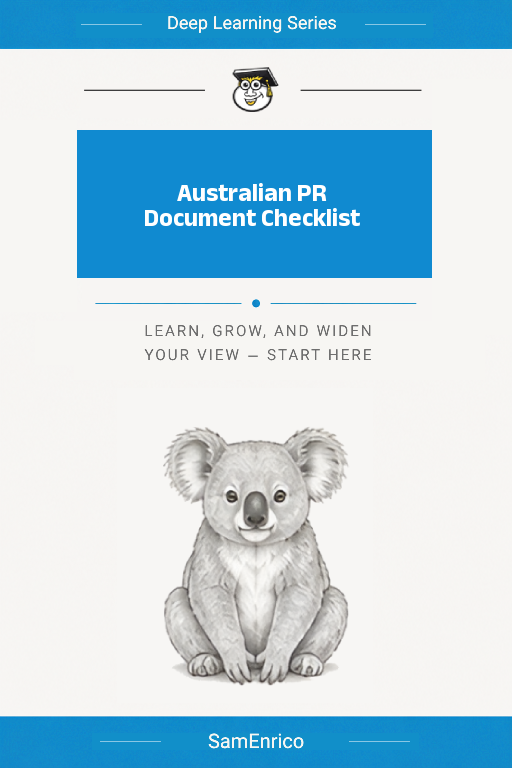
Non-FictionStudent's ShortcutDocument GuideChecklist
Australian PR Document Checklist eBook
Organize required documents for PR application inc
Organize required documents for PR application including identity education work and relationship evidence.
Formats
Free sample
Chapter 1: The Identity Trap--–- Maria had done everything right. She had spent three years accumulating Australian work experience, scored Superior on her English test, and hired a migration agent. When she submitted her Expression of Interest with 90 points, she was confident. The invitation arrived within weeks. She lodged her visa application, uploaded every document she could find, and waited.
Eight months later, the refusal letter arrived. The reason? Her birth certificate listed her as "Maria Rodriguez-Garcia." Her passport said "Maria Rodriguez." Her degree certificate said "M. Rodriguez." The case officer could not verify that these three documents referred to the same person. Maria lost AUD $4,640 in application fees and had to start the entire process again, this time paying for a Deed Poll and statutory declarations to explain the discrepancies.
She later told a Facebook support group: "I thought the case officer would understand that these were the same person. They didn't. They refused me on the spot."Maria's story is not unusual. It is, in fact, the most common cause of visa refusal that applicants never see coming. We spend months worrying about employer reference letters, police certificates, and skills assessments, but we ignore the most fundamental requirement of all: proving who we are.
The Department of Home Affairs processes over 200,000 permanent visa applications each year. Their case officers are not mind-readers. They do not know that "Jon," "John," and "Jonathan" are the same person. They do not know that a married woman's maiden name is not her current legal name unless she provides proof. They work with exactly what you give them, and if what you give them contradicts itself, they stop reading and issue a refusal.This chapter is called "The Identity Trap" because that is exactly what it is: a trap that most applicants walk into without realizing it.
You will learn how to establish a Single Source of Truth for your identity, how to fix every type of name discrepancy before the case officer notices it, and how to ensure that every document you submit tells the same story about who you are. By the end of this chapter, you will have a complete Identity Kit that no case officer can reject.The Single Source of Truth Principle Every successful visa application begins with a single, non-negotiable principle: you must select one authoritative document and ensure every other identity document matches it exactly. That authoritative document is your "Single Source of Truth." In 99 percent of cases, that document should be your passport. In rare cases where the passport is unavailable or contains errors, your full birth certificate can serve as the source. But once you choose, you never deviate.Why is this so critical?
Because the Department's systems are designed to cross-reference every document you upload. When you submit your passport, the system extracts your name, date of birth, and place of birth. When you submit your birth certificate, the system does the same. When you submit your degree certificate, your employment references, and your partner's documents, the system compares them all. If any two documents disagree on your name, your date of birth, or your parents' names, the system flags your application for manual review.
That manual review is not a quick process—it adds months to your processing time. And if the case officer cannot resolve the discrepancy from the documents you have provided, they will refuse your application without asking for clarification.The Single Source of Truth principle is simple: take your passport. Write down exactly how your name appears on the bio page. Write down your date of birth exactly as it appears (day, month, year). Write down your place of birth exactly as it appears.
Now, every single document you submit—your birth certificate, your degree, your marriage certificate, your employer letters, your partner's documents—must match these three pieces of information exactly. If a document does not match, you have two options: get the document corrected, or attach additional evidence explaining the discrepancy.This is not paranoia. This is what migration agents do for every client. The best agents spend hours checking name consistency across dozens of documents before they ever submit an Expression of Interest. They know that a single inconsistency can sink an otherwise perfect application.The Five Types of Name Discrepancies Name discrepancies come in many forms, and each type requires a different solution.
Before you can fix a discrepancy, you need to identify what type you are dealing with.Type 1: Maiden name discrepancies. This is the most common discrepancy, affecting married women who changed their surname after marriage. Your passport may show your married name ("Sarah Johnson"), your birth certificate shows your maiden name ("Sarah Chen"), and your degree certificate might show either one depending on when you earned it. The case officer sees two different last names and cannot automatically connect them. The solution is simple: attach your government-issued marriage certificate.
This document serves as the legal bridge between your maiden name and your married name. Note that a religious "celebrant certificate" is not sufficient—you need the certificate issued by the state or territory registry of births, deaths, and marriages.Type 2: Spelling errors. These are maddeningly common, especially for applicants from countries that use non-Latin alphabets. Your passport might say "Mohammed Al-Rashid," your degree says "Mohamed Al Rashid," and your employment reference says "M. Alrashid." These are all the same person, but the case officer cannot assume that.
The solution depends on the severity of the error. For minor spelling variations (one letter difference), a statutory declaration explaining that the variations are common transliterations and that all documents refer to the same person may be sufficient. For major variations (entirely different names), you will need a certified Deed Poll or an affidavit from a solicitor confirming that the names refer to the same individual.Type 3: Cultural naming structures. Many cultures have naming conventions that do not fit neatly into the "first name / last name" boxes on Australian forms. For example, some South Indian names do not include a family name at all—"Venkatesh" may be a given name, with no surname.
Some Chinese names present the family name first, then the given name. Some Afghan names include tribal affiliations that appear on some documents but not others. The solution is always the same: a statutory declaration explaining your cultural naming convention. In this declaration, you will state: "In my culture, names are structured as follows: [explanation]. The name on my passport is [name].
The name on my birth certificate is [name]. These refer to the same person, and the apparent discrepancy is due to cultural naming conventions." Attach this declaration to your application before the case officer asks for it.Type 4: Nicknames and abbreviations. John Smith might go by "Jack" in daily life. Some employers might refer to him as "J. Smith" on payslips.
His university might have recorded him as "Jonathan Smith." The case officer sees three different first names and flags the application. The solution is to avoid using nicknames on any official document submitted to the Department. If your employer's letter uses a nickname, ask them to reissue it with your full legal name. If that is impossible, attach…
This is the end of the free sample. Get the eBook to keep going. Buy now
About this book
Details
- Author
- Dexter Dennis
- Publisher
- SamEnrico
- Language
- English
- Genre
- Non-Fiction, Student's Shortcut, Document Guide, Checklist
- Released
- 2026-05-30
- Pages (approx.)
- 156
- Available as
- eBook, Audiobook

Read better in the ZLOADR app
Your eBooks on your phone or tablet. Sign in with your SamEnrico account and start reading.
More by Dexter Dennis
 Nairobi Remote Work Startup GuideDexter Dennis$11.99
 Body Scan for Cancer PatientsDexter Dennis$11.99
 Pain Work AccommodationDexter Dennis$11.99
 Change Management Personal ResilienceDexter Dennis$11.99
 Testosterone and Inflammation LinkDexter Dennis$11.99
 Velvet & Vengeance: The Duke Who Dared to Defy the CrownDexter Dennis$11.99
 The Silent Stands: Gymnastics’ Darkest SecretDexter Dennis$11.99
 Understanding Charcot–Marie–tooth Disease Deafness Mental RetardationDexter Dennis$17.99
 Diversity & Inclusion RecruiterDexter Dennis$11.99
 How to Start a Hobby in Learning foreign languagesDexter Dennis$11.99
 Proposal for International StudentsDexter Dennis$12.99
You may also like
 Hong Kong Handover 1997Dunn Johnnie$11.99
 Zumba For Postnatal Recovery CourseNeal Christian$11.99
 Zumba for BeginnersLadner Nikia$11.99
 YouTube Comment Mining GuideHumes Pandora$12.99
 Worry Box MeditationCarlin Rudy$11.99
 Workplace Stress MeditationNguyen Lynn$11.99
 Workplace Stress and Sleep RepairHawley Ivory$11.99
 Workplace Perfectionism CureDelaney Jeffry$11.99
 Workplace Injustice Anger GuideWallen Isabelle$11.99
 Work Addiction and Burnout LinkGreenwood Ester$11.99
 Women in Yoga and WellnessBeattie Galina$11.99
 Women in Stand Up ComedyChun Evangeline$11.99