
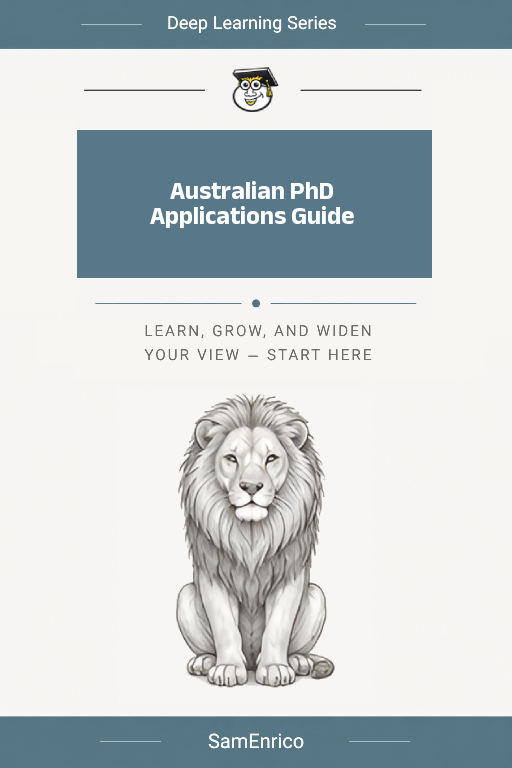
Non-FictionStudent's ShortcutAustralia
Australian PhD Applications Guide eBook
Australian PhD programs admit with honors degree o
Australian PhD programs admit with honors degree or master's, emphasizing research proposals.
Formats
Free sample
Chapter 1: The H1 Trap--–- The email arrived on a Tuesday afternoon. Priya had been checking her inbox every fifteen minutes for three weeks. She had imagined every possible outcome—acceptance, waitlist, rejection—but she had not imagined this. "Thank you for your application to the Doctor of Philosophy program. After careful consideration, we regret to inform you that your application has not been successful."She had a first-class honours degree.
She had two conference papers. Her referees were professors who had known her for years. By every objective measure, she was qualified. But the feedback was consistent across all three universities she had applied to: "Your research proposal is not sufficiently developed. We encourage you to strengthen your proposal and reapply in the next round."Priya was devastated.
She had spent months on that proposal. She had read sample proposals online. She had followed every guide she could find. What had she missed?What Priya did not understand—what thousands of applicants fail to understand every year—is that a first-class honours degree is not a golden ticket. It is a necessary condition for admission, but it is not sufficient.
Australian universities are not looking for the smartest applicant. They are looking for the best fit. The best fit for a specific supervisor, a specific department, and a specific research project. And the research proposal is the only document that demonstrates fit.This chapter is about the H1 Trap. It is about the false confidence that comes from high grades, the hidden thresholds that most applicants overlook, and the specific, actionable steps you need to take to ensure your honours degree actually opens doors rather than just looking impressive on paper.The Honours Degree: What It Is and What It Isn't An Australian honours degree is typically a fourth year of study following a three-year bachelor's degree.
During this year, students complete a significant research project or thesis under the supervision of an academic. The thesis is the centrepiece of the honours year. It is your first real experience of conducting independent research.The key threshold that admissions committees scrutinise is the research component. The University of Melbourne specifies that applicants "are normally required to have completed a research project, component, subject or group of subjects that accounts for at least 25% of their work (i.e. Honours year)." This research component may include a research thesis or dissertation, a sustained piece of scholarly writing, practice-based research with written documentation, or formal research skills training including methodology and reasoning subjects.But here is what many applicants misunderstand: the research must have been conducted and assessed individually.
Group research is acceptable only if individual contributions were graded separately. If your honours thesis was a group project and you received a shared grade, you may need additional documentation to demonstrate your individual contribution.The honours degree is a signal. It tells the admissions committee that you have completed research training and can work independently. But a signal is not a guarantee. The proposal must do the rest.The Honours Class System: More Than Just H1Australian universities classify honours degrees into five tiers.
Each tier sends a different signal to admissions committees.First Class Honours (H1): 80–100 percent. This is the highest level of achievement. It signals exceptional research capability and strong potential for doctoral study. H1 applicants are highly competitive for both admission and scholarships. However—and this is critical—H1 applicants with weak proposals are rejected every year.
The grade gets your foot in the door. The proposal determines whether you walk through it.Upper Second Class Honours (H2A): 75–79 percent. This is the minimum standard for Ph D admission at most universities. The University of Melbourne's Ph D-Science program requires "an overall H1 (80–100%) or H2A (75–79%) grade or equivalent." The University of Sydney looks for "first or upper second-class honours" with a Weighted Average Mark (WAM) above 75. H2A applicants must have a stronger proposal than H1 applicants to compensate, but admission is absolutely possible.Lower Second Class Honours (H2B): 70–74 percent.
This grade is typically insufficient for direct Ph D admission. However, H2B applicants may be accepted into a master's by research program, which serves as a pathway to the Ph D. Successful completion of the master's at a high standard qualifies you for Ph D admission.Third Class Honours (H3): 60–69 percent. This is not sufficient for direct Ph D admission. Applicants with H3 should plan to complete a master's by research or a Graduate Diploma of Research Studies before applying for a Ph D.Pass (Unclassified): Below 60 percent.
Not sufficient for research degrees at any level.The trap is assuming that H1 is enough. It is not. The proposal matters more.The Research Component Requirement: The 25% Rule Universities scrutinise the nature of your research experience, not just the grade. The University of Melbourne's requirement that the research component account for "at least 25% of their work (i.e. Honours year)" is a hard threshold.
If your honours year was structured differently—for example, if your thesis was only 15 percent of your total assessment—you may not meet the requirement even with an H1 grade.What qualifies as a research component? The University of Melbourne lists:A research thesis or dissertation A sustained piece of scholarly writing Practice-based research with written documentation (such as performance or fieldwork with scholarly analysis)Formal research skills training, including methodology and reasoning subjects If your honours year included multiple small research projects rather than one large thesis, the cumulative total must still reach 25 percent. If your honours year was entirely coursework with no thesis, you do not meet the requirement.International applicants face additional scrutiny. A four-year bachelor's degree from a country with a strong research tradition (such as the United Kingdom, Canada, or the United States) may be considered equivalent to an Australian honours degree, particularly if it included a substantial research thesis. However, a standard three-year bachelor's degree without an honours year is generally not sufficient.If you do not meet the research component requirement, do not despair.
The master's pathway (Chapter 2) or a Graduate Diploma of Research Studies may be appropriate.The Currency Trap: When Your Degree Is Too Old An often-overlooked requirement is the "currency" of your knowledge. The University of Melbourne expects that "the applicant's degree(s) and/or professional experience must demonstrate that the applicant's knowledge of the discipline in which they plan to undertake their Ph D is current." It is therefore expected that applicants will have completed their tertiary studies and/or any relevant professional experience within the ten years immediately prior to intended entry.If your honours degree is more than ten years old, you may need to demonstrate recent engagement with your discipline. This could include:Completion of recent coursework or a graduate certificate Professional experience in a research-intensive role Publications or conference presentations within the last five years Evidence of ongoing professional development The currency requirement is rarely mentioned in marketing materials, but it is enforced. If your qualifications are older than ten years, contact the admissions office before applying. They can advise on whether you need to update your knowledge or whether your professional experience is sufficient.International Equivalency: How Your Degree Compares If you completed your…
This is the end of the free sample. Get the eBook to keep going. Buy now
About this book
Details
- Author
- Minton Tristan
- Publisher
- SamEnrico
- Language
- English
- Genre
- Non-Fiction, Student's Shortcut, Australia
- Released
- 2026-05-30
- Pages (approx.)
- 115
- Available as
- eBook, Audiobook

Read better in the ZLOADR app
Your eBooks on your phone or tablet. Sign in with your SamEnrico account and start reading.
More by Minton Tristan
 Public Humiliation TriggersMinton Tristan$11.99
 Barbell Basics Strength BlueprintMinton Tristan$11.99
 Acupuncture For Headache ReliefMinton Tristan$11.99
 Evening Self Talk Reset GuideMinton Tristan$11.99
 Comparison Trap Relationship GuideMinton Tristan$11.99
 The Effortless Transcending MethodMinton Tristan$11.99
 Gamblers Anonymous StepsMinton Tristan$11.99
 Ralph Bunche NobelMinton Tristan$11.99
 Agency Burnout PreventionMinton Tristan$11.99
 The Spark of Reason: How Voltaire Lit the EnlightenmentMinton Tristan$11.99
 The Elegant Equations: Évariste Galois and the Birth of Modern AlgebraMinton Tristan$11.99
 Iron & Ice: The Untold Saga of the Titanic's Unsinkable RivalMinton Tristan$11.99
You may also like
 Hong Kong Handover 1997Dunn Johnnie$11.99
 Zumba For Postnatal Recovery CourseNeal Christian$11.99
 Zumba for BeginnersLadner Nikia$11.99
 YouTube Comment Mining GuideHumes Pandora$12.99
 Worry Box MeditationCarlin Rudy$11.99
 Workplace Stress MeditationNguyen Lynn$11.99
 Workplace Stress and Sleep RepairHawley Ivory$11.99
 Workplace Perfectionism CureDelaney Jeffry$11.99
 Workplace Injustice Anger GuideWallen Isabelle$11.99
 Work Addiction and Burnout LinkGreenwood Ester$11.99
 Women in Yoga and WellnessBeattie Galina$11.99
 Women in Stand Up ComedyChun Evangeline$11.99