
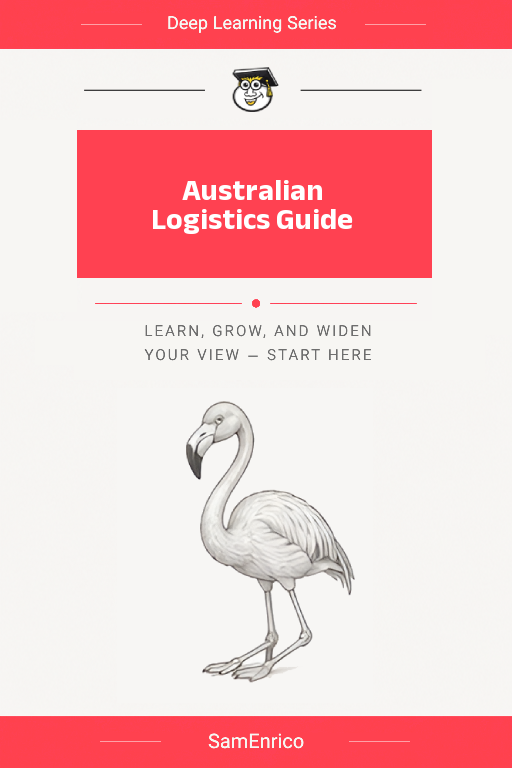
Non-FictionMarket Entry DirectoryAustralia Logistics
Australian Logistics Guide eBook
Directory of logistics providers across Australia
Directory of logistics providers across Australia including Sydney, Melbourne, Brisbane, and Perth.
Formats
Free sample
Chapter 1: The Distance Penalty--Australia is a country that hates its logistics managers. Not personally, of course, but structurally. The landmass is roughly the size of the continental United States, yet the population is barely that of Texas. Seventy-two percent of the country’s 27 million people are crammed into just 0.22 percent of its land area, creating a logistical paradox that has no equivalent anywhere else in the developed world. You have the sprawl of Canada, the isolation of Siberia, and the consumer expectations of Manhattan, all wrapped into one sunburnt, supply chain nightmare.
This is the distance penalty, and it is the single most important fact about Australian logistics. If you do not understand it, every decision you make about warehousing, transport, and partner selection will be wrong.The distance penalty is not merely a matter of geography. It is a cascading series of costs that multiply with every kilometer. A truck leaving Melbourne for Perth must cover 3,400 kilometers across the Nullarbor Plain, a route so empty that fuel stops are deliberately spaced at the maximum range of a standard semi-trailer. That same truck, in the same time, could have driven from London to Moscow, crossing eleven time zones and passing through a dozen major cities.
In Australia, it will pass through three towns with populations over 5,000. The driver will need two rest breaks mandated by law, one overnight stop, and enough fuel to cover a stretch where diesel prices fluctuate by 40 cents per liter depending on how far you are from the nearest rail terminal. That is the distance penalty.But the distance penalty is not just about trucks. It infects every mode of transport. Sea freight from Shanghai to Sydney takes eleven days.
Sea freight from Sydney to Perth takes another seven days, often longer than the original transoceanic voyage. Air freight from Brisbane to Port Moresby is cheaper than air freight from Brisbane to Broome, because the international route has competition and volume while the domestic route has neither. Rail is a different kind of punishment: the tracks exist, but they are narrow gauge in some states, standard gauge in others, forcing freight to be transhipped at borders unless you are using one of the few interoperable corridors. This is not a supply chain. It is a gauntlet.The distance penalty also warps pricing in ways that confound international logistics managers.
In the United States, the cost per mile decreases as distance increases, because fixed costs like loading and dispatching are amortized over longer hauls. In Australia, the cost per mile often increases with distance, because the return leg is likely to be empty. There is simply nothing to carry back from Perth to Melbourne. The mining equipment went one way. The FIFO workwear went one way.
The pallets of groceries for remote communities went one way. The truck comes back empty, and you pay for that emptiness. This is the tyranny of the backhaul, and it is the second great truth of Australian logistics.The post-2026 market has only intensified these pressures. The collapse of Sendle, once heralded as the great disrupter of last-mile delivery, left a vacuum in the mid-mile sector that has not been filled. For readers seeking a detailed post-mortem of that collapse, including warning signs and contingency planning, Chapter 12 provides a full analysis.
For now, it is enough to know that the market has consolidated around a smaller number of players, that pricing has become less transparent, and that the gap between what carriers advertise and what they deliver has widened. The era of cheap, venture-capital-subsidized logistics is over. The era of resilience has begun.This chapter will establish the foundation for everything that follows. It will explain why Australian logistics is structurally unique, break down the Four Pillars of national transport, introduce the key infrastructure owners you need to know, and finally contrast the old paradigm of lowest-cost logistics with the new imperative of highest-resilience supply chains. By the end of this chapter, you will understand not just where your freight goes, but why it costs what it costs, and why the cheapest quote is very rarely the best choice.The Four Pillars of Australian Logistics Every supply chain in Australia rests on four modes of transport: road, rail, sea, and air.
Each has its own economics, its own constraints, and its own role in the national network. Understanding how they interact is the first step to building a resilient operation.Road: The Workhorse That Is Breaking Down Road transport carries 85 percent of Australia’s domestic freight by tonnage. This is not because road is efficient. It is because rail does not go everywhere, sea is irrelevant for inland destinations, and air is too expensive for anything except high-value or perishable goods. Road is the default because it is the only option.The Australian road freight industry comprises approximately 120,000 registered heavy vehicles, operated by a mix of large national carriers, regional specialists, and owner-drivers.
The largest players—Linfox, Toll, Team Global Express—operate fleets in the thousands, but the majority of registered trucks belong to single-vehicle operators who are paid by the kilometer and live or die on fuel margins. This fragmentation creates a paradox: the industry is simultaneously dominated by a few giants and atomized into thousands of tiny businesses. For the logistics buyer, this means you can get national coverage from a single contract, but you will rarely know who is actually driving the truck or how well that driver has been trained.The challenges facing road transport are structural and worsening. The average age of a heavy vehicle driver in Australia is 54 years. The industry is shedding experienced drivers faster than it can recruit new ones, and the shortage is most acute on the long-haul routes that nobody wants to drive.
The result is upward pressure on wages, which translates directly into upward pressure on freight rates. At the same time, fuel prices remain volatile, and every major carrier has moved to a fuel levy mechanism that passes through diesel costs to customers. (For a detailed explanation of how fuel levies work and how to audit them, see Chapter 11.)Infrastructure is another bottleneck. Sydney’s M4-M5 Link, known as West Connex, has eased congestion between Parramatta and the city, but the approach roads to Port Botany remain a daily nightmare. Melbourne’s West Gate Bridge is a single point of failure for freight moving between the port and the western suburbs; when it closes, the entire city’s logistics network grinds to a halt.
Brisbane’s Bruce Highway is a national embarrassment, prone to washouts during cyclone season and congested year-round. Perth is isolated not by traffic but by distance: the road to Adelaide is a 2,700-kilometer test of driver endurance, vehicle reliability, and fuel planning.Despite these problems, road will remain the backbone of Australian logistics for the foreseeable future. The key for logistics buyers is to understand that not all road freight is equal. Linehaul between Sydney and Melbourne is a commodity, priced transparently and provided reliably by a dozen carriers. Long-haul to Perth or Darwin is a specialty, requiring carriers with specific equipment, driver training, and route experience.
Last-mile delivery in a dense suburb is a different business entirely. Treating them as the same service category is a…
This is the end of the free sample. Get the eBook to keep going. Buy now
About this book
Details
- Author
- Stout Johnson
- Publisher
- SamEnrico
- Language
- English
- Genre
- Non-Fiction, Market Entry Directory, Australia Logistics
- Released
- 2026-05-30
- Pages (approx.)
- 152
- Available as
- eBook, Audiobook

Read better in the ZLOADR app
Your eBooks on your phone or tablet. Sign in with your SamEnrico account and start reading.
More by Stout Johnson
 Physics Pattern RecognitionStout Johnson$11.99
 Food Addiction in LGBTQ Plus Community GuideStout Johnson$11.99
 Cortisol and Blood Pressure GuideStout Johnson$11.99
 Physical Anger Release SafelyStout Johnson$11.99
 Executive Assistant Interruption GuideStout Johnson$11.99
 The Celestial Cartographers: Mapping the Heavens from the Forbidden CityStout Johnson$11.99
 Neptune’s Gambit: The Billionaire’s Lost AtlantisStout Johnson$11.99
 Field Applications EngineerStout Johnson$11.99
 Understanding Emery–dreifuss Muscular Dystrophy, Dominant TypeStout Johnson$17.99
 Real Estate BookkeepingStout Johnson$12.99
 How to Start a Precast Cement Articles for Use In Construction Business (Beginners Guide)Stout Johnson$11.99
You may also like
 Hong Kong Handover 1997Dunn Johnnie$11.99
 Zumba For Postnatal Recovery CourseNeal Christian$11.99
 Zumba for BeginnersLadner Nikia$11.99
 YouTube Comment Mining GuideHumes Pandora$12.99
 Worry Box MeditationCarlin Rudy$11.99
 Workplace Stress MeditationNguyen Lynn$11.99
 Workplace Stress and Sleep RepairHawley Ivory$11.99
 Workplace Perfectionism CureDelaney Jeffry$11.99
 Workplace Injustice Anger GuideWallen Isabelle$11.99
 Work Addiction and Burnout LinkGreenwood Ester$11.99
 Women in Yoga and WellnessBeattie Galina$11.99
 Women in Stand Up ComedyChun Evangeline$11.99