
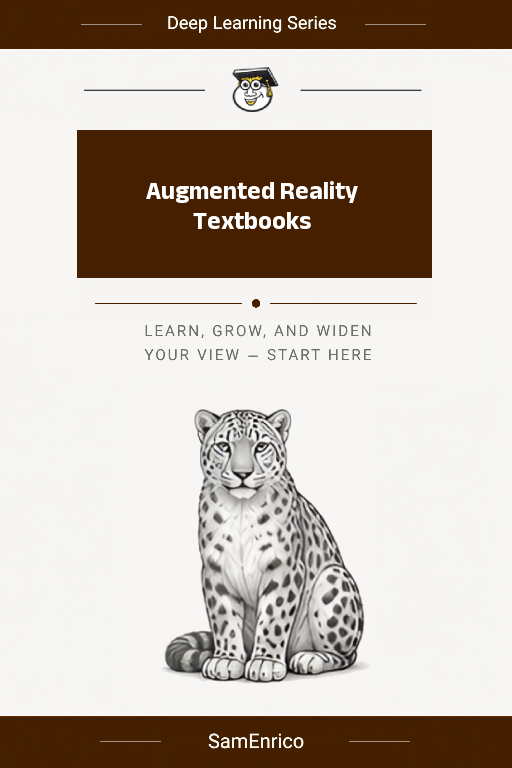
Non-FictionForecast & OutlookAR Learning
Augmented Reality Textbooks eBook
Discover interactive AR overlays bringing diagrams
Discover interactive AR overlays bringing diagrams, equations, and historical images to life on phone cameras.
Formats
Free sample
Chapter 1: The Unmoving Page--–- The printing press was the original educational technology revolution. For the first time in human history, knowledge could be reproduced reliably, distributed widely, and studied privately. The static page democratized learning. It also fixed it in place.For five centuries, the textbook has remained fundamentally unchanged. Words.
Diagrams. Equations. Photographs. All static. All silent.
All waiting for a human to interpret them. This worked when the only alternative was an oral lecture or a handwritten manuscript. But today's students have alternatives. You Tube tutorials. Interactive simulations.
3D models they can manipulate with their fingers. The static page is no longer the best way to learn. It is not even the most engaging.This chapter examines the paradox at the heart of modern education: printed textbooks remain the most authoritative, portable, and accessible learning resources, yet they are the least interactive. AR overlays resolve this paradox by adding a digital layer to physical pages. The book stays the same.
The experience transforms.I have spent the last decade researching the intersection of educational technology and cognitive science. I have observed classrooms where AR textbooks doubled student engagement. I have interviewed publishers who saw forty percent increases in retention. And I have concluded that the static page is not obsolete, but it is no longer sufficient. This chapter establishes the fundamental problem that AR textbooks solve, introduces the three limitations of static learning materials, and provides the pedagogical and market context for everything that follows.
If you read only one chapter to understand why AR textbooks matter, make it this one.The Unchanged Page Let me begin with a simple observation. Open any textbook from 1925 and compare it to a textbook published last year. The paper might be glossier. The photographs might be in color. The binding might be sturdier.
But the fundamental learning experience is identical. The reader looks at words and static images. The reader infers meaning. The reader moves on.This continuity is remarkable. In the same five centuries that textbooks have remained static, every other aspect of human communication has been transformed.
The telegraph gave way to the telephone, which gave way to email, which gave way to instant messaging, which gave way to video calls. Music progressed from sheet music to vinyl records to cassettes to CDs to MP3s to streaming. Even the book itself evolved from handwritten manuscripts to printed volumes to e-readers to audiobooks. But the textbook as a learning tool has barely changed.The reasons for this stability are not trivial. Textbooks are cheap to produce at scale.
They require no batteries, no internet connection, no technical support. They can be dropped in a backpack, left in the rain, written in with a pen. They are durable, portable, and accessible. These are genuine virtues. In much of the world, the textbook is still the only learning resource available.But the world has changed around the textbook.
Today's students have grown up with screens that respond. They tap a tablet and a puzzle solves itself. They touch a map and a city appears. They swipe a screen and a story unfolds. The static page, no matter how well written, cannot compete for their attention.
The textbook is losing the battle for student engagement not because it is badly made, but because it belongs to a different era.The paradox, then, is this: the textbook is more authoritative, portable, and accessible than any digital alternative, yet it is the least interactive. AR resolves this paradox by adding a digital layer to physical pages. The book stays the same. The experience transforms.The Three Limitations of Static Learning Materials Educational psychology has long recognized the value of multimodal learning. We do not all learn the same way, but we all learn better when multiple senses are engaged.
A diagram engages sight. A lecture engages hearing. A hands-on lab engages touch. A textbook primarily engages reading, a single mode.The static page has three specific limitations that AR addresses directly. Understanding these limitations is essential because it clarifies what AR adds and, just as importantly, what it does not add.Limitation One: No Motion or Change Over Time Static diagrams cannot show motion or change over time.
A diagram of the rock cycle shows arrows but not movement. A diagram of a chemical reaction shows before and after but not the process. A diagram of a beating heart shows the chambers but not the flow of blood. The student must infer motion from static representation. This inference is a cognitive skill, and not all students possess it equally.AR overlays solve this problem through what I call Visualization AR.
Visualization AR includes 3D models, animations, and reconstructions that show motion and spatial relationships. A student points a phone at a diagram of the rock cycle, and the AR overlay shows magma flowing, mountains eroding, and sediment compacting in real time. A student points at a chemical reaction, and the AR overlay shows bonds breaking and forming, electrons moving, and energy being released. A student points at the human heart, and the AR overlay shows blood flowing through the chambers, valves opening and closing, and the cardiac cycle animating.Visualization AR does not provide feedback or assessment. It does not quiz the student or adapt to their responses.
It simply shows what the static page cannot: motion, change, and process. This is its power and its limitation. For students who struggle to infer motion from static diagrams, Visualization AR is transformative. For students who need practice problems and immediate correction, other tools are required.Limitation Two: No Immediate Feedback When a student misinterprets a diagram or misapplies an equation, the static page does not correct them. The error persists.
The student may complete an entire chapter based on a misunderstanding. The teacher may not discover the error until a quiz or exam, days or weeks later. By then, the incorrect neural pathways are already established. The student has learned the wrong thing and must unlearn it before learning correctly.AR overlays solve this problem through what I call Assessment AR. Assessment AR includes interactive quizzes, practice problems, and performance tasks that provide immediate feedback.
A student points a phone at a diagram of the heart, and the AR overlay asks, "Tap the right ventricle." The student taps. The system responds, "Correct!" or "Try again. Look for the chamber that pumps blood to the lungs." The feedback is immediate. The correction happens before the error becomes a habit.Assessment AR requires more development effort than Visualization AR. It needs a database of questions and answers.
It needs logic to evaluate student responses. It needs integration with learning management systems if the data is to be saved and analyzed. But the pedagogical payoff is enormous. Research on learning shows that immediate feedback is one of the most powerful drivers of retention. The delay between action and feedback in traditional textbooks, days or weeks, weakens the learning signal.
Assessment AR reduces that delay to milliseconds.Limitation Three: No Adaptation to Individual Needs Every student sees the same diagram, the same text, the same examples. The student who already understands the material cannot skip ahead. The student who…
This is the end of the free sample. Get the eBook to keep going. Buy now
About this book
Details
- Author
- Arteaga Romana
- Publisher
- SamEnrico
- Language
- English
- Genre
- Non-Fiction, Forecast & Outlook, AR Learning
- Released
- 2026-06-01
- Pages (approx.)
- 109
- Available as
- eBook, Audiobook

Read better in the ZLOADR app
Your eBooks on your phone or tablet. Sign in with your SamEnrico account and start reading.
More by Arteaga Romana
 Finnish Energy Aid ProgramArteaga Romana$11.99
 Birthday Email AutomationArteaga Romana$11.99
 Relationship Rejection ResilienceArteaga Romana$11.99
 The Great Bitcoin Heist: How a Teen Hacker Stole Millions in the Wild West of CryptoArteaga Romana$11.99
 The Alchemists of the Nile: Black Pioneers in Physics and ChemistryArteaga Romana$11.99
 Post COVID Lease Amendment GuideArteaga Romana$12.99
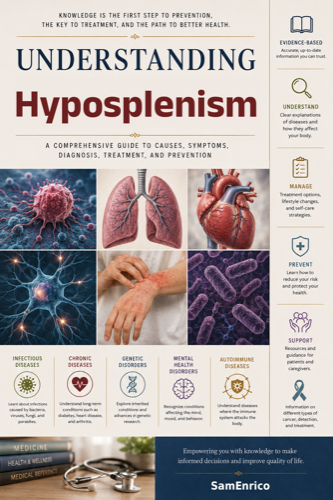 Understanding HyposplenismArteaga Romana$17.99
 Funeral Procession EscortArteaga Romana$11.99
 Ultimate Handbook Guide to Ulaanbaatar : (Mongolia) Travel GuideArteaga Romana$11.99
You may also like
 Hong Kong Handover 1997Dunn Johnnie$11.99
 Zumba For Postnatal Recovery CourseNeal Christian$11.99
 Zumba for BeginnersLadner Nikia$11.99
 YouTube Comment Mining GuideHumes Pandora$12.99
 Worry Box MeditationCarlin Rudy$11.99
 Workplace Stress MeditationNguyen Lynn$11.99
 Workplace Stress and Sleep RepairHawley Ivory$11.99
 Workplace Perfectionism CureDelaney Jeffry$11.99
 Workplace Injustice Anger GuideWallen Isabelle$11.99
 Work Addiction and Burnout LinkGreenwood Ester$11.99
 Women in Yoga and WellnessBeattie Galina$11.99
 Women in Stand Up ComedyChun Evangeline$11.99