
Audit Preparation Guide eBook
Prepare facility and documentation for sustainabil
by Dugas Reta
Organizes records for potential review.
Formats
Free sample
Chapter 1: The Container That Didn't Sail--The email arrived at 4:47 PM on a Thursday. Mai Tran, export manager for a mid-sized Vietnamese coffee roasting company, had just finished reviewing a shipping manifest when her phone buzzed. The subject line read: “URGENT – Rotterdam Customs Hold – Container VN-HCM-8842.”She opened it. Her heart dropped.“Dear Customer, Container VN-HCM-8842 has been detained at Rotterdam port pending verification of deforestation-free documentation for coffee products under EU Regulation 2023/1115 (EUDR). Please provide geolocation data for all farm origins, batch traceability reports, and third-party certification of land-use change by 4:00 PM CET Friday.
Failure to comply will result in shipment refusal and destruction of goods at consignee’s expense.”Mai stared at the screen. It was already 9:47 PM in Rotterdam. She had less than nineteen hours to produce documents that typically took her team two weeks to assemble. The container held 18 metric tons of specialty arabica coffee destined for a German roaster that had been a client for seven years. The order was worth 214,000.Thecontractpenaltiesfornondeliverywereanadditional214,000.
The contract penalties for nondelivery were an additional 214,000.Thecontractpenaltiesfornondeliverywereanadditional85,000. Demurrage and storage at Rotterdam would add another $12,000 per week if the container sat.She picked up the phone and called her quality manager, who was already driving home. “Turn around,” she said. “We have a problem.”That night, Mai’s team worked until 2:00 AM pulling satellite images of farms, reconciling batch numbers with harvest dates, and calling smallholder cooperatives in the Central Highlands to request GPS coordinates. By Friday morning, they had assembled a 147-page PDF.
They sent it at 9:14 AM Rotterdam time – seven hours before the deadline.The container sailed. But the experience cost Mai’s company $34,000 in rushed legal fees, overtime wages, and expedited courier services. Worse, the German client demanded a 15 percent discount on the next three shipments as “compensation for risk.”Mai’s story is not unusual. It is the new normal.Welcome to the era of the sustainability audit as export license.The Day Voluntary Became Mandatory For most of the past twenty years, sustainability certifications were like badges on a scout uniform. They looked nice.
They signaled virtue. But you could still cross the border without them.That era ended between 2023 and 2026.Three regulatory shifts have fundamentally rewritten the rules of international trade. If you export anything – coffee, textiles, steel, electronics, furniture, seafood, palm oil, or auto parts – you are already affected. You may not know it yet. But your customers do.
And so do the auditors they hire.The Three Hammers Hammer One: The EU Carbon Border Adjustment Mechanism (CBAM)CBAM is not a carbon tax in the traditional sense. It is a border adjustment mechanism that requires importers of certain goods – cement, iron, steel, aluminum, fertilizers, electricity, and hydrogen – to purchase certificates covering the embedded carbon emissions of their products. Starting in full implementation in 2026, if your factory in Vietnam, India, or Brazil produces steel with coal-fired furnaces, your European customer must pay a surcharge equal to the difference between your carbon intensity and the EU’s benchmark. That surcharge will be passed back to you – either as a price negotiation or a lost contract.The critical point for exporters: To calculate the surcharge, your customer needs verified data. That means an audit.
Not a self-declaration. Not an industry average. An independent, third-party verification of your facility’s energy sources, fuel consumption, and process emissions.Hammer Two: The EU Deforestation Regulation (EUDR)EUDR replaced the older EU Timber Regulation (EUTR) in 2025. It requires any company placing specific commodities – cattle, cocoa, coffee, oil palm, rubber, soya, and wood – on the EU market to prove that their products are “deforestation-free.” That means no production on land that was deforested after December 31, 2020.The proof requires geolocation data. For every plot of land that produced the commodity.
For every batch. Traceable back to the farm level. This is not a paper exercise. It requires digital mapping, satellite imagery, and supply chain traceability systems that most exporters did not have three years ago.Hammer Three: The German Supply Chain Due Diligence Act (Lk SG)Germany’s Act on Corporate Due Diligence in Supply Chains, expanded in 2024, requires companies with more than 1,000 employees in Germany to monitor environmental and human rights risks throughout their entire supply chain – not just first-tier suppliers but subcontractors, raw material providers, and logistics partners. Violations can result in fines up to 2 percent of global annual revenue and exclusion from public procurement contracts for up to three years.German importers, terrified of these penalties, are now pushing their entire supplier base – including small and medium enterprises in exporting countries – to undergo sustainability audits.
If you supply a German company, you are already in scope.These three hammers are not isolated. They are part of a broader trend. The UK, Japan, Canada, and the United States are all developing similar mechanisms. By 2028, an estimated 70 percent of global trade will be subject to some form of sustainability-linked border measure.The Cost of Non-Compliance: A Scorecard Let me be precise about what is at stake. The language around sustainability often becomes fuzzy – “commitment,” “aspiration,” “journey.” Audits are not fuzzy.
They produce binary outcomes: pass or fail.Here is what failure looks like in real terms.Direct Financial Penalties Under CBAM, a shipment of flat-rolled steel from India to the Netherlands in 2026 will face a carbon adjustment of approximately €65 per ton of CO2 equivalent if the Indian producer cannot provide verified emissions data. For a typical 25,000-ton shipment, that is €1.6 million. If the exporter cannot provide verified data, the EU importer defaults to the worst-case default value – which can be twice as high.Under EUDR, the penalty for placing non-compliant products on the market is up to 4 percent of the operator’s total annual EU turnover. For a mid-sized European coffee roaster with €50 million in EU sales, that is €2 million. That roaster will sue its supplier for indemnification.
The supplier’s export credit insurance will not cover regulatory fines.Operational Costs The container detention that opened this chapter cost Mai’s company 34,000.Thatisnotafine.Itisthecostofscrambling.Butitismoneythatcouldhavebeenspentonnewequipment,marketing,oremployeebonuses.Theaveragecontainerdetentionforsustainabilitydocumentationissuesnowrunsbetween34,000. That is not a fine. It is the cost of scrambling. But it is money that could have been spent on new equipment, marketing, or employee bonuses. The average container detention for sustainability documentation issues now runs between 34,000.Thatisnotafine.Itisthecostofscrambling.Butitismoneythatcouldhavebeenspentonnewequipment,marketing,oremployeebonuses.Theaveragecontainerdetentionforsustainabilitydocumentationissuesnowrunsbetween8,000 and $45,000 depending on port, duration, and legal fees.Worse, repeated detentions trigger heightened scrutiny.
Customs authorities maintain watch lists. Once your company appears on one, every shipment becomes suspect. Inspection rates increase from the standard 2–5 percent to 50–100 percent. Each inspection adds three to ten days of delay. Each delay incurs demurrage charges.
The cycle accelerates downward.Market Access Denial The most devastating cost is not a fine or a delay. It is a quiet email from a long-term customer saying, “We regret to inform you that we will be sourcing from alternative suppliers who can provide verified sustainability documentation.”This is happening now. A Malaysian electronics manufacturer lost a €12 million contract with a German automotive supplier in 2024 because it could not provide Scope 3 emissions data from its third-tier component suppliers. A Brazilian soy cooperative was dropped by a Dutch trading house in 2025 because its deforestation-free documentation was deemed…
This is the end of the free sample. Get the eBook to keep going. Buy now
About this book
Details
- Author
- Dugas Reta
- Publisher
- SamEnrico
- Language
- English
- Genre
- Non-Fiction, Business Brief, Audit Prep, Startup Guide, Auditing
- Released
- 2026-05-30
- Pages (approx.)
- 155
- Available as
- eBook, Audiobook

Read better in the ZLOADR app
Your eBooks on your phone or tablet. Sign in with your SamEnrico account and start reading.
More by Dugas Reta
 Workplace Esteem for Career ChangersDugas Reta$11.99
 International Expansion Business Planning HandbookDugas Reta$11.99
 The Train Window JourneyDugas Reta$11.99
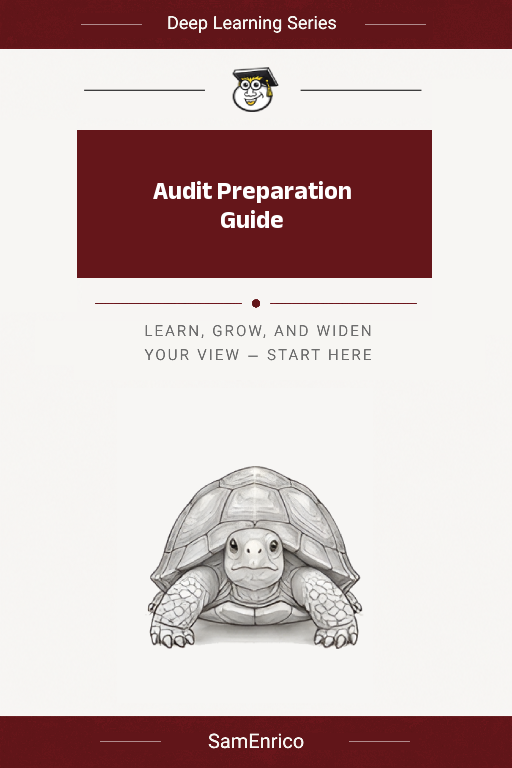 Audit Preparation GuideDugas Reta$12.99
 Genetic Testing for OsteoporosisDugas Reta$11.99
 Parent Death Practical Estate GuideDugas Reta$11.99
 Beneath the Phantom Waves: The Lost Sub of the Bermuda TriangleDugas Reta$11.99
 The Last Spice Seekers: Rediscovering the Amazon’s Hidden Treasures (1980s)Dugas Reta$11.99
 How to Start a Solid Waste Landfill BusinessDugas Reta$11.99
 Gold TradingDugas Reta$11.99
 Ray Kroc Cash Franchise WorkbookDugas Reta$12.99
 Understanding Gibson's SyndromeDugas Reta$17.99