
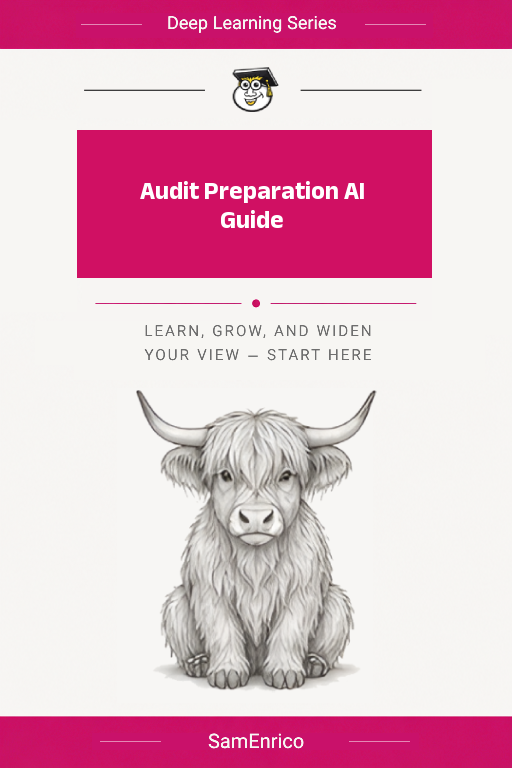
Non-FictionBusiness BriefAutomation Guide
Audit Preparation AI Guide
Prepare for audits using AI tools. Document collec
Prepare for audits using AI tools. Document collection and anomaly identification.
Formats
About this book
Free sample
Chapter 1: The Sampling Lie...--–- Every auditor has heard it. Every auditor has said it. “We reviewed a representative sample of transactions and found no material misstatements.” For decades, this sentence has been the bedrock of audit assurance. It is printed in management letters, repeated in audit committee meetings, and relied upon by investors, regulators, and the public. There is just one problem.
It is often a lie. Not a deliberate lie, not a fraudulent misrepresentation, but a lie of omission. A lie born of necessity. A lie that fraudsters have learned to exploit with surgical precision.The truth is uncomfortable but undeniable: sampling is a statistical compromise that bad actors have turned into a weapon. When an auditor reviews only five or ten percent of transactions, the fraudster simply hides the crime in the ninety percent that never sees the light of day.
This chapter dismantles the legacy of sampling, reveals why traditional methods are no longer defensible in an era of big data and sophisticated fraud, and establishes the urgent case for why AI is not a luxury but a necessity.The Birth and Death of Statistical Sampling Auditing, like medicine, once relied on intuition and experience. In the early twentieth century, auditors examined every transaction—a practice called “detailed auditing” or “100 percent testing.” This was possible when a company processed a few thousand invoices per year. But as businesses grew and transaction volumes exploded, detailed auditing became impossible. An auditor could not possibly review every sales order, every purchase order, every journal entry from a multinational corporation processing millions of transactions monthly.The profession turned to statistics. Sampling was the elegant solution.
If a population was large and reasonably homogeneous, examining a randomly selected subset could provide reasonable assurance about the whole. Mathematical formulas promised that a sample of just a few hundred items could represent a population of millions, with quantifiable confidence levels and tolerable error rates. This was not laziness. It was science.For decades, sampling worked reasonably well. Fraud was less sophisticated.
Systems were less integrated. The auditor’s sample, combined with a strong internal control environment, caught most material errors. But the…
This is the end of the free sample. Get the eBook to keep going. Buy now
Contents
- Chapter 1
- Chapter 2
- Chapter 3
- Chapter 4
- Chapter 5
- Chapter 6
- Chapter 7
- Chapter 8
- Chapter 9
- Chapter 10
- Chapter 11
- Chapter 12
Details
- Author
- Wallen Mariah
- Publisher
- SamEnrico
- Language
- English
- Genre
- Non-Fiction, Business Brief, Automation Guide
- Released
- 2026-06-01
- Pages (approx.)
- 156
- Available as
- eBook, Audiobook

Read better in the ZLOADR app
Your eBooks on your phone or tablet. Sign in with your SamEnrico account and start reading.
More by Wallen Mariah
 Pet Loss For Children GuideWallen Mariah$11.99
 Teen Complicated Grief GuideWallen Mariah$11.99
 Mindfulness for Impatience GuideWallen Mariah$11.99
 The Validating Grief and Loss GuideWallen Mariah$11.99
 The Ghost Fleet of Truk Lagoon: America’s Underwater RansomWallen Mariah$11.99
 Understanding Stiff Person SyndromeWallen Mariah$17.99
 Cinematics ArtistWallen Mariah$11.99
 Invoice Exception ResolutionWallen Mariah$12.99
 How to Start a Doilies Made of Textiles Business (Beginners Guide)Wallen Mariah$11.99
You may also like
 Hong Kong Handover 1997Dunn Johnnie$11.99
 Zumba For Postnatal Recovery CourseNeal Christian$11.99
 Zumba for BeginnersLadner Nikia$11.99
 YouTube Comment Mining GuideHumes Pandora$12.99
 Worry Box MeditationCarlin Rudy$11.99
 Workplace Stress MeditationNguyen Lynn$11.99
 Workplace Stress and Sleep RepairHawley Ivory$11.99
 Workplace Perfectionism CureDelaney Jeffry$11.99
 Workplace Injustice Anger GuideWallen Isabelle$11.99
 Work Addiction and Burnout LinkGreenwood Ester$11.99
 Women in Yoga and WellnessBeattie Galina$11.99
 Women in Stand Up ComedyChun Evangeline$11.99