
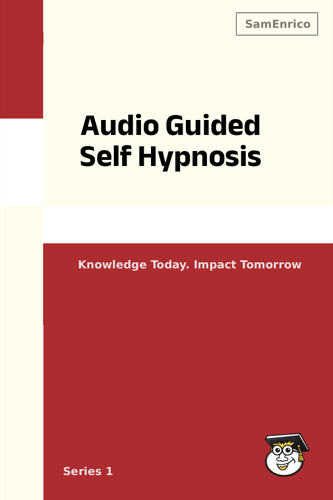
Non-FictionSelf-HelpAudio Methods
Audio Guided Self Hypnosis eBook
Teaches how to record and use your own voice for t
Teaches how to record and use your own voice for trance induction.
Formats
Free sample
Chapter 1: The Echo Within--–- Every night, millions of people put on headphones and listen to someone else’s voice telling them how to relax, how to sleep, how to quit smoking, how to build confidence, or how to fall in love with their own lives. They pay for apps, subscribe to You Tube channels, download hypnosis tracks from strangers with soothing voices and generic accents. And every morning, most of them wake up feeling exactly the same as they did before.Not because hypnosis doesn’t work. It does. The scientific literature on clinical hypnosis is vast, stretching back nearly two hundred years, with modern neuroimaging studies confirming that hypnotic suggestions literally change brain activity in regions associated with attention, self-awareness, and executive control.
The problem is not the tool. The problem is the voice.Specifically, the problem is that the voice is not yours.This book begins with a radical proposition: The most powerful hypnotic voice you will ever hear is the one that comes out of your own mouth, speaking your own words, at your own pace, in your own rhythm. Not because you are a better speaker than a trained professional. Not because you have a naturally soothing tone. But because your brain is wired—biologically, evolutionarily, neurologically—to respond to your own voice in ways it responds to no other sound on earth.This chapter will convince you of that truth.
More importantly, it will transform how you think about self-hypnosis entirely. By the time you finish reading these pages, you will understand why the generic recordings you have tried in the past probably failed, why the idea of recording yourself probably makes you uncomfortable, and why that discomfort is actually the first sign that you are on the right track.The Great Illusion of the Professional Voice Let us begin with a confession. I have recorded over two hundred hypnosis tracks in my career. I have produced guided meditations for national apps, voiced scripts for clinical research studies, and trained dozens of hypnotherapists in the art of vocal delivery. And I can tell you with absolute certainty that the most effective recording I ever made was not the one with the expensive microphone, the professional soundproofing, or the carefully rehearsed cadence.It was a scratchy, one-take voice memo recorded on an i Phone at two in the morning, in a closet full of winter coats, by a woman who had never studied hypnosis a day in her life.
She was a client. She had severe insomnia. And after three sessions of traditional hypnotherapy with me, she asked if she could try recording her own suggestions in her own voice, using the structure I had taught her.I was skeptical. I am no longer skeptical.She sent me the recording the next day. It was technically terrible—background noise, uneven volume, a few stumbles over words, a cough at the four-minute mark that she had not bothered to edit out.
But she listened to it every night for three weeks. And her insomnia, which had persisted for eleven years, resolved completely within the first ten days.When I asked her why she thought it worked when my professionally produced recordings had not, she said something I have never forgotten: “Because when I hear your voice, I’m listening to you. When I hear my own voice, I’m listening to me. And I trust me more than I trust anyone else.”This is the great illusion of the professional voice. We assume that smooth, polished, authoritative delivery is superior to our own imperfect, familiar, halting speech.
We assume that a stranger with a British accent or a soft whisper has some magical quality that we lack. We assume that the money we spend on expensive hypnosis apps is buying us access to a technology that we could not possibly replicate ourselves.All of these assumptions are wrong.Echoic Memory: Why Your Voice Lives in Your Brain Forever To understand why your own voice is uniquely powerful, you need to understand a neurological phenomenon called echoic memory. Echoic memory is a component of the sensory memory system that specifically handles auditory information. When you hear a sound, your brain holds an exact copy of that sound for approximately three to four seconds—long enough to decide whether the sound is worth processing further.Most sounds are discarded immediately. The hum of a refrigerator, the distant sound of traffic, the rustle of clothing—these never make it past echoic memory into conscious awareness.
But certain sounds are prioritized. A sudden loud noise. The sound of your own name spoken across a crowded room. And, most powerfully, the sound of your own voice.Here is what the research shows: When you hear a recording of your own voice, your brain activates a distinct neural network that is not engaged when you hear any other voice. This network includes the superior temporal gyrus (involved in processing familiar sounds), the insula (associated with self-awareness and emotional salience), and the anterior cingulate cortex (which modulates attention and error detection).
In simple terms, your brain treats your own voice as a special category of auditory stimulus—one that demands attention, triggers self-referential processing, and bypasses many of the filters that normally protect the conscious mind from external influence.This is not an accident. From an evolutionary perspective, the ability to recognize and prioritize one’s own vocalizations—and the vocalizations of close kin—was essential for survival. A cub that cannot distinguish its mother’s growl from a predator’s growl does not live long. A human infant that does not preferentially attend to its parents’ voices fails to form critical attachment bonds. The neural architecture that makes your voice powerful is the same architecture that kept your ancestors alive.When you apply this to hypnosis, the implications are staggering.
Traditional hypnosis relies on the hypnotist building rapport—a state of trust and attentional focus—with the subject. This takes time, skill, and often multiple sessions. But when you listen to your own voice, rapport is instantaneous. There is no trust to build. There is no authority to establish.
The voice is already yours. The brain already prioritizes it. The gate is already open.The Three Hidden Failures of Generic Hypnosis If your own voice is so powerful, why do most people never try recording themselves? Why do they instead spend hundreds of dollars on generic hypnosis tracks that rarely produce lasting change?The answer lies in three hidden failures that plague nearly every commercial hypnosis recording. Understanding these failures is essential because they illuminate exactly what your own recordings will do differently.Failure One: The Problem of Personal Relevance A generic hypnosis track cannot know your specific history, your specific triggers, or your specific language.
The script writer has never met you. They do not know that your anxiety spikes not in crowds but in the moments before you enter a crowd. They do not know that the word “relax” makes you tense because your father used to shout it at you during arguments. They do not know that the visualization of a peaceful beach reminds you of a traumatic vacation…
This is the end of the free sample. Get the eBook to keep going. Buy now
About this book
Details
- Author
- Vang Anderson
- Publisher
- SamEnrico
- Language
- English
- Genre
- Non-Fiction, Self-Help, Audio Methods
- Released
- 2026-06-09
- Pages (approx.)
- 147
- Available as
- eBook, Audiobook

Read better in the ZLOADR app
Your eBooks on your phone or tablet. Sign in with your SamEnrico account and start reading.
More by Vang Anderson
 Pet Tech Capital GuideVang Anderson$11.99
 The Candle Flame FocusVang Anderson$11.99
 OCD JournalVang Anderson$11.99
 MBSR for PregnancyVang Anderson$11.99
 Anchoring Scripts for HypnosisVang Anderson$11.99
 Menino BostonVang Anderson$11.99
 Intensive Care Nurse ResilienceVang Anderson$11.99
 Anger Role ReversalVang Anderson$11.99
 The Deep Dive: Africa's Underwater RevolutionVang Anderson$11.99
 The Architect's Gambit: Designing the City of GoldVang Anderson$11.99
 Echoes of the Apollo: The Lost Tapes of the Moon LandingVang Anderson$11.99
 Professional Ethics and Compliance AdvancedVang Anderson$11.99
You may also like
 Hong Kong Handover 1997Dunn Johnnie$11.99
 Zumba For Postnatal Recovery CourseNeal Christian$11.99
 Zumba for BeginnersLadner Nikia$11.99
 YouTube Comment Mining GuideHumes Pandora$12.99
 Worry Box MeditationCarlin Rudy$11.99
 Workplace Stress MeditationNguyen Lynn$11.99
 Workplace Stress and Sleep RepairHawley Ivory$11.99
 Workplace Perfectionism CureDelaney Jeffry$11.99
 Workplace Injustice Anger GuideWallen Isabelle$11.99
 Work Addiction and Burnout LinkGreenwood Ester$11.99
 Women in Yoga and WellnessBeattie Galina$11.99
 Women in Stand Up ComedyChun Evangeline$11.99