
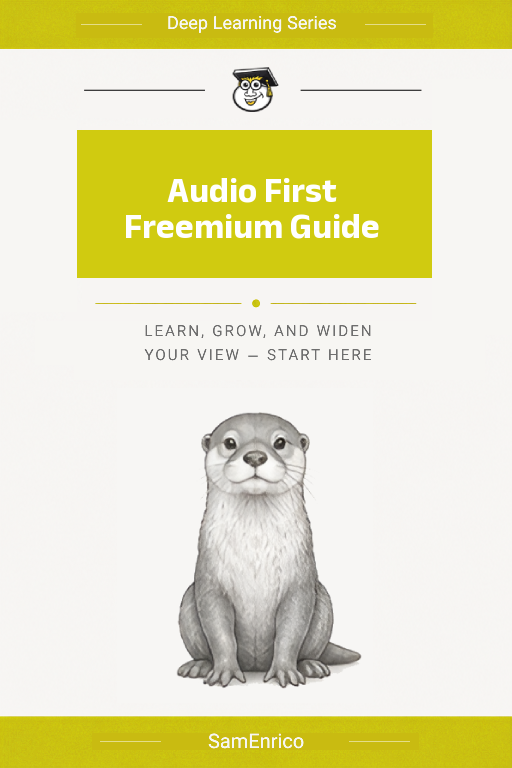
Non-FictionBusiness BriefAudio First
Audio First Freemium Guide eBook
Design audio-centric freemium products that work w
by Kruse Terisa
Design audio-centric freemium products that work well on low-bandwidth connections.
Formats
Free sample
Chapter 1: The Bandwidth Illusion--–- In 2018, a team of engineers from a prominent global streaming service flew to Lagos, Nigeria, to investigate a puzzling metric. Their analytics showed that over 60% of users in the region who downloaded the app never successfully played a single track. The team assumed the problem was a bug in the Android client, a memory leak, or perhaps a conflict with local carriers. They spent two weeks rewriting code, optimizing asset loading, and compressing images. After deploying the update, the metric improved by less than 3%.
Frustrated, the lead engineer rented a car and drove from the company’s upscale office in Victoria Island to the sprawling mainland neighborhood of Ojuelegba. He sat on a plastic chair outside a small convenience store, pulled out his flagship smartphone, and tried to use the app exactly as a local user would. The app took 47 seconds to load the home screen. Every album art image rendered as a broken gray square. Every time he tried to play a 30-second song preview, the audio stuttered for five seconds, played for two seconds, and then stopped entirely.
The network meter on his phone showed 2G. He had 2.5 megabytes of prepaid data remaining. The product manager back in San Francisco, watching his screen share, asked: “Why don’t you just switch to Wi Fi?” The engineer looked at the convenience store owner, who laughed. Wi Fi, in that part of Lagos, cost more per hour than the store made in a day.This story reveals the central deception that shapes most digital product strategies. The illusion is this: that high-bandwidth connectivity is the normal state, that low bandwidth is a temporary exception, and that users in challenging network environments will somehow upgrade their circumstances to meet the product’s demands.
Every single part of that assumption is wrong. Low-bandwidth connectivity is not an edge case. It is the reality for hundreds of millions of people, and for the foreseeable future, that reality is not changing. The only thing that can change is the product.This chapter dismantles the bandwidth illusion. It exposes the actual data about global connectivity, reveals why audio is uniquely suited to survive and thrive in low-bandwidth environments, and makes the strategic case that building for low bandwidth is not an act of charity or compromise but a competitive advantage that video-heavy incumbents cannot replicate.
By the end of this chapter, you will understand why the “next billion users” will not be won by better video compression but by audio-first design that treats low bandwidth as a feature, not a bug.The Geography of Connectivity: What the Coverage Maps Don’t Show The telecommunications industry loves coverage maps. These colorful graphics blanket continents in shades of blue, purple, and green, suggesting that 4G and 5G signals reach every corner of every country. The maps are not technically false, but they are deeply misleading in two critical ways.First, coverage maps show the theoretical maximum reach of a signal, not the actual performance a user experiences. A 4G tower might cover a ten-kilometer radius, but if that tower is serving ten thousand users simultaneously, each user’s effective bandwidth may drop to 3G levels or below. A GSMA study from 2023 found that in twelve major emerging market cities, average 4G download speeds dropped by 60% or more during peak evening hours.
The coverage map showed beautiful purple coverage. The user experienced buffering.Second, coverage maps do not show the cost of connectivity. In many countries, mobile data is purchased in small bundles measured in megabytes or hundreds of megabytes, not gigabytes. A user in Kenya might buy a daily data package of 50 megabytes for the equivalent of 0.30.Auserinthe Philippinesmightpurchaseaweeklypackageof500megabytesfor0.30. A user in the Philippines might purchase a weekly package of 500 megabytes for 0.30.Auserinthe Philippinesmightpurchaseaweeklypackageof500megabytesfor1.00.
In both cases, the cost per megabyte is dramatically higher than in wealthy countries, and the total monthly data budget is a fraction of what a typical Western user consumes before lunch.The numbers tell a stark story. According to the International Telecommunication Union, approximately 38% of the world’s population remains offline entirely. Of the 62% who are online, the majority access the internet exclusively through mobile devices, and the majority of those users have data plans that cap out at less than 1 gigabyte per month. A single 4K You Tube video, lasting three minutes, would consume that entire monthly budget. Even a standard 480p video at 500 kbps would burn through 225 megabytes in one hour, consuming nearly a quarter of a typical emerging market user’s monthly data.Now add latency to the equation.
Latency, the delay between a request and a response, is the silent killer of user experience. High-bandwidth satellite connections often have latency above 600 milliseconds. Congested 4G networks can spike to 300 milliseconds or more during peak hours. Rural DSL connections, still common in parts of Europe and North America, often have latencies of 100 to 200 milliseconds with severe jitter. For video, these latencies cause buffering, frame drops, and synchronization errors.
For audio, they cause occasional stutters, but the stream remains largely intact because audio packets are smaller and can be buffered more efficiently.The implication is clear. A product that requires consistent high bandwidth and low latency is a product designed only for wealthy urban users in developed countries. A product that works at 48 kbps with 300 milliseconds of latency can reach tens of millions of users that its competitors cannot touch.Why Audio Survives Where Video Dies To understand why audio is uniquely resilient in low-bandwidth environments, you need to understand a little about how digital media works. Compression algorithms, called codecs, take raw audio or video and remove information that the human senses are unlikely to notice. The most efficient audio codec widely available today is Opus, an open standard developed by the Internet Engineering Task Force.
Opus can deliver intelligible speech at 6 kilobits per second, acceptable music at 32 kilobits per second, and near-transparent music quality at 64 kilobits per second for most listeners.Video codecs, by contrast, are fundamentally constrained by the nature of visual information. The most efficient modern video codec, AV1, can deliver acceptable standard definition video at around 500 kilobits per second. That is an order of magnitude higher than audio. To achieve the smooth motion and crisp edges that users expect from video, 1 to 2 megabits per second is more realistic. And that is just for the video stream.
Audio for that video adds another 64 to 128 kilobits per second.The difference in data consumption between audio and video is not linear. It is exponential. A 10-minute audio track at 48 kbps consumes approximately 3.6 megabytes. A 10-minute video at 500 kbps consumes 37.5 megabytes. At 2 megabits per second, that same video consumes 150 megabytes.
A user with a 500 megabyte monthly data plan could listen to 138 audio tracks or watch 3 videos. The math is brutal and unescapable.But bandwidth is only part of the story. Audio also has radically different buffering and error recovery characteristics. When a video packet is lost, the player must either freeze the frame, show artifacts, or request a retransmission. All of these outcomes are highly noticeable and frustrating.
When an audio packet is lost, the codec can often conceal the loss by repeating a tiny slice of the…
This is the end of the free sample. Get the eBook to keep going. Buy now
About this book
Details
- Author
- Kruse Terisa
- Publisher
- SamEnrico
- Language
- English
- Genre
- Non-Fiction, Business Brief, Audio First
- Released
- 2026-06-01
- Pages (approx.)
- 131
- Available as
- eBook, Audiobook

Read better in the ZLOADR app
Your eBooks on your phone or tablet. Sign in with your SamEnrico account and start reading.
More by Kruse Terisa
 Task Analysis Meal PrepKruse Terisa$11.99
 Breaking Bad Habits WorkbookKruse Terisa$11.99
 Foreign Language Small Talk WorkbookKruse Terisa$11.99
 Nobel Laureates In AstronomyKruse Terisa$11.99
 Walking Meditation for ADHDKruse Terisa$11.99
 The Great Butter Heist: How One Man Stole a Million Pounds of ButterKruse Terisa$11.99
 Operation Paperclip: The Forgotten Scientists of the Cold WarKruse Terisa$11.99
 PMO ManagerKruse Terisa$11.99
 Understanding Gombo SyndromeKruse Terisa$17.99
 One Page Marketplace Marketing WorkbookKruse Terisa$12.99
 How to Become a Clearing SupervisorKruse Terisa$11.99
You may also like
 Hong Kong Handover 1997Dunn Johnnie$11.99
 Zumba For Postnatal Recovery CourseNeal Christian$11.99
 Zumba for BeginnersLadner Nikia$11.99
 YouTube Comment Mining GuideHumes Pandora$12.99
 Worry Box MeditationCarlin Rudy$11.99
 Workplace Stress MeditationNguyen Lynn$11.99
 Workplace Stress and Sleep RepairHawley Ivory$11.99
 Workplace Perfectionism CureDelaney Jeffry$11.99
 Workplace Injustice Anger GuideWallen Isabelle$11.99
 Work Addiction and Burnout LinkGreenwood Ester$11.99
 Women in Yoga and WellnessBeattie Galina$11.99
 Women in Stand Up ComedyChun Evangeline$11.99