
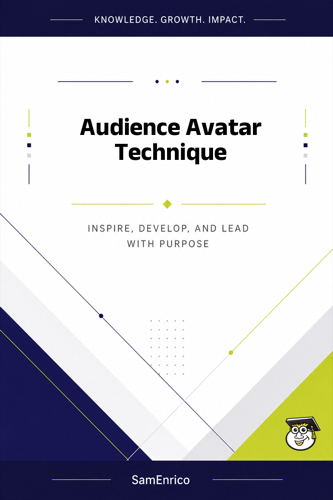
Non-FictionMental WealthSocial Cognition
Audience Avatar Technique eBook
Visualize speaking to one friendly person to reduc
Visualize speaking to one friendly person to reduce crowd threat.
Formats
Free sample
Chapter 1: The Stadium Effect--It was 3:47 on a Tuesday afternoon when I found myself sitting on a cold tile bathroom floor, hiding from three hundred people who had come to hear me speak.My father's funeral had ended twenty minutes earlier. The eulogy I had promised to deliver—the one I had rewritten twelve times, the one I had practiced in the shower, in the car, in the mirror until my eyes went blurry—remained folded in my jacket pocket, untouched. Every time I stood up to walk toward the podium, my legs turned to concrete. My chest constricted. My vision tunneled.
And then I sat back down, pretending to adjust my shoe, until my mother finally walked to the podium herself and read my words off my phone while I listened from the bathroom floor.I was twenty-four years old. I had a graduate degree, a job that required weekly presentations, and a carefully constructed identity as a competent adult. And I could not say goodbye to my own father because sixty pairs of eyes were looking at me.That is not sadness. That is not grief. That is not even anxiety, in the way we usually mean it.That is a brain misfiring.
And until you understand why your brain misfires, no amount of breathing exercises, positive affirmations, or power poses will ever fix the problem.The Problem That Has No Name Let me be clear about what this book is not.It is not a collection of breathing exercises. It is not a guide to beta-blockers or meditation apps or the power of positive thinking. It is not about reducing your caffeine intake or doing power poses in the elevator or repeating affirmations into a mirror. Those things may help at the margins. They may make you feel slightly better for slightly longer.
But they will not solve the problem because they do not address the cause.The problem is this: your brain cannot tell the difference between a boardroom and a battlefield.For one hundred thousand years, the sight of fifty faces staring at you meant one thing and one thing only. You were surrounded by a hostile tribe. Your life was in immediate danger. The correct response was not eloquence or charm or confident body language. The correct response was to freeze, to flee, or to fight.
Every single time. The ones who hesitated—the ones who stopped to wonder whether those fifty faces might actually be friendly—did not pass on their genes. You are descended from the anxious ones. The paranoid ones. The ones who ran first and asked questions later.The modern world has changed faster than the human brain can keep up.
You now walk into conference rooms, wedding receptions, and Zoom calls with fifty faces staring at you. Your brain, however, is still running software from the Pleistocene era. It sees fifty faces. It releases cortisol and adrenaline. It shuts down your prefrontal cortex—the part of your brain responsible for complex language, memory retrieval, and social reasoning—and diverts all blood flow to your limbs so you can run from the sabertooth tiger that does not exist.You are not weak.
You are not broken. You are not an imposter. You are not even particularly anxious, in the clinical sense.You are a perfectly evolved human being who has been asked to use a hammer to screw in a lightbulb. You have the wrong tool for the job. And no amount of deep breathing will turn a hammer into a screwdriver.This book gives you the right tool.
It is called the Audience Avatar Technique. But before you can use it, you have to understand exactly what you are fighting against. You have to understand the Stadium Effect.What Happens Inside You in Three Seconds Let me take you inside the skull of a terrified speaker. This is not metaphor. This is biology.You walk onto the stage.
Fifty faces turn toward you. Some are smiling. Most are neutral. A few are checking their phones. None of them wish you harm.
But your brain does not know that. Your brain sees fifty faces and performs a lightning-fast threat assessment that bypasses conscious thought entirely. You do not decide to be afraid. The fear happens to you.Here is what happens inside your body in the three seconds after you see a crowd.Second One: Your amygdala—an almond-shaped cluster of neurons deep in your brain that functions as your smoke detector—sounds the alarm. It does not consult your prefrontal cortex first.
It does not ask, "Are these people actually dangerous?" It acts. Evolution has taught it that hesitation gets you killed. The amygdala can detect a potential threat in as little as thirty milliseconds, which is fifty times faster than conscious perception. By the time you are aware that you are looking at a crowd, your amygdala has already decided that the crowd is trying to kill you.Second Two: Your hypothalamus activates your sympathetic nervous system. Your adrenal glands release a flood of cortisol and adrenaline into your bloodstream.
Your heart rate jumps from seventy to one hundred and twenty beats per minute. Your blood pressure spikes. Your breathing becomes shallow and rapid. Your palms sweat. Your mouth goes dry.
Your pupils dilate. These are not side effects of fear. They are the fear. They are your body preparing for physical combat.Second Three: Your prefrontal cortex—the part of your brain responsible for working memory, impulse control, and complex language—begins to shut down. Blood flow is redirected from your frontal lobe to your large muscle groups.
Your body is preparing to fight or flee, not to deliver a quarterly earnings report or a wedding toast. The neural pathways that connect your language centers to your mouth are literally being deprioritized. This is why your mind goes blank. This is why you forget words you have known since childhood. This is why you open your mouth and nothing comes out.
Your brain has decided that speaking is less important than surviving.This is the Stadium Effect. It is not a metaphor. It is not a character flaw. It is a measurable, repeatable, physiological response that has been documented in hundreds of peer-reviewed studies. And it happens whether you are facing five people or five thousand.
The brain does not scale its threat response linearly. Fifty faces trigger the same response as five hundred. The exact threshold varies by individual, but the pattern is universal: once the crowd exceeds the size of a small hunting band—roughly twenty to thirty people—the primal brain treats it as a mob.Here is the cruel irony. The Stadium Effect is strongest in people who are most socially aware, most empathetic, and most concerned with doing a good job. The very traits that make you a good speaker—sensitivity to audience feedback, desire to connect, awareness of social dynamics—are the traits that trigger the most aggressive threat response.
You are not failing despite your sensitivity. You are failing because of it. The people who feel no fear on stage are not better speakers. They are often worse. They lack the…
This is the end of the free sample. Get the eBook to keep going. Buy now
About this book
Details
- Author
- Monson Jefferson
- Publisher
- SamEnrico
- Language
- English
- Genre
- Non-Fiction, Mental Wealth, Social Cognition
- Released
- 2026-06-06
- Pages (approx.)
- 139
- Available as
- eBook, Audiobook

Read better in the ZLOADR app
Your eBooks on your phone or tablet. Sign in with your SamEnrico account and start reading.
More by Monson Jefferson
 Interracial Relationship Anger GuideMonson Jefferson$11.99
 The Self Sabotage Childhood Roots WorkbookMonson Jefferson$11.99
 Schema Therapy Childhood Modes GuideMonson Jefferson$11.99
 Burnout In Finance ProfessionalsMonson Jefferson$11.99
 Phantom Freight: The Trucker Who Vanished on Route 66Monson Jefferson$11.99
 Renewable Energy IPP Africa GuideMonson Jefferson$12.99
 Dashboard Design For Non DesignersMonson Jefferson$12.99
 How to Become a Coffee WeigherMonson Jefferson$11.99
 Understanding Lysinuric Protein IntoleranceMonson Jefferson$17.99
 Jewelry MerchandiserMonson Jefferson$11.99
You may also like
 Hong Kong Handover 1997Dunn Johnnie$11.99
 Zumba For Postnatal Recovery CourseNeal Christian$11.99
 Zumba for BeginnersLadner Nikia$11.99
 YouTube Comment Mining GuideHumes Pandora$12.99
 Worry Box MeditationCarlin Rudy$11.99
 Workplace Stress MeditationNguyen Lynn$11.99
 Workplace Stress and Sleep RepairHawley Ivory$11.99
 Workplace Perfectionism CureDelaney Jeffry$11.99
 Workplace Injustice Anger GuideWallen Isabelle$11.99
 Work Addiction and Burnout LinkGreenwood Ester$11.99
 Women in Yoga and WellnessBeattie Galina$11.99
 Women in Stand Up ComedyChun Evangeline$11.99