
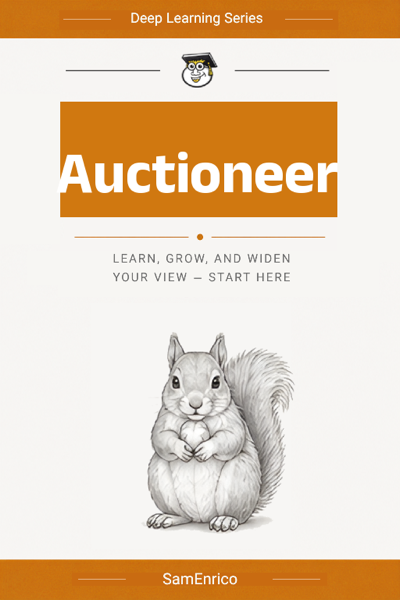
Non-FictionInformativeEducational
Auctioneer eBook
A Coursebook on Auctioneer
by Goebel Ona
A Coursebook on Auctioneer
Formats
Free sample
Chapter 1: The Bones of Babylon...--The first auction did not begin with a gavel. It began with a woman.In the ancient marketplace of Babylon, around 500 B.C., the Greek historian Herodotus recorded a practice that would have made most modern auctioneers blush. Once a year, every village gathered to auction off the marriageable young women. The auctioneer—though no surviving text calls him that—started with the most beautiful woman first. Bidders raised their hands, offered their silver, and the woman went to the highest bidder.
When the most desirable were sold, the auctioneer moved to the less attractive, then the plain, then finally those with physical infirmities. These last women were sold not with a minimum price but with a negative one: the auctioneer would offer a dowry to any man willing to take them. The bidding went down, not up. In a single marketplace, on a single day, the auctioneer employed both the English ascending bid and the Dutch descending bid—centuries before anyone gave those formats names.Why does this matter to you, holding this book, preparing to stand behind a podium with a microphone and a chant in your chest? Because the auction has never been about the object.
It has always been about the human animal in competition. The woman in Babylon, the vase in Rome, the tulip bulb in Holland, the used car on e Bay, the foreclosed farmhouse in Ohio—all are excuses for the same primal drama: I want it, and I am willing to prove that I want it more than you do.This book is not a manual for talking fast. Talking fast is the least important skill an auctioneer possesses. This book is a coursebook on becoming a student of that primal drama. It will teach you the history that explains why auctions survive when other market mechanisms have died.
It will teach you the law that protects you from the shill and the mock auction. It will teach you the psychology that turns a nod into a bid. And it will teach you the chant—not as a party trick, but as an instrument of control.But first, you must understand what you are stepping into. The auction is older than money. It is older than the written word.
And if you do not respect its bones, it will break you.The First Price-Discovery Mechanism Before there were department stores with fixed prices, before there was Amazon with a "Buy Now" button, there was the problem of the unique object. How much is a clay pot worth when no one has ever sold that exact pot before? How much is a slave worth when the last sale was six months ago in a different city? The fixed price—the sticker, the menu, the tag—is a relatively recent invention. For most of human history, the answer to "What is this worth?" was answered by an auction.The auction is what economists call a price-discovery mechanism.
It is a process designed to find the market-clearing price—the exact point where a willing seller and a willing buyer meet—when no reliable reference price exists. There are three primary formats for this discovery, and every auction you will ever run falls into one of these three boxes.The English Ascending Bid You have seen this one a thousand times in movies. The auctioneer starts low. "Do I have ten dollars? Ten?
Ten? Thank you, sir. Now eleven? Eleven? Who will give me eleven?" The price climbs until only one bidder remains.
The auctioneer calls "Going once, going twice, sold!" and the gavel falls. This is the English ascending bid auction, and it is the most common format in the Western world for art, antiques, real estate, and livestock.Why does it work? Because it exploits a psychological quirk called the endowment effect. Once a bidder has raised their hand—once they have, in their mind, "won" the bid at the current price—they feel ownership. When the next bidder raises the price, the first bidder experiences a sense of loss.
And humans hate loss more than they love gain. The English auction turns a rational calculation ("What is this object worth to me?") into an emotional competition ("I am not going to let him take it from me").The Dutch Descending Bid Imagine the reverse. The auctioneer starts high—absurdly high, higher than any rational person would pay. A clock on the wall ticks downward. One thousand dollars, nine hundred, eight hundred, seven hundred.
The first person to press a button or shout "Mine!" stops the clock and buys the item at that price. This is the Dutch auction, named for its use in the 17th-century flower markets of the Netherlands, where speed mattered more than maximizing the final bid.The Dutch auction solves a different problem: perishability. A tulip bulb that does not sell today is worthless tomorrow. The Dutch auction creates urgency. There is no "going once, going twice." There is only the descending clock and the terror of waiting too long.
This format is now used for fish markets, tobacco auctions, and—in a modified form—initial public offerings on the stock market. It is brutal, fast, and unforgiving. And it requires a different kind of auctioneer: one who can speak not with rhythmic persuasion but with the authority of a countdown.The Sealed Bid The third format has no chant at all. The auctioneer announces a deadline. Bidders submit their best offer in a sealed envelope.
At the appointed hour, the auctioneer opens all envelopes, announces the highest bid, and declares the winner. This is the sealed bid auction, common in government contracts, real estate foreclosures, and competitive tenders.The sealed bid removes the emotional theater entirely. There is no bidding war, no eye contact, no "I will not be beaten." The only thing that matters is the number on the paper. Sealed bids are used when the auctioneer wants to prevent collusion (buyers cannot see each other's bids) or when the seller values confidentiality over maximum price.Every auction you run will be one of these three formats, or a hybrid. Your job is to choose the right format for the right asset.
A room full of antique furniture? English ascending. A trailer full of day-old produce? Dutch descending. A commercial building with three qualified buyers?
Sealed bid. Choose wrong, and the price-discovery mechanism fails. Choose right, and you become the bridge between a seller's hope and a buyer's desire.Why Auctions Survived: The Three Conditions Auctions are not efficient for everything. You do not auction a loaf of bread at the grocery store. You do not auction a pair of socks on Amazon.
Fixed prices work better for commodities—items that are identical, abundant, and frequently traded. So when should you use an auction? The economic literature, from Ralph Cassady's Auctions and Auctioneering to the modern work of Nobel laureate Paul Milgrom, points to three conditions.Condition One: Uniqueness The more unique the item, the harder it is to set a fixed price. How do you price a painting that has never been sold before? How do you price a vintage car with a custom…
This is the end of the free sample. Get the eBook to keep going. Buy now
About this book
Details
- Author
- Goebel Ona
- Publisher
- SamEnrico
- Language
- English
- Genre
- Non-Fiction, Informative, Educational
- Released
- 2026-06-02
- Pages (approx.)
- 132
- Available as
- eBook, Audiobook

Read better in the ZLOADR app
Your eBooks on your phone or tablet. Sign in with your SamEnrico account and start reading.
More by Goebel Ona
 The Anti Inflammatory Brain DietGoebel Ona$11.99
 Sleep Meditation for ToddlersGoebel Ona$11.99
 Assertiveness for College StudentsGoebel Ona$11.99
 The Deep Work Single Task GuideGoebel Ona$11.99
 Racial Isolation Connection GuideGoebel Ona$11.99
 The Raven Mockers: Navajo Spirits of the Dying WindGoebel Ona$11.99
 How to Start a Carbon Dioxide Business (Beginners Guide)Goebel Ona$11.99
 Learn to Play the BeatboxingGoebel Ona$11.99
 Startup Competition Directory GuideGoebel Ona$12.99
 Sibling in Canada CRS BonusGoebel Ona$12.99
You may also like
 Hong Kong Handover 1997Dunn Johnnie$11.99
 Zumba For Postnatal Recovery CourseNeal Christian$11.99
 Zumba for BeginnersLadner Nikia$11.99
 YouTube Comment Mining GuideHumes Pandora$12.99
 Worry Box MeditationCarlin Rudy$11.99
 Workplace Stress MeditationNguyen Lynn$11.99
 Workplace Stress and Sleep RepairHawley Ivory$11.99
 Workplace Perfectionism CureDelaney Jeffry$11.99
 Workplace Injustice Anger GuideWallen Isabelle$11.99
 Work Addiction and Burnout LinkGreenwood Ester$11.99
 Women in Yoga and WellnessBeattie Galina$11.99
 Women in Stand Up ComedyChun Evangeline$11.99