
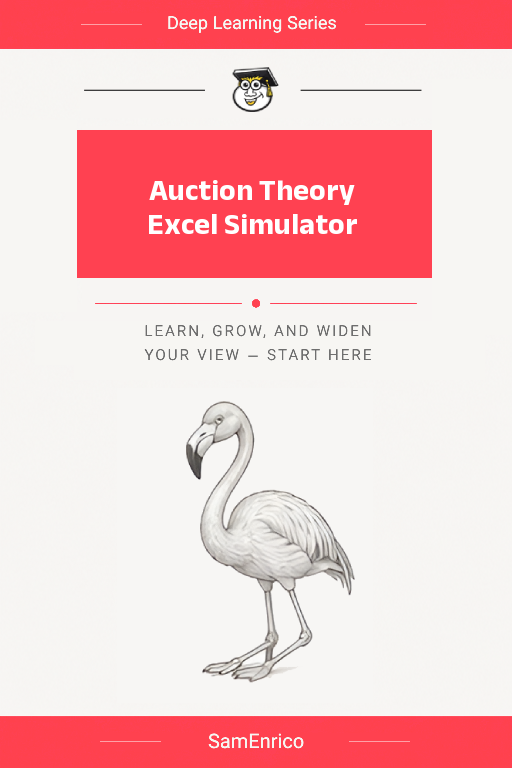
Auction Theory Excel Simulator
Model first-price, second-price, and all-pay aucti
by Koenig Dung
Model first-price, second-price, and all-pay auctions using Excel. Calculate equilibrium bids for industrial organization or microeconomics exam questions.
Formats
About this book
Free sample
Chapter 1: The Auction Illusion--–- You have already overpaid. Perhaps not today, and perhaps not in an auction house with a gavel and mahogany paddles. But somewhere, in some competitive bidding environment—a house negotiation, a freelance contract bid, an e Bay sniping war, or even a internal corporate budget fight—you left money on the table. The person across from you walked away with surplus that rightfully could have been yours. And the worst part?
You never even knew it happened.This is the auction illusion. We tend to think of auctions as exotic events: Sotheby’s, Christie’s, billion-dollar spectrum bids, or perhaps the occasional charity gala where wine flows freely and judgment flows even more freely. In truth, auctions are everywhere. Every time two people compete for a scarce resource—a job candidate, a promotion, a date, a parking spot, a government contract—an auction is taking place. The only difference is whether the rules are written down or merely implied.The central argument of this book is simple: you cannot win what you do not understand.
And understanding auctions requires not just theory, but simulation. You need to see the numbers move. You need to feel the probability shift as you change your bid. You need to build the machine yourself.That machine is Excel. Not because Excel is glamorous—it is not.
But because Excel is everywhere. It sits on your laptop, on your work computer, on the dusty university lab machines that somehow still run Windows 7. It requires no programming, no special licenses, no cloud subscriptions. And it is powerful enough to simulate millions of auctions, revealing the hidden mathematics that separates winners from losers.This chapter does something unusual for a book on auction theory. It does not begin with a theorem.
It does not begin with a formula. It begins with a lie.The Lie You Have Been Told Walk into any economics classroom, and you will hear a comforting story. The story goes like this: in a competitive market, prices reflect true value. Buyers and sellers meet, haggle rationally, and settle at…
This is the end of the free sample. Get the eBook to keep going. Buy now
Contents
- Chapter 1
- Chapter 2
- Chapter 3
- Chapter 4
- Chapter 5
- Chapter 6
- Chapter 7
- Chapter 8
- Chapter 9
- Chapter 10
- Chapter 11
- Chapter 12
Details
- Author
- Koenig Dung
- Publisher
- SamEnrico
- Language
- English
- Genre
- Non-Fiction, Student's Shortcut, Auction Theory
- Released
- 2026-06-01
- Pages (approx.)
- 111
- Available as
- eBook, Audiobook

Read better in the ZLOADR app
Your eBooks on your phone or tablet. Sign in with your SamEnrico account and start reading.
More by Koenig Dung
 Catherine Great Prison ReformKoenig Dung$11.99
 Financial Stress for PilotsKoenig Dung$11.99
 Unmet Expectations Coping GuideKoenig Dung$11.99
 Parent Student Stress GuideKoenig Dung$11.99
 The Phantom Express: The Unsolved Robbery of the Santa Fe ChiefKoenig Dung$11.99
 Full Charge BookkeeperKoenig Dung$11.99
 How to Start a Drinking Chocolate Business (Beginners Guide)Koenig Dung$11.99
 How to Produce AutoclavesKoenig Dung$11.99