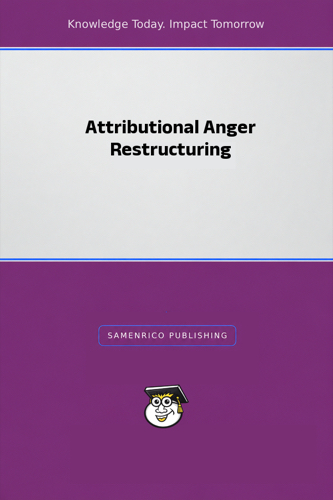
Attributional Anger Restructuring eBook
Examines how you explain others' negative behavior
Examines how you explain others' negative behavior.
Formats
Free sample
Chapter 1: The 3-Second Lie--–- You are driving down a familiar road. The light turns green. You begin to accelerate. And then, from nowhere, a dark sedan swerves into your lane, missing your front bumper by inches. Your hands grip the wheel.
Your chest tightens. Your jaw clenches. Before you have even touched the brake pedal, before you have consciously registered the color of the car or the license plate or whether the driver looked apologetic or oblivious, your brain has already completed a remarkable piece of storytelling.That selfish idiot. They think they own the road. They probably do this every single day.
Someone should teach them a lesson.This entire narrative—complete with a protagonist (you, the wronged innocent), an antagonist (the reckless stranger), a moral judgment (they are a bad person), and a recommended course of action (punishment, confrontation, or at least sustained fury)—has been written, edited, and published in your mind in less time than it takes to blink. You did not choose to write this story. You did not review the evidence. You did not interview witnesses or review traffic camera footage. You simply arrived at the story, fully formed, as if it had been handed to you by a reliable news source.And here is the most disturbing part of all: that story is almost certainly wrong.The Universal Experience You Have Never Named Every human being on earth experiences this phenomenon dozens of times per day.
A colleague sends a curt email. A partner forgets to take out the trash. A friend cancels plans at the last minute. A stranger on social media posts something inflammatory. In each case, your brain performs the same lightning-fast operation: it searches for a cause.Psychologists call this the attributional search.
It is not a bug in your mental software. It is a feature—one that evolved over millions of years to keep you alive. Your ancient ancestors did not have the luxury of pondering whether the rustling in the bushes was caused by the wind or a saber-toothed tiger. The ones who assumed "tiger" and ran survived. The ones who waited for more evidence became dinner.
Your brain is the descendant of survivors who erred on the side of assuming threat.But here is the problem: the world you live in is not the savanna. The "threats" you face are not tigers. They are ambiguous social interactions—text messages, tone of voice, silence, forgetfulness, perceived slights. And your brain, still wired for survival, continues to default to the most threatening possible explanation.This default setting is called the hostile attribution bias. When you are under stress, time pressure, or emotional duress—which is to say, most of the time—your brain systematically overestimates the likelihood that other people's negative behavior is caused by their internal, stable, controllable characteristics (they are mean, selfish, lazy, stupid, malicious) rather than external, temporary, situational factors (they are tired, overwhelmed, distracted, grieving, ignorant).This bias is not a character flaw.
It is not a sign that you are a bad person. It is the inheritance of every human nervous system. And it is the single greatest source of unnecessary anger in your life.Why This Chapter Exists This book is called Attributional Anger Restructuring. Those are three large words that sound like they belong in a graduate psychology textbook. Let me translate them into something you can feel in your body.Attribution: The story you tell yourself about why something happened.Anger: The emotional consequence of a specific kind of attribution—namely, the attribution that someone harmed you intentionally, controllably, and stably (they meant to do it, they could have done otherwise, and they will do it again).Restructuring: The deliberate, learnable skill of catching that automatic story, holding it up to the light, and replacing it with a story that is more accurate and less painful.In other words, this book teaches you how to stop being angry at people who did not actually deserve it.
And because most anger is caused not by what people did but by the reason you invented for why they did it, the potential for relief is enormous.But before we can restructure anything, we have to see the structure clearly. That is what this chapter is for. By the time you finish reading it, you will understand:The three-second lie your brain tells you dozens of times per day Why your brain evolved to lie to you (and why you should not feel guilty about it)The difference between anger as a feeling and anger as a verdict Why appealing a verdict is always possible, even when the feeling remains The single most important concept in this entire book: the Fundamental Attribution Error A simple three-second drill that will change how you experience your next conflict Let us begin with a confession.The Confession No Self-Help Book Wants to Make You are going to be wrong about why people do things. Frequently. Dramatically.
Embarrassingly wrong.I am not saying this to be harsh. I am saying it because every piece of psychological research on this topic points to the same conclusion: human beings are terrible at inferring the causes of other people's behavior. We are overconfident in our inferences. We are biased toward hostile explanations. And we almost never update our attributions when new evidence arrives, because we do not even realize we made an attribution in the first place.Consider a study conducted by social psychologists Jones and Harris in 1967, which has been replicated dozens of times with the same results.
Participants were asked to read an essay that argued in favor of a controversial political position. Half were told that the essay writer had freely chosen that position. The other half were told that the writer had been assigned that position by a coin flip—they had no choice. Then participants were asked to guess the writer's true opinion.The results were striking. Even when participants knew the writer had been assigned the position against their will, they still assumed the writer privately agreed with it.
They could not separate the behavior from the person. They saw a pro-Castro essay and concluded "pro-Castro person," even when the person had been forced to write it.This is the Fundamental Attribution Error in its purest form: the systematic tendency to over-attribute behavior to internal causes (personality, character, intention) and under-attribute behavior to external causes (situation, pressure, accident).You do this every day. When someone cuts you off in traffic, you conclude "aggressive person" rather than "person rushing to the hospital." When a colleague misses a deadline, you conclude "lazy colleague" rather than "colleague whose child was up all night vomiting." When a friend forgets your birthday, you conclude "selfish friend" rather than "friend who is drowning in their own invisible crisis."The Fundamental Attribution Error is not a minor cognitive glitch. It is the engine of most interpersonal anger. And the first step to restructuring that anger is simply naming the error so that you can recognize it when it happens.Anger Is Not What You Think It Is Most people believe that anger is a feeling—a raw, primal emotion that rises up from the depths…
This is the end of the free sample. Get the eBook to keep going. Buy now
About this book
Details
- Author
- Croteau Elvis
- Publisher
- SamEnrico
- Language
- English
- Genre
- Non-Fiction, Self-Help, Attribution
- Released
- 2026-06-11
- Pages (approx.)
- 147
- Available as
- eBook, Audiobook

Read better in the ZLOADR app
Your eBooks on your phone or tablet. Sign in with your SamEnrico account and start reading.
More by Croteau Elvis
 Fear of Failure in Asking for HelpCroteau Elvis$11.99
 The Low Income Coping GuideCroteau Elvis$11.99
 Suicide Concern ConversationsCroteau Elvis$11.99
 The Mother's Vegas ShowgirlCroteau Elvis$11.99
 Weight Loss Surgical AdaptationCroteau Elvis$11.99
 Housing Cost Anxiety ReliefCroteau Elvis$11.99
 The Clown of Cairo: Egypt's Forgotten Serial KillerCroteau Elvis$11.99
 The Essential Guide to Traditional BluegrassCroteau Elvis$11.99
 Venture Debt for Family OfficesCroteau Elvis$12.99
 Email Fasting for ProfessionalsCroteau Elvis$12.99
 Pistachio Nut: Shell SplittingCroteau Elvis$11.99
 How to Produce Electrical MotorsCroteau Elvis$11.99