
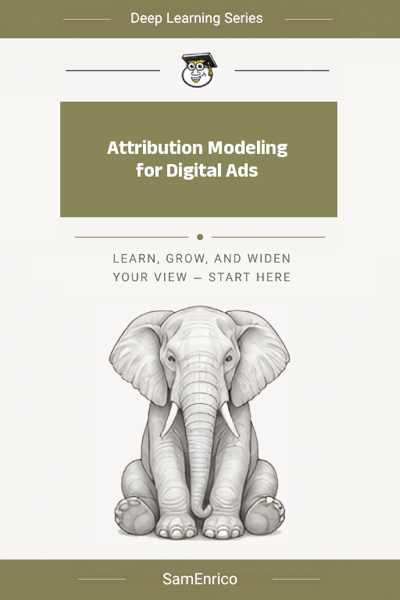
Non-FictionInformativeEducational
Attribution Modeling for Digital Ads eBook
A Coursebook on Attribution Modeling for Digital A
A Coursebook on Attribution Modeling for Digital Ads
Formats
Free sample
Chapter 1: The Ten Percent Lie--–- It was a Tuesday morning when Sarah, the head of marketing for a six-million-dollar direct-to-consumer skincare brand, nearly fired her best-performing channel. She sat in front of her Google Ads dashboard, a cup of coffee growing cold beside her, and stared at the numbers. Display advertising—the banner ads her team had placed across lifestyle blogs, news sites, and beauty forums—was reporting a return on ad spend of just 0.8x. For every dollar she spent on display, she was getting back eighty cents. That was not a winning investment.
That was a slow bleed.She clicked through to Meta Ads Manager. Same story. Her prospecting campaigns on Facebook and Instagram were showing a 1.2x ROAS. Not quite as bad as display, but still well below the 3x target her CFO had mandated. Meanwhile, her branded search campaigns—the ads that appeared when someone typed her company’s name directly into Google—were showing a glorious 6x ROAS.
The conclusion seemed obvious. Cut display. Scale back prospecting on social. Pour every available dollar into branded search. That was what the data said.
That was what any reasonable marketer would do.Over the next four weeks, Sarah did exactly that. She cut display spend by eighty percent. She reduced her Facebook prospecting budget by half. She doubled down on branded search. The result, thirty days later, was a disaster.
Total revenue dropped by forty percent. The branded search ads, now carrying the full weight of the business, saw their cost-per-click rise as she bid against herself in auction. The new customer acquisition rate—the lifeblood of any direct-to-consumer brand—fell off a cliff. Returning customers, who had previously been nurtured through a mix of display and social touchpoints, began to churn at higher rates.Sarah had done everything right according to the last-click attribution model. And she had broken her business.This chapter is about why that happens.
It is about the single most dangerous assumption in digital advertising: that the last click a user makes before converting deserves all the credit. It is about the history of how we got trapped in this way of thinking, the psychology that keeps us trapped, and the concrete steps you can take today to escape. By the end of this chapter, you will understand why last-click attribution is not just inaccurate but strategically dangerous, and you will have a clear framework for what to do instead.The Cookie Jar Fallacy The problem with last-click attribution begins with what I call the Cookie Jar Fallacy. This is the seductively simple but deeply flawed belief that because we can easily track the final click, that final click must be the most important one. Imagine a child reaching into a cookie jar.
You see the hand go in, you see the cookies come out, and you conclude that the hand caused the cookie extraction. That is not wrong, exactly. But you have missed everything that came before: the parent buying the cookies, the child smelling them from across the room, the internal debate about whether to ask permission or just go for it. The final hand movement is merely the last visible action in a long chain of invisible causes.Digital advertising suffers from the same fallacy. We have extraordinarily precise tracking for the final milliseconds of the customer journey.
We know exactly which ad a user clicked immediately before completing a purchase. We know the keyword, the creative, the time of day, the device type. That precision creates an illusion of completeness. If we can see the last click so clearly, surely that must be where the real action happened.But the last click is almost never the most important click. It is simply the most convenient click to measure.The history of this problem goes back to the earliest days of digital advertising.
In the late 1990s and early 2000s, online marketing was dominated by a simple model: direct response. You ran a banner ad, someone clicked it, they landed on your page, they bought something. The customer journey was typically a single touchpoint or a very short sequence. Last-click attribution worked reasonably well in that world because there often was only one click to attribute.Then everything changed. The rise of social media, mobile devices, multiple browsers, and cross-device behavior shattered the simple linear journey.
Today, the average customer for a considered purchase—anything above fifty dollars—interacts with seven to twelve touchpoints before converting. They might see a Tik Tok video, click a Facebook ad two days later, search for the brand on Google a week after that, read three email newsletters, visit the site directly, and finally click a retargeting ad to complete the purchase. In that journey, last-click attribution gives all the credit to that final retargeting ad, while the Tik Tok video, Facebook ad, search click, and emails get nothing.That is not just unfair. It is actively misleading.The Case Study That Changes Everything Let me walk you through a simplified but realistic case study. This is based on actual data from a mid-sized e-commerce company, anonymized and aggregated for clarity.The company spent 10,000ondigitaladvertisingacrossthreechannelsoverathirty−dayperiod:Display(10,000 on digital advertising across three channels over a thirty-day period: Display (10,000ondigitaladvertisingacrossthreechannelsoverathirty−dayperiod:Display(3,000), Social (4,000),and Search(4,000), and Search (4,000),and Search(3,000).
At the end of the month, they had generated $25,000 in attributed revenue under the last-click model. That gave them a blended ROAS of 2.5x. But here is how the credit broke down by channel under last-click:Search: 18,000inattributedrevenue(18,000 in attributed revenue (18,000inattributedrevenue(6,000 above spend) → 6x ROASSocial: 5,000inattributedrevenue(5,000 in attributed revenue (5,000inattributedrevenue(1,000 above spend) → 1.25x ROASDisplay: 2,000inattributedrevenue(2,000 in attributed revenue (2,000inattributedrevenue(1,000 below spend) → 0.67x ROASBased on these numbers, any rational marketer would cut display immediately, reduce social spend, and pour more money into search. That is exactly what Sarah did in the opening story.But here is the truth that last-click hides. The company had a multi-touch attribution system running in parallel, tracking the full customer journey.
When you look at the actual conversion paths—the sequence of touchpoints that led to each sale—a completely different picture emerges. Display ads, far from being a money-losing channel, appeared in the conversion path of seventy percent of all purchasers. Social ads appeared in eighty-five percent of paths. Search ads, despite getting all the last-click credit, actually appeared in only forty percent of paths.Under a multi-touch model that gives fair credit across the journey, the revenue allocation shifted dramatically:Search: 8,000inattributedrevenue(8,000 in attributed revenue (8,000inattributedrevenue(5,000 above spend) → 2.67x ROASSocial: 10,000inattributedrevenue(10,000 in attributed revenue (10,000inattributedrevenue(6,000 above spend) → 2.5x ROASDisplay: 7,000inattributedrevenue(7,000 in attributed revenue (7,000inattributedrevenue(4,000 above spend) → 2.33x ROASThe total revenue remained $25,000, but the distribution was almost exactly reversed. Search went from looking like a 6x superstar to a decent but not exceptional 2.67x channel.
Social improved from 1.25x to a strong 2.5x. Display turned from a 0.67x loser into a perfectly respectable 2.33x channel. Under the multi-touch model, no channel was below the 2x profitability threshold. Under last-click, two channels appeared to be failing.This is not an edge case. This pattern repeats across thousands of businesses.
Last-click systematically undervalues top-funnel and mid-funnel channels while overvaluing bottom-funnel channels. It rewards the closer while ignoring the setup, the…
This is the end of the free sample. Get the eBook to keep going. Buy now
About this book
Details
- Author
- Messina Zandra
- Publisher
- SamEnrico
- Language
- English
- Genre
- Non-Fiction, Informative, Educational
- Released
- 2026-05-23
- Pages (approx.)
- 148
- Available as
- eBook, Audiobook

Read better in the ZLOADR app
Your eBooks on your phone or tablet. Sign in with your SamEnrico account and start reading.
More by Messina Zandra
 LGBTQ Student Academic StressMessina Zandra$11.99
 Australian Green Tax CreditsMessina Zandra$11.99
 Appointment Loci SystemMessina Zandra$11.99
 Pulsatile HGH Secretion GuideMessina Zandra$11.99
 Dream Vision BoardMessina Zandra$11.99
 Bipolar Seasonal Pattern GuideMessina Zandra$11.99
 Romantic Partner Difficult TalksMessina Zandra$11.99
 TM for ParamedicsMessina Zandra$11.99
 HGH And Fat LossMessina Zandra$11.99
 Baba Yaga’s Iron Mortar: The Witch’s Skyward FlightMessina Zandra$11.99
 The Siege of Sphacteria: Sparta's Humiliation at Athens' HandsMessina Zandra$11.99
 Lost in the Labyrinth: The Secrets of KnossosMessina Zandra$11.99
You may also like
 Hong Kong Handover 1997Dunn Johnnie$11.99
 Zumba For Postnatal Recovery CourseNeal Christian$11.99
 Zumba for BeginnersLadner Nikia$11.99
 YouTube Comment Mining GuideHumes Pandora$12.99
 Worry Box MeditationCarlin Rudy$11.99
 Workplace Stress MeditationNguyen Lynn$11.99
 Workplace Stress and Sleep RepairHawley Ivory$11.99
 Workplace Perfectionism CureDelaney Jeffry$11.99
 Workplace Injustice Anger GuideWallen Isabelle$11.99
 Work Addiction and Burnout LinkGreenwood Ester$11.99
 Women in Yoga and WellnessBeattie Galina$11.99
 Women in Stand Up ComedyChun Evangeline$11.99