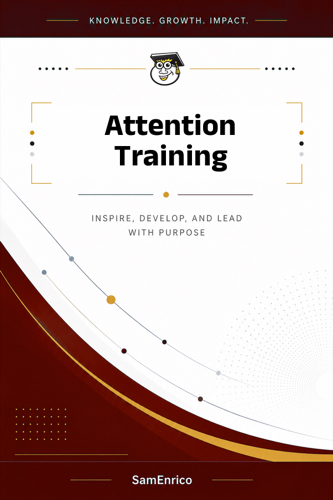
Attention Training eBook
Teaches shifting focus from internal to external c
Teaches shifting focus from internal to external cues.
Formats
Free sample
Chapter 1: The Spotlight Illusion--–- The surgeon’s hands hovered over the open incision, trembling for no physical reason. She had performed this procedure over two hundred times. Her vitals were normal. The room was quiet. Yet her fingers would not move.
In her mind, a loop played: Don’t slip. Don’t slip. The last time you almost slipped. She was not looking at the tissue that needed cutting. She was looking at her own hands, watching them as if they belonged to a stranger.
The patient’s heartbeat beeped steadily, but the surgeon heard only her own pulse pounding in her ears. She was, in that moment, the most dangerous person in the operating room. Not because she lacked skill. Because she had turned her attention away from the external world and pointed it directly at herself.This is the Spotlight Illusion.Every human being suffers from it, yet almost no one recognizes it when it happens. The illusion is simple: you believe that because you are looking at something, you are paying attention to it.
But attention is not the same as gaze. You can stare directly at a patient’s incision while your mind replays a mistake from last week. You can look into your partner’s eyes while rehearsing what you will say next. You can watch the ball leave the pitcher’s hand while calculating the angle of your own elbow. In each case, your eyes are pointed outward, but your attention—the spotlight—is pointed inward.
And the gap between where your eyes point and where your spotlight shines is where performance dies.The Anatomy of a Single Mistake Consider the last time you made an error that felt inexplicable. Perhaps you fumbled your keys while someone was watching. Perhaps you forgot a colleague’s name mid-introduction. Perhaps you missed an easy shot in a game you usually win. In the aftermath, you likely told yourself a story: I was nervous.
I wasn’t focused. I choked. These explanations are not wrong, but they are not precise. They describe the result, not the mechanism.The mechanism is always the same. At the moment of failure, you switched your attentional spotlight from the external world to your internal world.
You stopped tracking the ball’s spin and started tracking your own heartbeat. You stopped listening to the other person’s words and started listening to your own inner critic. You stopped feeling the texture of the tool in your hand and started feeling the sweat on your palm. The external cues that predict success became invisible not because you closed your eyes, but because you blinded yourself with self-awareness.This chapter will dismantle the Spotlight Illusion. You will learn the precise difference between internal and external cues, why your brain is wired to prefer internal monitoring even when it hurts you, and how to detect the exact millisecond when your spotlight drifts.
By the end, you will never mistake looking for seeing again.The Two Streams of Human Attention Neuroscience has confirmed what athletes and artists have known intuitively for centuries: the human brain operates two distinct attentional systems, and they cannot operate at full strength simultaneously. The first system, called the default mode network (DMN) , is your brain’s internal processing center. It activates when you think about yourself—your memories, your emotions, your future plans, your social standing, your bodily sensations. The DMN is the neural correlate of the internal spotlight. The second system, called the dorsal attention network (DAN) , activates when you focus on the external environment—tracking objects, scanning for changes, processing spatial relationships, decoding faces and voices.
The DAN is the neural correlate of the external spotlight.Here is the critical fact that most self-help books ignore: the DMN and the DAN are anticorrelated. When one is active, the other is suppressed. You cannot deeply process an external cue while simultaneously analyzing your internal state. You cannot track a ball and track your heartbeat with equal fidelity. The brain simply does not have enough metabolic resources to run both networks at maximum capacity.
Every moment of attention is a choice. When you point the spotlight at yourself, you are not merely distracted—you are actively blinding yourself to the external world.This is not a metaphor. Researchers using f MRI have shown that when subjects are asked to perform a visual tracking task while also reporting on their internal feelings, the DAN’s activity drops by approximately 40 percent. The brain literally turns down the volume on external perception to free up energy for internal self-monitoring. You do not notice this happening because the drop in external perception feels like nothing at all.
You simply miss the cue. The ball goes past you. The patient’s expression changes and you do not see it. The opportunity passes and you do not know it was ever there.Internal Cues: The Siren Song of the Self What exactly counts as an internal cue? The list is broader than most people realize.
Internal cues include:Bodily sensations. Heart rate, breathing depth, muscle tension, fatigue, hunger, thirst, temperature, pain, itching, the need to use the bathroom, the feeling of clothes against skin, the position of your limbs in space (proprioception), and the sense of balance (vestibular sensation). Every one of these signals competes for attentional bandwidth. When you become aware of your heartbeat during a presentation, you have just lost the ability to track the audience’s micro-expressions for the next several seconds.Self-referential thoughts. Any sentence that contains the word “I,” “me,” “my,” or “mine” is an internal cue.
“What if I fail?” “I should have said something different.” “They think I am stupid.” “I am doing well today.” Even positive self-talk—“I’ve got this!” “I am prepared”—is an internal cue. Positive internal dialogue feels better than negative internal dialogue, but it is equally distracting. The moment you talk to yourself, you are no longer listening to the world.Emotions. Fear, excitement, anger, sadness, jealousy, shame, pride, relief, boredom, curiosity—all emotions are internal signals. They arise from the brain’s limbic system and demand attention.
The problem is not that emotions exist; the problem is that processing an emotion takes time. By the time you have labeled your fear (“I am nervous”), you have missed the external cue that occurred during that labeling.Mental imagery and rehearsal. Visualizing your swing, replaying a past conversation, imagining a future outcome, running through a checklist in your head—all of these are internal cues. They feel productive, and sometimes they are. But they are not external perception.
When you rehearse what you will say next, you are not listening to what is being said now.External Cues: The Landscape of Performance External cues, by contrast, are anything that exists independently of your internal state. They include:Physical objects. The ball, the tool, the screen, the paper, the door, the face across from you. These are the raw data of performance. When you track a physical object, your dorsal attention network is fully engaged.
You are not interpreting, evaluating, or judging. You are simply seeing.Spatial relationships. Distance, trajectory, angle, speed, position. Is the ball…
This is the end of the free sample. Get the eBook to keep going. Buy now
About this book
Details
- Author
- Diamond Tristan
- Publisher
- SamEnrico
- Language
- English
- Genre
- Non-Fiction, Health & Wellness, Attention
- Released
- 2026-06-06
- Pages (approx.)
- 131
- Available as
- eBook, Audiobook

Read better in the ZLOADR app
Your eBooks on your phone or tablet. Sign in with your SamEnrico account and start reading.
More by Diamond Tristan
 Understanding Compulsive Overeating PatternsDiamond Tristan$11.99
 Titanic Stern Section AnalysisDiamond Tristan$11.99
 Small Talk for Professional ConferencesDiamond Tristan$11.99
 Alzheimer's Early Onset CrisisDiamond Tristan$11.99
 Workaholic Sabbatical GuideDiamond Tristan$11.99
 The Anger and Resentment GuideDiamond Tristan$11.99
 Asking For Help GuideDiamond Tristan$11.99
 Anansi the Weaver and the Round TableDiamond Tristan$11.99
 The Alchemist and the Astronomer: A Love Written in the StarsDiamond Tristan$11.99
 How to Produce Hockey GoalsDiamond Tristan$11.99
 How to Produce Tanning ProductsDiamond Tristan$11.99
 International Franchise Marketing FundDiamond Tristan$12.99