
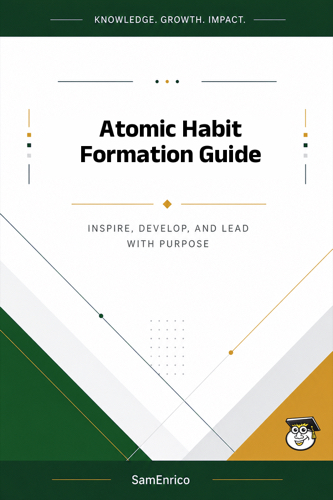
Atomic Habit Formation Guide eBook
Teaches small, incremental changes that compound i
Teaches small, incremental changes that compound into remarkable results over time.
Formats
Free sample
Chapter 1: The 1% Lie--–- Most people get the 1% rule completely backwards.They hear that small changes compound into remarkable results, and they nod along. They imagine themselves improving by 1% each day—getting a little healthier, a little wealthier, a little wiser—until one day, magically, they wake up transformed. It sounds reasonable. It sounds motivating. It is also, for the vast majority of people, exactly the wrong way to think.Here is what actually happens.You decide to improve by 1% today.
You eat a slightly healthier breakfast. You take the stairs instead of the elevator. You read ten pages instead of scrolling social media. You feel good. Virtuous, even.
You go to bed proud of your tiny victory.Then tomorrow arrives.You wake up tired. Your knee hurts from the stairs. The healthy breakfast requires washing a cutting board, and the cutting board is in the dishwasher, and the dishwasher hasn't been run, and suddenly an apple and a handful of nuts seems like an unreasonable amount of effort. You tell yourself you will do better tomorrow. You believe it.By the end of the week, you have strung together two good days, three mediocre days, and two days where you forgot you were even trying.
You look back at your "1% improvement" plan and feel like a failure. Not because the math is wrong, but because you misunderstood what the 1% rule actually demands of you.This chapter will show you the real 1% rule—not the motivational poster version, but the mechanical, unforgiving, liberating truth about how tiny changes actually compound. You will learn why "just this once" is the most dangerous sentence in the English language, why the airplane problem determines your entire future, and most importantly, why you have already failed at every habit you have ever tried to build—and why that is actually good news.Let us begin with a story about Japan.The Pointing and Calling Method In 1994, Japan’s railway system faced a crisis. Trains were running on time with remarkable precision—except for the mistakes. Engineers forgot to flip switches.
Conductors missed signals. Brakes were applied thirty seconds too late. These were not catastrophic errors; they were tiny, almost invisible lapses of attention. But in a system moving millions of people per day, a 0.1% error rate meant hundreds of incidents per year.The solution was not better training. It was not punishment.
It was not motivation.It was pointing and shouting.Every train conductor, every engineer, every station master was required to point at every signal and shout its status aloud. "Green signal! Speed forty! Crossing clear!" They pointed at the platform edge and shouted. They pointed at the schedule and shouted.
They looked like they were performing a strange, choreographed dance with invisible partners.It looked absurd. It felt absurd. And it reduced errors by over 85%.Here is why pointing and shouting works: it forces you out of autopilot. When you simply glance at a green light, your brain processes the information in milliseconds and moves on. But when you point and shout, you engage multiple sensory systems—visual, motor, auditory—and you create a moment of deliberate awareness.
You cannot point and shout at a green light and then forget you saw it. The action itself prevents the lapse.The 1% improvement in the Japanese railway system was not "try harder to pay attention." It was a specific, repeatable, almost comically simple behavior that interrupted the default pattern of automaticity.Most people try to improve by 1% by wanting more willpower. The Japanese railway improved by 1% by adding a stupid little ritual. One approach works. The other leads to exhaustion.The Mathematics You Cannot Argue With Let us get the numbers straight, because they matter, and because you will see them referenced throughout this book.If you improve by 1% every day for one year, you do not improve by 365%.
You improve by 1.01 raised to the 365th power.1.01^365 ≈ 37.78That means a 1% daily improvement results in being nearly thirty-eight times better at the end of the year than you were at the beginning. Not 365% better. 3,778% better.Conversely, if you decline by 1% every day for one year, you do not decline by 365%. You decline to nearly zero.0.99^365 ≈ 0.03A 1% daily decline leaves you with 3% of your starting point. You have effectively erased yourself.These numbers are not motivational metaphors.
They are mathematics. They describe the difference between two identical people who make opposite small choices every day. One chooses the stairs; the other chooses the elevator. One reads for ten minutes; the other scrolls for ten minutes. One sends one email to grow their network; the other sends none.After one year, these two people do not live slightly different lives.
They live in entirely different universes.But here is what the motivational posters do not tell you. The mathematics only work if you are consistent. The 1% rule does not reward occasional effort. It punishes inconsistency brutally. Missing one day is not a 1% decline.
Missing one day, and then trying twice as hard the next day, does not average out to 1%. The compounding breaks. The chain shatters. You do not get 1.01^365. You get something closer to 1.01^180 multiplied by 0.99^180, which is approximately 0.99—meaning you have treaded water for an entire year while exhausting yourself.The Japanese railway did not improve by 1% by having perfect attention 365 days per year.
They improved by 1% by building a ritual that made it almost impossible to fail on any given day. The pointing and shouting did not require willpower. It required compliance with a simple, stupid rule.That is the real 1% rule. Not "try a little harder every day." But "build a system so simple that you can do it even on your worst day."The Airplane Problem Imagine you are a pilot taking off from Los Angeles International Airport, heading for New York’s JFK Airport. The distance is roughly 2,500 miles.
Your heading is approximately 70 degrees northeast.Now imagine you make a tiny error at takeoff. You set your heading to 71 degrees instead of 70. That is a 0.4% error—far smaller than the 1% we are discussing.Where do you land?Not in New York. Not in Boston. Not in Maine.With a one-degree error at takeoff, you miss New York by nearly 30 miles.
You land somewhere in the Atlantic Ocean if you do not correct course. A 0.4% error results in a 100% failure to reach your destination.This is the Airplane Problem. Small daily deviations compound not into slightly different outcomes, but into completely different destinations. You do not end up "a little off track." You end up somewhere you never intended to go.Now apply this to your life.You intend to be healthy. But today, you skip your workout because you are tired.
That is a 0.5% deviation. Tomorrow, you eat fast food because you are busy. Another 0.5%. Next week, you stay up late watching Netflix and throw off your sleep schedule. Another 0.5%.You are not "a little less healthy" after three months.
You are unhealthy. You have landed in the Atlantic. The person who made the opposite tiny choices—who worked out when tired, who ate the packed lunch, who went to bed on time—is not slightly ahead of you. They are thirty-eight times…
This is the end of the free sample. Get the eBook to keep going. Buy now
About this book
Details
- Author
- Beckman Adella
- Publisher
- SamEnrico
- Language
- English
- Genre
- Non-Fiction, Self-Help / Habits
- Released
- 2026-06-09
- Pages (approx.)
- 113
- Available as
- eBook, Audiobook

Read better in the ZLOADR app
Your eBooks on your phone or tablet. Sign in with your SamEnrico account and start reading.
More by Beckman Adella
 Retail Worker Stress GuideBeckman Adella$11.99
 Addressing Teen Substance UseBeckman Adella$11.99
 Fasting for Heart HealthBeckman Adella$11.99
 Amazon Review Research GuideBeckman Adella$11.99
 Self Talk for Depression LiftBeckman Adella$11.99
 Joe Biden ScrantonBeckman Adella$11.99
 Bipolar Alternative Treatment GuideBeckman Adella$11.99
 HGH And Cold ExposureBeckman Adella$11.99
 The Southern Cross and the Stars: New Zealand's Scientific LeapBeckman Adella$11.99
 The Hellfighters' Last Stand: The Battle of Chateau-ThierryBeckman Adella$11.99
 Love in the Shadows: The Secret Affair That Shook a KingdomBeckman Adella$11.99
 Sales Battle Card Automation HandbookBeckman Adella$12.99
You may also like
 Hong Kong Handover 1997Dunn Johnnie$11.99
 Zumba For Postnatal Recovery CourseNeal Christian$11.99
 Zumba for BeginnersLadner Nikia$11.99
 YouTube Comment Mining GuideHumes Pandora$12.99
 Worry Box MeditationCarlin Rudy$11.99
 Workplace Stress MeditationNguyen Lynn$11.99
 Workplace Stress and Sleep RepairHawley Ivory$11.99
 Workplace Perfectionism CureDelaney Jeffry$11.99
 Workplace Injustice Anger GuideWallen Isabelle$11.99
 Work Addiction and Burnout LinkGreenwood Ester$11.99
 Women in Yoga and WellnessBeattie Galina$11.99
 Women in Stand Up ComedyChun Evangeline$11.99