
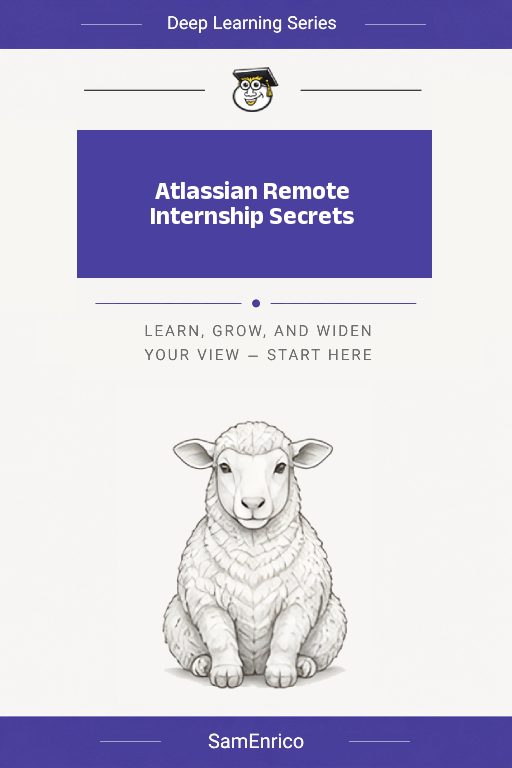
Non-FictionVirtual Work ExperienceAgile Guide
Atlassian Remote Internship Secrets eBook
Secure a virtual internship at Atlassian. Jira, Co
Secure a virtual internship at Atlassian. Jira, Confluence, and remote agile team collaboration.
Formats
Free sample
Chapter 1: The Asynchronous Mindset--Remote internships are not office internships performed from a coffee shop. This is the single most important distinction you will read in this entire book, and if you forget everything else, remember this: Atlassian treats distributed work as a design principle, not a pandemic compromise. The company has been refining what it calls the “Team Anywhere” philosophy for years, long before COVID-19 made remote work a household term. When you apply for a virtual internship at Atlassian, you are not asking for a special accommodation. You are stepping into a system built from the ground up for people who may never meet their teammates in person.Most students approach remote internships with the wrong mental model.
They imagine a typical office job where the only difference is that the office happens to be their bedroom. They think they will wake up, log into Zoom, attend meetings, chat on Slack, and somehow replicate the in-office experience through a screen. This approach fails at Atlassian because it misunderstands the fundamental economics of distributed work. The company does not want you to replicate the office. It wants you to abandon the office mindset entirely.This chapter dismantles the assumptions you bring about what work looks like.
It introduces you to the philosophy that guides every decision at Atlassian, from how teams plan their quarters to how interns ask for help. You will learn why asynchronous communication is not just a preference but a survival skill. You will understand the difference between remote work and being a digital nomad. And you will discover the three soft skills that separate interns who struggle from interns who receive return offers before their last week.By the end of this chapter, you will know whether you are truly ready for an Atlassian internship. The self-audit at the conclusion will force you to confront a hard question: are you comfortable with written conflict resolution?
If the answer is no, this book may save you from a painful summer. If the answer is yes, you are about to learn how to thrive in one of the most sophisticated remote work environments on the planet.What “Team Anywhere” Actually Means Atlassian coined the term “Team Anywhere” in 2020, but the ideas behind it had been brewing for years. The company’s founders, Mike Cannon-Brookes and Scott Farquhar, built Atlassian without a traditional sales force, relying on digital downloads and word of mouth. That early bias toward digital-first operations seeded a culture that never fetishized physical presence.Team Anywhere has three core principles. First, work is something you do, not a place you go.
Second, every employee should have the freedom to live where they thrive personally and professionally. Third, teams must be designed for distribution from the start, not adapted after the fact.The third principle is the one that trips up most newcomers. When a team is colocated, you can rely on hallway conversations, overheard problem-solving, and spontaneous whiteboard sessions. Those serendipitous interactions grease the wheels of collaboration. In a distributed team, those wheels do not exist.
You cannot design a team for colocation and then force it to work remotely. You must design the team’s processes, tools, and norms around the assumption that everyone is always somewhere else.This is why Atlassian rejects the term “remote work” internally. The word “remote” implies that the normal state is colocated and that working from a distance is a deviation. “Team Anywhere” signals that any location—whether it is Sydney, San Francisco, or a small town in rural Europe—is equally valid. There is no center.
There is no headquarters. There is only the network.For an intern, this means you will never be treated as a second-class citizen because you are not in the office. There is no office. Your manager may live in a different country. Your mentor may work from a converted shed in their backyard.
Your pair programming partner may be eight time zones away. The playing field is level, but only if you understand how to play the game.Asynchronous First, Synchronous Second The most practical expression of Team Anywhere is the principle of asynchronous-first communication. At its simplest, asynchronous communication means you send a message that someone reads and responds to later, on their own schedule. Synchronous communication means both parties are present at the same time, typically on a video call or in a rapid-fire Slack exchange.Atlassian prioritizes asynchronous communication for the vast majority of work. There is a reason for this, and it is not just about accommodating different time zones.
Asynchronous communication creates a written record. It forces clarity because you cannot rely on tone, gesture, or immediate clarification. It allows people to think before they respond rather than reacting under pressure. And it respects the deep focus time that knowledge workers need to do their best thinking.When you send a message on Slack and expect an immediate reply, you are not collaborating. You are interrupting.
The default expectation at Atlassian is that you will write things down in Confluence, record a Loom video for complex explanations, or leave a detailed comment in Jira. Your teammates will respond when they have finished their current block of focused work.This does not mean synchronous communication is forbidden. There are legitimate uses for real-time interaction. Incident response requires immediate coordination. Complex design debates sometimes reach resolution faster in a thirty-minute Zoom call than in a week of threaded comments.
And certain team rituals, like retrospectives, benefit from the energy of live discussion.The key is intentionality. You should never default to a meeting when a document would work. You should never Slack someone “quick question” without first checking if the answer already exists in Confluence. And you should never expect an immediate response unless you have explicitly agreed on a synchronous window.Atlassian’s internal data shows that teams who shift even twenty percent of their synchronous interactions to asynchronous formats report higher satisfaction and lower burnout. For interns, the stakes are even higher.
You will be judged not on how quickly you reply to messages but on the quality of your written communication. A well-structured Confluence page that answers a question once for everyone is worth more than a hundred Slack DMs.The Three Exceptions When Sync Is Required While asynchronous communication is the default, there are three specific situations where synchronous communication is not only acceptable but expected. Understanding these exceptions will prevent you from becoming the person who refuses to join a critical video call because “async is the Atlassian way.”Exception One: Live Interviews. Your interview loop, described in detail in Chapter 3, is a synchronous event. You will share your screen, type JQL queries in real time, and respond to questions on a video call.
There is no asynchronous alternative. The interview tests your ability to perform under pressure, and that pressure includes real-time interaction.Exception Two: Security Incidents. If a customer-facing system is down or a data breach is suspected, teams move to synchronous coordination immediately. Every second of delay costs money and trust. In these moments, you will join a video bridge and stay there until the incident is resolved.
Your manager will not ask you to document your thoughts in Confluence first.Exception Three: Stalled Async Decisions. Sometimes an asynchronous…
This is the end of the free sample. Get the eBook to keep going. Buy now
About this book
Details
- Author
- Woodruff Risa
- Publisher
- SamEnrico
- Language
- English
- Genre
- Non-Fiction, Virtual Work Experience, Agile Guide
- Released
- 2026-05-30
- Pages (approx.)
- 139
- Available as
- eBook, Audiobook

Read better in the ZLOADR app
Your eBooks on your phone or tablet. Sign in with your SamEnrico account and start reading.
More by Woodruff Risa
 Pregnancy Gentle Walking GuideWoodruff Risa$11.99
 Being Micromanaged Anger WorkbookWoodruff Risa$11.99
 Agricultural Cooperative Marketing PlanWoodruff Risa$11.99
 Pomodoro for Reading ComprehensionWoodruff Risa$11.99
 Difficult People Assertiveness GuideWoodruff Risa$11.99
 The Blood of the Naga: Khmer Empire's Last Stand at Angkor ThomWoodruff Risa$11.99
 A Beginners Guide to Fives (Volume 1)Woodruff Risa$11.99
 Focused Ion Beam (Fib) MillingWoodruff Risa$11.99
 Guardant Health SWOTWoodruff Risa$12.99
 Understanding Omphalocele Exstrophy Imperforate AnusWoodruff Risa$17.99
You may also like
 Hong Kong Handover 1997Dunn Johnnie$11.99
 Zumba For Postnatal Recovery CourseNeal Christian$11.99
 Zumba for BeginnersLadner Nikia$11.99
 YouTube Comment Mining GuideHumes Pandora$12.99
 Worry Box MeditationCarlin Rudy$11.99
 Workplace Stress MeditationNguyen Lynn$11.99
 Workplace Stress and Sleep RepairHawley Ivory$11.99
 Workplace Perfectionism CureDelaney Jeffry$11.99
 Workplace Injustice Anger GuideWallen Isabelle$11.99
 Work Addiction and Burnout LinkGreenwood Ester$11.99
 Women in Yoga and WellnessBeattie Galina$11.99
 Women in Stand Up ComedyChun Evangeline$11.99