
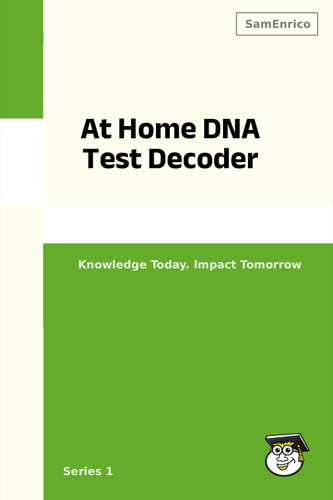
Non-FictionHealth & WellnessConsumer
At Home DNA Test Decoder eBook
Teaches how to critically evaluate 23andMe and Anc
by Langdon Ima
Teaches how to critically evaluate 23andMe and Ancestry health reports.
Formats
Free sample
Chapter 1: Beyond the Spit--–- You have just performed one of the most scientifically profound acts of your life, and you did it in your bathroom. You filled a plastic tube with saliva, screwed on a cap filled with stabilizing solution, and dropped it in a mailer. No white coat. No needle. No waiting room.
Just you, your spit, and a prepaid box.That ease is the genius of direct-to-consumer genetic testing. It is also the danger.Within a few weeks, that vial will travel to a laboratory, where robots will extract your DNA, amplify it, and scan it against a fixed set of genetic markers. A few days after that, you will receive an email with a subject line designed to make your heart beat faster: “Your health results are ready” or “New genetic insights available.” You will click the link, log in, and confront a dashboard of colored bars, risk percentages, and cheerful icons. A green checkmark means you are “typical.” A yellow triangle means you are “elevated.” A red exclamation means something has gone wrong in the lab or, more likely, in your family tree.And you will have no idea what any of it actually means.This chapter is not an introduction. It is a rescue mission.
Before you can decode the health reports from 23and Me or Ancestry, you must understand what those companies actually measured, what they ignored, and why the difference between a research-grade microarray and a clinical-grade diagnostic test could save you from unnecessary surgery or, conversely, from a false sense of security that delays a real diagnosis.Let us begin with the most common misconception in all of consumer genetics: that these tests read your entire genome. They do not. They read a tiny, carefully selected fraction of it—about 0.01 percent—and then use statistical models to infer the rest. That fraction is not a random sample. It is a deliberately chosen set of locations where humans tend to differ from one another.
These locations are called SNPs, pronounced “snips,” which stands for single nucleotide polymorphisms.A SNP is a single letter in your DNA that varies between people. At most positions in your genome, every human on Earth has the same letter. But at approximately 4 to 5 million positions, the letter can differ. One person might have an A where another has a G. Those differences are what make you genetically unique.
They are also what DTC tests are designed to detect.The technology that detects them is called a SNP microarray, or sometimes a genotyping chip. It works like a barcode scanner for your DNA. The chip contains millions of microscopic probes, each designed to stick to a specific SNP. When your DNA is washed over the chip, fragments bind to the probes that match their sequence. A laser then reads which probes have bound DNA, and the instrument produces a genotype call for each SNP: AA, AG, or GG—two letters, one from each parent.This is elegant, fast, and cheap.
It costs about forty to sixty dollars per sample in bulk, which is why 23and Me and Ancestry can sell their tests for under a hundred dollars. But elegance and speed come with trade-offs. The most important trade-off is coverage.A typical DTC microarray scans between 600,000 and 700,000 SNPs. That sounds impressive. Your genome, however, contains approximately 3 billion base pairs.
Six hundred thousand SNPs represent roughly 1.2 billion base pairs if you count the flanking regions, but the actual informative content—the positions where the test actually measures something—is a tiny fraction of that. The vast majority of your genome, including most of the regions that control gene expression, regulate protein folding, and influence complex diseases, is never examined.Imagine you are given a thousand-piece jigsaw puzzle of a photograph. You are allowed to look at only ten pieces. You are then asked to describe the entire photograph. That is what a DTC test does with your genome.
It looks at a handful of pieces and makes probabilistic claims about the rest.The companies know this. They are not hiding it. The limitations are spelled out in their terms of service, their white papers, and their FDA filings. But no one reads those documents. You read the colorful dashboard, not the twenty-page technical appendix.
And the dashboard does not say, “We looked at 0.01 percent of your genome.” It says, “Your risk for celiac disease is typical.” That is technically true, based on the SNPs they examined. But it is also dangerously incomplete.The Research-Grade Distinction Here is a term you will see throughout this book: research-grade. It is the opposite of clinical-grade. A research-grade test is designed for discovery, not diagnosis. It is optimized for throughput, cost, and population-level statistics.
It is allowed to make mistakes because those mistakes are averaged out across thousands of samples. A clinical-grade test, by contrast, is designed for individual medical decisions. It is validated against stricter standards, often repeated in duplicate, and interpreted by a licensed professional.Your DTC health report is research-grade. It is not a medical device. The FDA has explicitly classified it as “information” rather than “diagnostic.” That classification is why you can buy the test without a prescription.
It is also why the companies include disclaimers like this one, buried in 23and Me’s terms of service: “The information provided by our Services is for informational purposes only and is not intended to diagnose, prevent, or treat any disease or condition.”The company that sold you the test is telling you, in writing, that the test does not diagnose anything. Most people never see that sentence. If they do, they dismiss it as legal boilerplate. It is not. It is the single most important sentence in the entire user agreement.What does research-grade mean in practice?
It means the test is about 99 percent accurate for the specific SNPs it targets. That 1 percent error rate sounds small, but with 600,000 SNPs, it translates to approximately 6,000 incorrect genotype calls per person. Most of those errors will be random noise at positions that have no known clinical significance. But some will not. Some will land on medically relevant genes and produce false positives or false negatives.A false positive means the test says you have a variant that you do not actually possess.
A false negative means the test says you do not have a variant that you actually carry. Both are dangerous. False positives lead to unnecessary medical procedures, invasive testing, and years of anxiety. False negatives lead to false reassurance, delayed diagnosis, and missed opportunities for prevention.Consider a real-world example. In 2019, the clinical testing company Invitae published an analysis of DTC test results that customers had brought to them for confirmation.
Among customers who had received a positive result for a hereditary cancer syndrome from a DTC test, 40 percent were false positives when re-tested with clinical-grade sequencing. Forty percent. That is not a rare edge case. That is nearly half.The false negative rate is harder to measure because people who receive negative results rarely seek confirmation. But the available data suggests it is substantial, particularly for rare variants that the microarray does not cover at all.
If you have a family history of early-onset breast cancer but you are not of Ashkenazi Jewish descent, 23and Me’s…
This is the end of the free sample. Get the eBook to keep going. Buy now
About this book
Details
- Author
- Langdon Ima
- Publisher
- SamEnrico
- Language
- English
- Genre
- Non-Fiction, Health & Wellness, Consumer
- Released
- 2026-06-11
- Pages (approx.)
- 141
- Available as
- eBook, Audiobook

Read better in the ZLOADR app
Your eBooks on your phone or tablet. Sign in with your SamEnrico account and start reading.
More by Langdon Ima
 Paleo Desserts CookbookLangdon Ima$11.99
 Pitch Competitions Preparation CourseLangdon Ima$11.99
 The Green Meadow StreamLangdon Ima$11.99
 Equifax Breach Children ImpactLangdon Ima$11.99
 Nefertiti’s Last Embrace: The Pharaoh’s Forbidden LoveLangdon Ima$11.99
 Burke and Wills: The Forgotten Odyssey to the Red Heart of AustraliaLangdon Ima$11.99
 Diane Hendricks Cash PrimerLangdon Ima$12.99
 Pet Friendly Travel GuideLangdon Ima$12.99
 Field Project ManagerLangdon Ima$11.99
 Understanding Germinal Cell AplasiaLangdon Ima$17.99
 How to Start a Primer Paint Business (Beginners Guide)Langdon Ima$11.99
You may also like
 Hong Kong Handover 1997Dunn Johnnie$11.99
 Zumba For Postnatal Recovery CourseNeal Christian$11.99
 Zumba for BeginnersLadner Nikia$11.99
 YouTube Comment Mining GuideHumes Pandora$12.99
 Worry Box MeditationCarlin Rudy$11.99
 Workplace Stress MeditationNguyen Lynn$11.99
 Workplace Stress and Sleep RepairHawley Ivory$11.99
 Workplace Perfectionism CureDelaney Jeffry$11.99
 Workplace Injustice Anger GuideWallen Isabelle$11.99
 Work Addiction and Burnout LinkGreenwood Ester$11.99
 Women in Yoga and WellnessBeattie Galina$11.99
 Women in Stand Up ComedyChun Evangeline$11.99