
Non-FictionBusiness BriefRecruitingTalent Acquisition
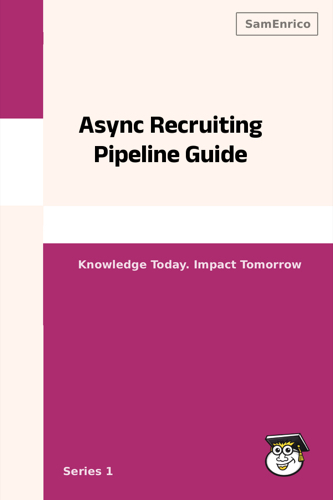
Async Recruiting Pipeline Guide eBook
Manage candidate communication, interview scheduli
Manage candidate communication, interview scheduling, and feedback collection asynchronously using recruiting tools.
Formats
Free sample
Chapter 1: Calendar Tetris--–- The email thread had reached forty-seven messages. Forty-seven. Sarah, a senior backend engineer at a fast-growing fintech company, had been excited about this opportunity for exactly twelve days. Then the scheduling began. The recruiter proposed a time.
The hiring manager was unavailable. The recruiter proposed five more times. The hiring manager’s EA intervened. The panel lead was on paternity leave. Someone suggested a Doodle poll.
Three people never responded. One person responded with “anytime except all the times you listed.” Sarah, who had taken time off from her current job for the interview loop, finally sent her withdrawal email: “If this is how you treat candidates, I don’t want to see how you treat employees.”That story is not an outlier. It is the norm.The Hidden Cost of Synchronous Hiring Every day, in thousands of companies, the same scene plays out. Recruiters spend 60 percent of their time on logistics rather than relationships. Engineering managers lose ten or more hours each week to interview loops that could have been asynchronous tasks.
Candidates, especially high-demand ones with multiple offers, drop out after a single scheduling delay. The problem has a name, though no one says it out loud: Calendar Tetris.Calendar Tetris is the exhausting, synchronous game of aligning multiple live schedules across time zones, priorities, and personal constraints. It is the reason a forty-five-minute interview requires twelve emails to schedule. It is why a candidate who applied on Monday might not speak to a human until the following Thursday. It is why recruiters burn out, why hiring managers resent interviewing, and why top talent ghosts you for a competitor who simply replied faster.The costs are not abstract.
Let us quantify them.A senior engineer earning one hundred eighty thousand dollars per year who spends ten hours weekly in interview loops costs the company approximately ninety thousand dollars annually in diverted productivity. A recruiting coordinator making seventy thousand dollars who spends 60 percent of their time on scheduling—not sourcing, not relationship-building, not strategy—represents forty-two thousand dollars in wasted salary. A single delayed hire for a revenue-generating role costs, on average, five thousand to fifteen thousand dollars per day in lost opportunity.And those are just the direct costs. The indirect costs are harder to measure but larger still: candidate brand damage, recruiter turnover, hiring manager frustration, and the slow erosion of trust in the recruiting function.What This Book Is (and Is Not)This book introduces a different way. It is called async recruiting.Async recruiting does not mean ignoring candidates.
It does not mean replacing humans with chatbots. It does not mean eliminating live conversations entirely. Those are misconceptions, and we will address them directly.What async recruiting actually means is this: decoupling communication in time so that each party works on their own schedule, producing richer, more thoughtful outputs, while preserving live interaction only where it adds unique value.Under this model, candidates complete take-home exercises and recorded video responses when it is convenient for them—after their day job ends, on a weekend morning, during a quiet lunch break. Recruiters review those submissions in focused blocks of deep work, not scattered between meetings. Hiring managers provide timestamped feedback on scorecards, not hurried verbal impressions in a hallway.And live conversations?
They remain, but only at the end of the process and only for one purpose: assessing culture contribution, not technical skills. This is a critical rule that will appear throughout the book. Live interviews are expensive, biased, and poor predictors of job performance. But they are excellent for answering one question: “Do I want to work with this person?” That question matters. It just should not be asked until after you already know the candidate can do the job.The Quality of Signal Principle Traditional recruiting optimizes for the wrong variable: speed of reply.
The belief is that faster responses equal better candidate experience. But speed of reply often comes at the cost of thoughtful evaluation. A recruiter who fires off a templated rejection in thirty seconds is fast but not helpful. A hiring manager who rushes through a live interview because they have back-to-back meetings is fast but inaccurate.Async recruiting optimizes for something else: quality of signal.Signal quality means the evidence you collect about a candidate actually predicts their future job performance. Live interviews, unstructured and rushed, have low signal quality.
Research consistently shows that unstructured interviews predict job performance only slightly better than chance—a correlation of around 0.20 on a scale where 1.0 is perfect prediction. That is barely above random.Structured, asynchronous work samples, by contrast, have much higher predictive validity. A well-designed take-home exercise that mimics real job tasks can achieve correlations of 0.50 or higher. A recorded video response to standardized questions eliminates the variability of interviewer style and candidate small talk. A written case study reviewed by multiple blinded evaluators produces defensible, auditable evidence.Speed of reply is still important.
Candidates should not wait weeks for a status update. But speed of reply applies to communication, not evaluation. You can acknowledge an application instantly while still taking time to evaluate it carefully. That is the core insight of async recruiting.The Three Synchronous Handoffs That Kill Your Pipeline Most recruiting processes contain between eight and fifteen synchronous touchpoints. The number varies by company and role, but the pattern is consistent.
Each synchronous touchpoint introduces delay, coordination cost, and candidate drop-off risk.Through extensive research across dozens of companies, we have identified three synchronous handoffs that cause the most damage. Remove these three, and you eliminate the majority of scheduling chaos.Handoff One: The Recruiter Screen to Hiring Manager Review In traditional recruiting, a recruiter screens a candidate via live phone call or video chat. Then the recruiter must coordinate a time for the hiring manager to review the candidate’s materials and decide whether to advance them. This handoff often takes three to five days and generates ten to twenty emails. The candidate waits in silence.Async alternative: The recruiter screen becomes an asynchronous questionnaire or recorded video response.
The candidate completes it on their own time. The hiring manager reviews the submission when they are in deep work mode. No scheduling required.Handoff Two: The Hiring Manager Interview to Panel Coordination After a successful hiring manager interview, the candidate must be scheduled with a panel of three to five interviewers. This is where Calendar Tetris reaches its peak difficulty. Each interviewer has different availability, different time zone constraints, and different levels of responsiveness.Async alternative: The panel interview is replaced by asynchronous work samples.
Each panel member reviews the same submission independently using a collaborative scorecard. A brief synchronous calibration meeting (thirty minutes or less) resolves major discrepancies. The candidate interacts with the panel once, not five times.Handoff Three: The Offer to Onboarding Transition Even after a candidate accepts an offer, synchronous handoffs continue. Background checks, equipment provisioning, and IT setup all require coordination. Delays here can push start dates back by weeks.Async alternative: Automated workflows triggered by offer acceptance.
Background check authorization sent instantly. Equipment ordered via API integration with your logistics provider. Onboarding documents available in a self-service portal.…
This is the end of the free sample. Get the eBook to keep going. Buy now
About this book
Details
- Author
- Beckett Britt
- Publisher
- SamEnrico
- Language
- English
- Genre
- Non-Fiction, Business Brief, Recruiting, Talent Acquisition
- Released
- 2026-06-07
- Pages (approx.)
- 126
- Available as
- eBook, Audiobook

Read better in the ZLOADR app
Your eBooks on your phone or tablet. Sign in with your SamEnrico account and start reading.
More by Beckett Britt
 Book Reading Comparison CureBeckett Britt$11.99
 Cocaine Recovery Body Image ManualBeckett Britt$11.99
 MAT for Chronic Pain PatientsBeckett Britt$11.99
 Essential Oil Business GuideBeckett Britt$11.99
 The Mechanical Mind: The Birth of Artificial Reason in 18th-Century EuropeBeckett Britt$11.99
 Google Cookie Consent PolicyBeckett Britt$12.99
 Shopify SEO Basics GuideBeckett Britt$12.99
 How to Start a Felt Hat Body Making Business (Beginners Guide)Beckett Britt$11.99
 Cleanroom TechnicianBeckett Britt$11.99
 Understanding Cortical Blindness Mental Retardation PolydactylyBeckett Britt$17.99
You may also like
 Hong Kong Handover 1997Dunn Johnnie$11.99
 Zumba For Postnatal Recovery CourseNeal Christian$11.99
 Zumba for BeginnersLadner Nikia$11.99
 YouTube Comment Mining GuideHumes Pandora$12.99
 Worry Box MeditationCarlin Rudy$11.99
 Workplace Stress MeditationNguyen Lynn$11.99
 Workplace Stress and Sleep RepairHawley Ivory$11.99
 Workplace Perfectionism CureDelaney Jeffry$11.99
 Workplace Injustice Anger GuideWallen Isabelle$11.99
 Work Addiction and Burnout LinkGreenwood Ester$11.99
 Women in Yoga and WellnessBeattie Galina$11.99
 Women in Stand Up ComedyChun Evangeline$11.99