
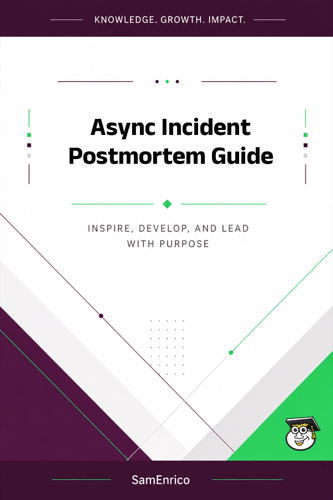
Async Incident Postmortem Guide Audiobook
Document system outages, errors, and failures asyn
Document system outages, errors, and failures asynchronously using written timelines and root cause analysis.
Formats
Free sample
Chapter 1: The War Room Lie--–- The first time I watched a company lose $2 million in ninety minutes, I was eating cold pizza in a glass-walled conference room at 2:37 AM. The pizza was not the problem. The problem was that twelve engineers were shouting at three different dashboards while a VP paced behind us asking, "Does anyone know what's actually happening?" No one answered because no one knew. We had logs, we had metrics, we had the best monitoring money could buy, and we had absolutely no idea why the payment service was rejecting thirty percent of transactions.The outage lasted four hours and eleven minutes. The postmortem took six weeks to write, required three separate drafts, and ultimately blamed "a race condition in the cache layer." That was not wrong, but it was also not useful.
Six months later, a nearly identical race condition caused another outage. This time the company lost $2.4 million. I wrote both postmortems. I learned from neither. Because I did not yet understand the difference between fixing a problem and learning from a failure.This chapter argues that the traditional "war room"—where engineers gather synchronously to debug a live outage—is fundamentally flawed as a learning mechanism.
It is excellent for stopping the bleeding. It is terrible for understanding the wound. The war room prioritizes speed over accuracy, heroism over documentation, and intuition over evidence. And until you abandon its hidden assumptions, you will write postmortems that are structurally incapable of preventing the next outage.The Seduction of the War Room Every engineer remembers their first war room. The energy is electric.
Someone shouts, "I think it's the database!" Someone else runs a query. A third person says, "No, look at the latency spike!" There is a sense of urgency, a shared mission, the thrill of the chase. When the team finally finds the misconfigured flag or the missing index and the graphs turn green again, there is cheering. High-fives. Relief.This feeling is addictive.
And it is dangerous.The war room seduces us because it feels productive. Noise feels like activity. Activity feels like progress. But what actually happens inside a war room is a predictable cascade of cognitive failures. The first is tunnel vision: under stress, humans narrow their attention to the most obvious signal and filter out everything else.
In one famous study of airline cockpit emergencies, researchers found that pilots under time pressure consistently failed to notice instrument…
This is the end of the free sample. Get the Audiobook to keep going. Buy now
About this book
Details
- Author
- Whipple Douglass
- Publisher
- SamEnrico
- Language
- English
- Genre
- Non-Fiction, Business Brief, Incident Response, Postmortem
- Released
- 2026-06-08
- Pages (approx.)
- 135
- Available as
- eBook, Audiobook

Listen in the VoxFlicks app
Audiobooks and audio dramas wherever you go. Sign in with your SamEnrico account and press play.
More by Whipple Douglass
 Fentanyl Test Strip Use GuideWhipple Douglass$11.99
 DIY Essential Oil ExtractionWhipple Douglass$11.99
 Bill of Lading Customs GuideWhipple Douglass$11.99
 Cocaine Recovery Dating Boundaries GuideWhipple Douglass$11.99
 Into the Abyss: The Pioneers of Atlantic Underwater Caves (1950s-1960s)Whipple Douglass$11.99
 The Afflicted: Voices from Salem's ShadowsWhipple Douglass$11.99
 Understanding Corpus Callosum AgenesisWhipple Douglass$17.99
 How to Start a Felt Tipped Pen Business (Beginners Guide)Whipple Douglass$11.99
 Cash App Money ManagementWhipple Douglass$11.99
 Meta Lead Ads PolicyWhipple Douglass$12.99
 Legal Policies Free GuideWhipple Douglass$12.99