
Non-FictionBusiness BriefDesign SystemsUI UX
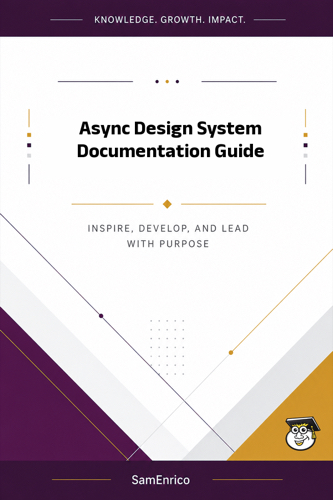
Async Design System Documentation Guide eBook
Maintain component libraries, usage guidelines, an
Maintain component libraries, usage guidelines, and version history as async communication for designers and devs.
Formats
Free sample
Chapter 1: The $47,000 Button--It was 3:47 PM on a Tuesday when the pager went off. Not a literal pager—this was 2023—but the Slack channel exploded with the kind of red “prod-issues” alerts that make engineering managers lose their appetite. A fintech startup’s payment button had stopped working. Not for everyone. Just for left-handed users on mobile devices using Safari.
The bug took seventeen hours to trace. The root cause? A designer had increased the button’s padding from 16px to 20px in Figma at 10 AM, a developer had referenced an outdated Storybook instance at 2 PM, and by 3:47 PM, three different button styles existed across the application. One of them, the one deployed to production, had a touch target area that overlapped with another element on Safari mobile—a conflict that existed in exactly zero design files and zero documentation pages.The company lost $47,000 in abandoned transactions before the fix was deployed.The button itself was fine. The team was smart.
The process was the problem.The Broken Telephone of Modern Product Development This is not a book about buttons. This is a book about communication—specifically, why the way most design and development teams communicate is fundamentally broken, and how asynchronous documentation can fix it. The button story is real (the names and company have been anonymized, but the financial impact is accurate to the decimal point), and it represents a disease that infects thousands of organizations: the gradual, invisible erosion of shared understanding.Here is what happened in that fintech startup, and what happens in your organization every single day, whether you notice it or not.The designer, let us call her Maya, opened Figma at 9:47 AM. She had received feedback from user testing that the primary call-to-action button was too easy to miss on mobile. The solution seemed simple: increase the padding from 16px to 20px, making the button larger and more prominent.
Maya made the change in her master component, published the library update to Figma, and moved on to her next task. Total time invested: twelve minutes.The developer, let us call him James, pulled the latest design specs at 2:00 PM. But James did not use Figma directly—he relied on Storybook, where the component library was documented with live code examples. The Storybook instance pulled from a design token repository that was updated once per week, not in real time. The 20px padding change had not yet made it through the sync.
James built his page using 16px padding. His work was correct according to the documentation he had.At 3:00 PM, another developer, Priya, merged a different feature that also used the button component. She had seen Maya’s Slack message about “button padding tweak” and assumed the change was already in the design system. She wrote a CSS override to make her buttons 20px, not realizing she was creating a third variant.By 3:47 PM, three versions of the button existed: Maya’s Figma file (20px), James’s Storybook (16px), and Priya’s production override (20px with different margins). The overlap on Safari mobile affected only the version that combined Priya’s override with a specific viewport width.
The bug was not caught in testing because the testing environment used James’s 16px version.This is the broken telephone of design systems. Not malice. Not incompetence. A cascade of small, rational decisions made by smart people working with incomplete information.The Anatomy of a Communication Catastrophe Let me name the three villains of this story, because they are the same three villains in every design system failure.Villain One: The Ephemeral Conversation. Maya posted about her button change in Slack.
By 4:00 PM, that message was buried under seventeen other threads. Slack is not an archive; it is a flowing river. Decisions made in Slack are decisions made on quicksand. When James searched for “button padding” the next day, he found eight different conversations, three conflicting answers, and no clear resolution. The information existed, technically, but it was not findable.
Findability is more important than existence.Villain Two: The Static Artifact. The Storybook instance updated once per week because “real-time syncing was too expensive to implement.” This is a lie teams tell themselves. The real cost is not technical; it is political. Someone decided that documentation was less important than feature work, and that decision created a six-day window where the design system was actively lying to its users. Static artifacts are not documentation; they are fossil records.
They tell you what was true once, not what is true now.Villain Three: The Unwritten Assumption. Priya assumed the Slack message meant the change was live. She did not check. Neither did her code reviewer. Neither did the QA engineer.
Why? Because checking would have required opening three different tools, comparing versions, and resolving contradictions. The friction of verification was higher than the friction of assumption. When you make verification harder than guessing, people will guess.The Bus Factor: A Metric You Cannot Afford to Ignore There is a grim joke told in engineering organizations: “What is the bus factor?” It is the number of people who need to get hit by a bus before your project collapses. If only one person knows why the button has 16px padding, your bus factor is one.
If that person takes vacation, gets sick, or leaves the company, the knowledge leaves with them.In the fintech startup, the bus factor for the button component was three—but not in a good way. Three different people had three different, contradictory understandings of the truth. The real bus factor was negative: adding more people made the problem worse, because each person introduced a new interpretation of undocumented decisions.I want you to calculate your team’s bus factor right now. Not literally—put down the spreadsheet. But think about the last three questions someone asked you about your design system.
How many of those answers were written down somewhere discoverable? How many lived only in your head, or in a Slack DM, or in a meeting recording that no one will ever watch again?Here is the uncomfortable truth: if you cannot answer a question by pointing to documentation, your bus factor is one. And that bus is coming. It might be an actual bus, or it might be a paternity leave, or it might be a competitor offering double your salary. The mechanism does not matter.
What matters is that your system is fragile.Why “Just Communicate More” Is Terrible Advice Every time I tell the button story to a room of designers and developers, someone raises their hand and says, “This is why we need more sync meetings. If they had just had a daily standup, this would have been caught.”This is wrong. Let me explain why.Real-time communication—meetings, Slack threads, hallway conversations—has three fatal flaws for design system maintenance.First, real-time communication does not scale. A meeting with three people is productive. A meeting with thirty people is a lecture.
A meeting with three hundred people is impossible. As your organization grows, the number of possible communication pairs grows quadratically. The math defeats you. At 100 people, there are 4,950 possible pairs. At 1,000 people, there are 499,500.
You cannot schedule enough meetings.Second, real-time communication favors the loud and the present. The person who speaks first frames the…
This is the end of the free sample. Get the eBook to keep going. Buy now
About this book
Details
- Author
- Beattie Idalia
- Publisher
- SamEnrico
- Language
- English
- Genre
- Non-Fiction, Business Brief, Design Systems, UI UX
- Released
- 2026-06-09
- Pages (approx.)
- 131
- Available as
- eBook, Audiobook

Read better in the ZLOADR app
Your eBooks on your phone or tablet. Sign in with your SamEnrico account and start reading.
More by Beattie Idalia
 TM School ProgramBeattie Idalia$11.99
 EQ for Small Business OwnersBeattie Idalia$11.99
 Buprenorphine Induction StrategiesBeattie Idalia$11.99
 Peer Support for Imposter RecoveryBeattie Idalia$11.99
 The Vanishing Billionaire: The Mysterious Disappearance of Jho LowBeattie Idalia$11.99
 The Last Flight of the Hindenburg: A Balloon’s Tragic AscentBeattie Idalia$11.99
 How to Start a Bread and Flour Confectionery Baking Business (Beginners Guide)Beattie Idalia$11.99
 UN Internship to Staff GuideBeattie Idalia$12.99
 Retail Lease Rent RestructuringBeattie Idalia$12.99
 Understanding Craniofacial DysynostosisBeattie Idalia$17.99
 Front Desk ManagerBeattie Idalia$11.99
You may also like
 Hong Kong Handover 1997Dunn Johnnie$11.99
 Zumba For Postnatal Recovery CourseNeal Christian$11.99
 Zumba for BeginnersLadner Nikia$11.99
 YouTube Comment Mining GuideHumes Pandora$12.99
 Worry Box MeditationCarlin Rudy$11.99
 Workplace Stress MeditationNguyen Lynn$11.99
 Workplace Stress and Sleep RepairHawley Ivory$11.99
 Workplace Perfectionism CureDelaney Jeffry$11.99
 Workplace Injustice Anger GuideWallen Isabelle$11.99
 Work Addiction and Burnout LinkGreenwood Ester$11.99
 Women in Yoga and WellnessBeattie Galina$11.99
 Women in Stand Up ComedyChun Evangeline$11.99