
Non-FictionBusiness BriefConflict ResolutionMediation
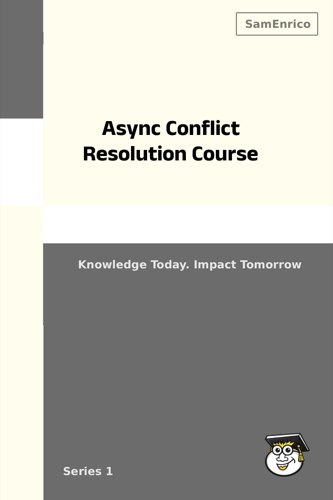
Async Conflict Resolution Course eBook
Resolve team disagreements asynchronously using wr
Resolve team disagreements asynchronously using written position statements, evidence logs, and mediation documents.
Formats
Free sample
Chapter 1: The Meeting Trap--–- The Slack notification arrived at 2:47 PM on a Tuesday. “Let’s hop on a quick call to resolve this,” your colleague wrote, following up with a calendar invite for 3:00 PM. Fifteen minutes later, you sat in front of your screen, watching four faces flicker onto the Zoom grid. Within ninety seconds, voices overlapped. Within five minutes, someone cried.
Within twenty minutes, nothing was resolved, but two people had stopped speaking to each other entirely. The “quick call” lasted an hour and a half. The damage lasted six months.You have lived this scene. So has every knowledge worker who has ever been part of a team. When conflict arises—a missed deadline, a disputed decision, a perceived slight—the default instinct is almost universal: “Let’s get on a call to talk it through.” This instinct is not only wrong; it is actively destructive.
The meeting is the worst possible container for resolving team disagreements. And yet, we reach for it every single time, as if the proximity of voices will somehow conjure understanding.This book exists because that assumption is a lie.Welcome to The Asynchronous Negotiator. Over the next twelve chapters, you will learn a completely different way to resolve team conflict: not through real-time conversation, but through written position statements, evidence logs, and mediation documents. You will learn why waiting is smarter than reacting, why typing is clearer than speaking, and why silence is more powerful than the loudest voice on a Zoom call. But before we build the new system, we must first demolish the old one.
We must understand, with surgical precision, why the synchronous meeting fails as a conflict resolution tool—and why asynchronous writing is not merely a compromise for remote teams, but a superior method for any team, anywhere.The Amygdala Hijack: Why Your Brain Betrays You on Calls To understand why meetings make conflict worse, you must first understand what happens inside your skull when you perceive a threat. Conflict—even professional, low-stakes conflict about a deadline or a deliverable—activates the same neural circuits as physical danger. Your brain does not distinguish between a colleague questioning your competence and a predator approaching through tall grass. The response is identical.Deep within your brain lies the amygdala, a pair of almond-shaped clusters of nuclei that serve as your body’s threat-detection system. When the amygdala detects a challenge to your status, your safety, or your sense of fairness, it initiates a cascade of physiological events: your heart rate increases, your breathing becomes shallower, your pupils dilate, and your prefrontal cortex—the rational, planning part of your brain—begins to shut down.
Blood flow diverts from the frontal lobes to the limbic system. You literally become less intelligent in the moment of confrontation.This is the amygdala hijack, a term coined by emotional intelligence researcher Daniel Goleman. In a live meeting, the hijack happens in real time. You hear a tone of voice you interpret as dismissive. You see a facial expression you read as contempt.
You feel the pressure of three people waiting for you to respond. Your amygdala fires. Your prefrontal cortex dims. You say something you regret. The other person’s amygdala fires in response.
Within sixty seconds, two rational adults have been replaced by two defensive animals, and the conflict has escalated beyond anything the original issue warranted.Here is the brutal truth that the meeting-industrial complex does not want you to know: the real-time nature of synchronous conversation is not a feature of conflict resolution; it is a fatal bug. The speed of speech outruns the speed of thought. By the time your rational brain catches up to what you just said, the damage is already done. There is no delete key in a conversation. There is no edit history.
There is only the permanent memory of the wound.The Four Fatal Flaws of Synchronous Conflict Resolution Let us name the enemies. Every live meeting about a disagreement suffers from four structural flaws that are not fixable through better facilitation, more ground rules, or more emotional intelligence training. These flaws are baked into the medium itself.Flaw One: Emotional Contagion Emotions are contagious. This is not a metaphor; it is a neurological fact. Mirror neurons in your brain fire when you observe another person’s emotional state, causing you to unconsciously replicate that state.
In a live meeting, one person’s frustration becomes two people’s frustration becomes the entire team’s frustration, all within minutes. The emotion spreads faster than the facts can be established. By the time someone says “let’s stick to the data,” the data no longer matters. The room has already chosen sides based on who sounded most aggrieved, not who was most correct.Asynchronous writing interrupts this contagion. When you read a position statement, you experience the words without the tone, the facial expression, or the physical presence of the other person.
You have time to notice your own emotional reaction—to feel the flash of anger or defensiveness—without immediately broadcasting that reaction to the room. You can sit with the discomfort. You can let it pass. And then you can respond as the rational adult you actually are, not the reactive animal the meeting turned you into.Flaw Two: The Speed-Over-Accuracy Tradeoff Speech is fast. The average person speaks at approximately 150 words per minute.
The average person thinks at approximately 400 words per minute. This gap means that while someone is talking, your brain is racing ahead—anticipating their next point, formulating your rebuttal, searching for counterexamples. You are not listening; you are waiting for your turn to speak. This is not a personal failing; it is a cognitive limitation.In a live conflict meeting, this speed-pressure forces you to respond before you have fully processed what was said. You grab the first argument that comes to mind, which is rarely your best argument.
You make claims you cannot support. You miss nuances you would have caught with thirty seconds of quiet reflection. The meeting rewards speed, but conflict resolution rewards accuracy. These two goals are fundamentally incompatible.Asynchronous writing flips the tradeoff. You can read a position statement at 9 AM, feel the urge to fire back immediately, and then—because there is no meeting happening—you can close the document and go for a walk.
You can return at 2 PM with a clearer head and a better argument. You can research the facts. You can check the timestamps. You can write and rewrite your response until it says exactly what you mean, without the heat of the moment distorting your words.Flaw Three: The Disappearing Record This is the most underappreciated flaw of live conflict resolution. In a meeting, almost nothing is saved.
Yes, someone might take notes. Yes, you might record the call. But the actual emotional texture of the conversation—who said what, in what tone, with what implication—evaporates the moment the meeting ends. This ephemerality creates two catastrophic problems.First, it enables gaslighting. After the meeting, parties can and do disagree about what was said, what was agreed, and who promised what.
Without a verbatim record, these disagreements become second-order conflicts that consume more time than the original dispute. You end up…
This is the end of the free sample. Get the eBook to keep going. Buy now
About this book
Details
- Author
- Scoggins Florencio
- Publisher
- SamEnrico
- Language
- English
- Genre
- Non-Fiction, Business Brief, Conflict Resolution, Mediation
- Released
- 2026-06-07
- Pages (approx.)
- 156
- Available as
- eBook, Audiobook

Read better in the ZLOADR app
Your eBooks on your phone or tablet. Sign in with your SamEnrico account and start reading.
More by Scoggins Florencio
 Clary Sage Hormone GuideScoggins Florencio$11.99
 Cocaine Sobriety First Steps ManualScoggins Florencio$11.99
 Self Hypnosis Healing AcceleratorScoggins Florencio$11.99
 Happiness Comparison Social MediaScoggins Florencio$11.99
 The Silent Coup: How a 22-Year-Old Hacker Almost Toppled a KingdomScoggins Florencio$11.99
 The Forgotten Pathfinders: Decoding the Psychology of Prehistoric Silk Road PioneersScoggins Florencio$11.99
 Understanding Conn's SyndromeScoggins Florencio$17.99
 Google Healthcare Ads UpdateScoggins Florencio$12.99
 Dubai Student Registration GuideScoggins Florencio$12.99
 Tour OperatorScoggins Florencio$11.99
 How to Become a Die FinisherScoggins Florencio$11.99
You may also like
 Hong Kong Handover 1997Dunn Johnnie$11.99
 Zumba For Postnatal Recovery CourseNeal Christian$11.99
 Zumba for BeginnersLadner Nikia$11.99
 YouTube Comment Mining GuideHumes Pandora$12.99
 Worry Box MeditationCarlin Rudy$11.99
 Workplace Stress MeditationNguyen Lynn$11.99
 Workplace Stress and Sleep RepairHawley Ivory$11.99
 Workplace Perfectionism CureDelaney Jeffry$11.99
 Workplace Injustice Anger GuideWallen Isabelle$11.99
 Work Addiction and Burnout LinkGreenwood Ester$11.99
 Women in Yoga and WellnessBeattie Galina$11.99
 Women in Stand Up ComedyChun Evangeline$11.99