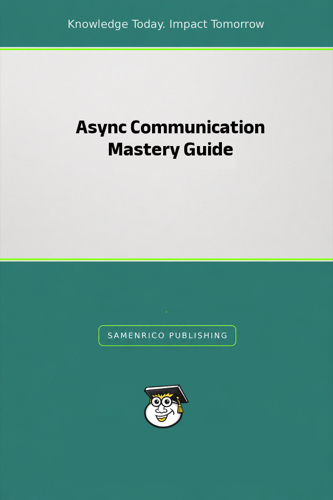
Async Communication Mastery Guide eBook
Write clear Slack messages and emails for differen
Write clear Slack messages and emails for different time zones with this workbook.
Formats
Free sample
Chapter 1: The Ping-Pong Prison--You just lost thirty-seven minutes of your life, and you didn't even notice.Look at your Slack sidebar right now. Count the unread threads. Now check your email. How many messages arrived in the last hour that said nothing more than "Thanks!" or "Following up on this" or a single checkmark emoji? Each one of those cost you something.
Not just the three seconds to read it. The twenty-three minutes it takes to find your flow again afterward.This is the Ping-Pong Prison. And you are serving a life sentence without knowing you were convicted.The term "ping-pong" describes a specific pattern of workplace communication that has become so normal we no longer see it. Someone sends you a message. You reply within minutes—because that's what good teammates do, right?
They reply within minutes. Then they reply to your reply. Back and forth. Back and forth. The ball never stops moving.
Your attention never settles. By 11 AM, you have exchanged forty-seven messages, answered exactly zero complex problems, and feel exhausted despite having accomplished nothing that required deep thought.Here is the truth that no one tells you: faster replies do not make you a better teammate. They make you a more anxious teammate. They make you a more interruptible teammate. They make you a teammate who has confused activity with progress.The Ping-Pong Prison has three walls.
The first wall is the belief that responsiveness equals reliability. Your boss says "I need someone responsive on this project," and you hear "I need someone who replies within three minutes." Those are not the same thing. Reliability means delivering what you promised when you promised it. Responsiveness means reacting immediately to whatever appears in front of you. One produces finished work.
The other produces notification badges.The second wall is the assumption that every message requires an immediate reply. Read the message. Feel the little spike of obligation. Type something—anything—to clear the notification. This is not communication.
This is compulsion. When you reply to a non-urgent message within sixty seconds, you are not being helpful. You are training everyone around you to expect that speed forever. You are building a cage where the bars are other people's expectations.The third wall is the most insidious. It is the belief that if you do not reply instantly, you are failing.
This belief lives in your chest, not your head. It is the feeling that buzzes your phone at 9:47 PM and makes you open Slack even though you are on your couch, even though you are exhausted, even though you know—somewhere in the rational part of your brain—that nothing good happens at 9:47 PM. But you open it anyway. Because what if? What if it is important?
What if they think you are ignoring them? What if you wake up tomorrow and that message is still there, unanswered, like an accusation?This is the Ping-Pong Prison. And this book is the key.The Cost of the Ping-Pong Mentality Let us quantify what you are losing. Not in vague terms like "productivity" or "focus." Let us use numbers that you can feel.The average knowledge worker checks Slack or email every six minutes. Not every six minutes during deep work.
Every six minutes, period. That means if you work eight hours, you interrupt yourself approximately eighty times per day. Each interruption costs an average of twenty-three minutes to fully refocus—not to reply, but to return to the same level of cognitive engagement you had before the interruption. Do the math. Eighty interruptions times twenty-three minutes is 1,840 minutes.
That is thirty hours. Per day. Obviously you cannot interrupt yourself eighty times and also lose twenty-three minutes each time—the math breaks because you never actually get back to deep work. That is the point. You never actually get back to deep work.
You live in a permanent state of shallow, fragmented, reactive attention.The Ping-Pong Prison does not just steal your time. It steals the quality of your time.Here is what the research actually shows. A 2019 study at the University of California, Irvine found that after a three-second interruption, it takes an average of twenty-three minutes and fifteen seconds to return to the original task with the same level of focus. That is not twenty-three minutes to "finish the interruption." That is twenty-three minutes to mentally re-engage with what you were doing before the notification appeared. Most people never reach that state again before the next interruption arrives.
They live in what neuroscientists call "continuous partial attention"—a low-grade, always-on alertness that feels like productivity but produces the cognitive output of someone who has had four drinks.The Ping-Pong Prison costs companies an estimated $588 billion per year in lost productivity. But you do not care about global estimates. You care about your own exhaustion. So let us talk about that.When you live in the Ping-Pong Prison, you experience six specific symptoms. First, you feel busy but not productive.
You move from message to message, task to task, but at the end of the day you cannot name one significant thing you completed. Second, you have trouble remembering what you did yesterday. The days blur together because they are all the same pattern of reaction. Third, you feel guilty when you are not working, even during off-hours, because somewhere in the back of your mind you know there are unread messages waiting. Fourth, you have started working at odd hours—late at night, early morning, weekends—just to find uninterrupted time.
Fifth, you have noticed that your best ideas come when you are in the shower or walking the dog, not when you are sitting at your computer. That is because your computer is now an interruption machine, not a thinking machine. Sixth, you have started to resent your colleagues for messaging you, even though you know they are not doing anything wrong. The resentment is not about them. It is about the system.
But you cannot see the system because you are inside it.This is the Ping-Pong Prison. And you did not build it alone.How the Prison Was Built The Ping-Pong Prison did not appear overnight. It was constructed incrementally, by well-intentioned people using tools designed for a different era.Slack was launched in 2013. Its founders famously described it as a tool that would "kill email" and make work "more fun, more productive, and less stressful." They succeeded at the first goal. Email still exists, but Slack became the primary communication channel for most knowledge workers within five years.
What the founders did not anticipate was that reducing the friction of communication would not reduce the volume of communication. It would increase it. When it takes three seconds to send a message, you send more messages. When you send more messages, you receive more messages. When you receive more messages, you spend more time processing messages.
And when you spend more time processing messages, you have less time for everything else.Email had natural friction. You had to write a subject line. You had to address it to specific people. You had to wait for it to send. You had to open your inbox to…
This is the end of the free sample. Get the eBook to keep going. Buy now
About this book
Details
- Author
- Varney Arlyne
- Publisher
- SamEnrico
- Language
- English
- Genre
- Non-Fiction, Self-Help, Asynchronous Work
- Released
- 2026-06-06
- Pages (approx.)
- 138
- Available as
- eBook, Audiobook

Read better in the ZLOADR app
Your eBooks on your phone or tablet. Sign in with your SamEnrico account and start reading.
More by Varney Arlyne
 Morning Body AwarenessVarney Arlyne$11.99
 The Scarcity Persuasion MethodVarney Arlyne$11.99
 Self Hypnosis for Hernia PainVarney Arlyne$11.99
 Design Thinking for LeadershipVarney Arlyne$11.99
 Curiosity Driven CollaborationVarney Arlyne$11.99
 Self Esteem for Public ServantsVarney Arlyne$11.99
 Structuring Powerful PresentationsVarney Arlyne$11.99
 The Iron Chariots of Qin: How a Technological Revolution Forged an EmpireVarney Arlyne$11.99
 The Dance That Defied the Church: The Secret Renaissance of MovementVarney Arlyne$11.99
 Launching A Youtube Channel For Your Brand UpgradeVarney Arlyne$12.99
 VoIP Provider Selection WorkbookVarney Arlyne$12.99
 How to Produce Collar StaysVarney Arlyne$11.99