
Non-FictionBusiness BriefCode ReviewSoftware Engineering
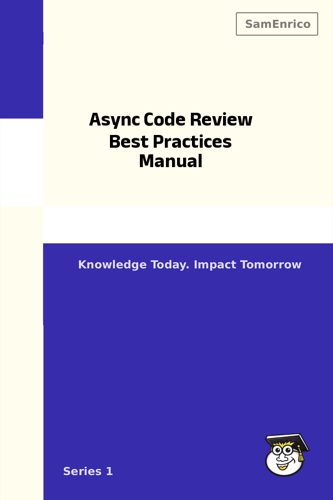
Async Code Review Best Practices Manual Audiobook
Write clear PR descriptions, use review checklists
Write clear PR descriptions, use review checklists, and give actionable feedback asynchronously on GitHub.
Formats
Free sample
Chapter 1: The Small PR Habit...--You have just opened a pull request. It is 2,847 lines of changes. Forty-seven files. Fourteen commits. The title is "Update stuff." The description is blank.
You scroll through the diff for ten minutes, your eyes glazing over by the twenty-fifth file. You close the tab. You tell yourself you will come back to it later. You do not come back to it later. Three days pass.
The author pings you on Slack. You feel guilty. You open the PR again. You skim the remaining twenty-two files in five minutes. You type "LGTM" and click Approve.
You have no idea if the code works. Neither, frankly, does the author.This is not a failure of will. It is not a failure of the reviewer. It is not even a failure of the author, exactly. It is a failure of the process.
The single biggest predictor of a good code review is not the skill of the reviewer, the quality of the tests, or the complexity of the change. It is the size of the pull request. Small PRs are reviewed faster, more thoroughly, and with less frustration. Large PRs are skimmed, approved without real understanding, or rejected outright. And the line between "small" and "large" is far lower than most engineers believe.This chapter is the foundation of everything that follows.
If you take only one lesson from this book, make it this one: keep your pull requests small. Not because small is elegant or tidy, but because small is the only way to get a review that matters.The Data That Changed How We Review In 2006, a team of researchers at Cisco Systems conducted a study that would reshape how the software industry thought about code review. They analyzed thousands of code reviews across hundreds of projects, measuring both the size of the change and the number of defects found. The result was a clear, unambiguous curve.Up to about 200 lines of changes, reviewers found roughly 85 percent of the defects present in the code. Between 200 and 400 lines, defect detection dropped to about 75 percent.
Between 400 and 1,000 lines, it fell to around 60 percent. Beyond 1,000 lines, defect detection plummeted to below 30 percent—barely better than random chance. Reviewers were rubber-stamping.Follow-up studies at Google and Microsoft confirmed the finding. In 2015, a large-scale analysis of code review data from both companies found that the optimal…
This is the end of the free sample. Get the Audiobook to keep going. Buy now
About this book
Details
- Author
- Ellsworth Altagracia
- Publisher
- SamEnrico
- Language
- English
- Genre
- Non-Fiction, Business Brief, Code Review, Software Engineering
- Released
- 2026-06-09
- Pages (approx.)
- 91
- Available as
- eBook, Audiobook

Listen in the VoxFlicks app
Audiobooks and audio dramas wherever you go. Sign in with your SamEnrico account and press play.
More by Ellsworth Altagracia
 Polysubstance Use with OpioidsEllsworth Altagracia$11.99
 Mentorship for Imposter RecoveryEllsworth Altagracia$11.99
 TM Creativity UnblockEllsworth Altagracia$11.99
 Emotional Intelligence for TherapistsEllsworth Altagracia$11.99
 The Duchess's Secret War: A Spy in the Court of George IIIEllsworth Altagracia$11.99
 Echoes of the Argo: The Lost Generation Ship of 2087Ellsworth Altagracia$11.99
 How to Start a Breed Society Business (Beginners Guide)Ellsworth Altagracia$11.99
 ADA Compliance Post COVIDEllsworth Altagracia$12.99
 Bundle Products Free GuideEllsworth Altagracia$12.99
 Understanding Cranioa–craniomEllsworth Altagracia$17.99
 Event Waiver Collection/verificationEllsworth Altagracia$11.99
You may also like
 Hong Kong Handover 1997Dunn Johnnie$11.99
 Zumba For Postnatal Recovery CourseNeal Christian$11.99
 Zumba for BeginnersLadner Nikia$11.99
 YouTube Comment Mining GuideHumes Pandora$12.99
 Worry Box MeditationCarlin Rudy$11.99
 Workplace Stress MeditationNguyen Lynn$11.99
 Workplace Stress and Sleep RepairHawley Ivory$11.99
 Workplace Perfectionism CureDelaney Jeffry$11.99
 Workplace Injustice Anger GuideWallen Isabelle$11.99
 Work Addiction and Burnout LinkGreenwood Ester$11.99
 Women in Yoga and WellnessBeattie Galina$11.99
 Women in Stand Up ComedyChun Evangeline$11.99