
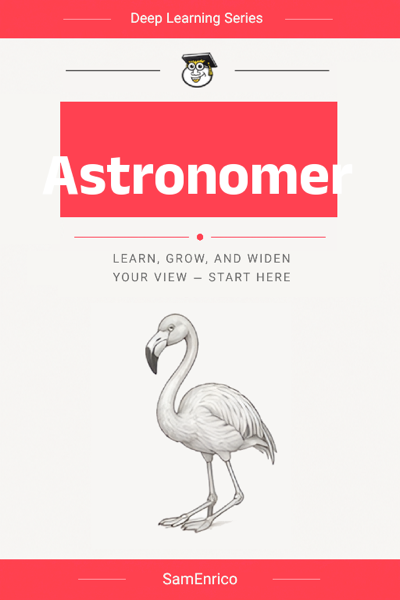
Astronomer eBook
A Coursebook on Astronomer
by See Donita
A Coursebook on Astronomer
Formats
Free sample
Chapter 1: The Ancestral Urge...--–- Every human who has ever looked up on a clear night has felt it: a wordless pull toward the pinpricks of light scattered across the darkness. Before writing, before agriculture, before the first cities rose from the earth, our ancestors were already astronomers. They had no telescopes, no computers, no language for atoms or galaxies. But they watched. They remembered.
They passed down what they saw. This chapter traces that long arc – from the myth-making stargazers of prehistory to the data-driven scientists of today – while also being honest about what this book is and who it is for.This is not a textbook for professional astrophysicists. It will not turn you into a tenured professor or a principal investigator on a NASA mission. What it will do is give you something rarer and, in many ways, more precious: the ability to step outside on any clear night, anywhere from a light-polluted city to a remote mountain, and know what you are looking at. You will learn the constellations as neighbors.
You will understand why the Moon rises an hour later each night. You will know how to find Saturn’s rings with a telescope you can carry in one hand. You will develop the patience to see faint fuzzies that most people never even know exist. And along the way, you will join a lineage that stretches back tens of thousands of years – the lineage of people who have looked up and asked: what are those lights?The First Astronomers: Survival and the Sky Long before the word “science” existed, the sky was a tool. For hunter-gatherers, knowing when the cold would come or when the herds would migrate was a matter of life and death.
The sky provided a calendar more reliable than any memory. The reappearance of certain stars marked the seasons. The phases of the Moon tracked the months. The Sun’s arc across the sky told the hours.Consider the Paleolithic cave paintings of Lascaux, France, dated to roughly 17,000 years ago. Among the bison, horses, and deer painted on the cave walls, some researchers have identified what look like star charts.
A bull’s eye may represent the Pleiades cluster. A bird on a staff may mark the summer solstice. Whether deliberate or coincidence, the pattern is striking: our ancestors painted the sky alongside the animals they hunted.More certain evidence comes from the Nebra Sky Disc, a bronze artifact from Germany dated to about 1600 BCE. Roughly the size of a dinner plate and colored blue-green with gold inlays, it depicts the Sun or Moon, a crescent Moon, and a cluster of seven stars widely agreed to be the Pleiades. Two golden arcs on opposite edges mark the solstices – the points where the Sun stops its northward or southward drift and reverses direction.
This is not art for art’s sake. This is functional astronomy. The Pleiades appear in the autumn sky in the Northern Hemisphere, signaling the time for harvest. The solstice marks reset the agricultural calendar. The Nebra Sky Disc is proof that Bronze Age Europeans understood seasonal astronomy well enough to encode it in metal.Elsewhere in the world, similar knowledge flourished.
In Mesopotamia, Babylonian scribes recorded the motions of Venus on clay tablets in cuneiform script, noticing that the planet’s appearances repeated in predictable cycles. They called Venus the “bright queen of the sky” and understood that its morning and evening appearances were the same object – a non-obvious conclusion when Venus disappears for weeks at a time. In Egypt, the heliacal rising of Sirius (its first appearance in the dawn sky after being lost in the Sun’s glare) announced the annual flooding of the Nile, the most important event in Egyptian agriculture. Temples were aligned to the rising points of specific stars; the great pyramid at Giza has air shafts pointing toward the then-north star, Thuban.In China, astronomers kept continuous records of comets, “guest stars” (supernovae), and sunspots for millennia. A Chinese record from July 4, 1054 CE describes a “guest star” in the constellation Taurus so bright that it was visible in daylight for twenty-three days.
That guest star was the supernova that created the Crab Nebula, a cloud of expanding gas still visible today in small telescopes. In Central America, the Maya developed a complex calendar system based on precise observations of Venus and the Moon, achieving an accuracy that rivals modern calculations. At Chichén Itzá, the pyramid of El Castillo is aligned so that during the spring and autumn equinoxes, shadows cast by the setting Sun create the illusion of a serpent slithering down the staircase.What unites all these ancient cultures is not the sophistication of their mathematics – though some was impressive – but their motivation. They watched the sky because their lives depended on it. When to plant, when to harvest, when to move, when to perform religious ceremonies: the sky answered these questions.
Astronomy was not a separate discipline. It was woven into agriculture, religion, navigation, and governance.The Celestial Sphere: A Necessary Fiction Before we go any further, we need a shared mental model of the sky. Astronomers use a concept called the celestial sphere. Imagine a giant, hollow sphere surrounding Earth, with Earth at its exact center. Now imagine that all the stars, the Sun, the Moon, and the planets are stuck to the inside surface of this sphere.
When Earth rotates, the sphere appears to spin in the opposite direction – east to west – carrying the stars across the sky.The celestial sphere is a fiction, of course. Stars are not stuck to a sphere; they lie at vastly different distances. The Sun does not orbit Earth; Earth orbits the Sun. But for the purpose of finding things in the night sky, the celestial sphere is exceptionally useful. It turns a three-dimensional universe into a two-dimensional map, like projecting a globe onto a flat wall.The celestial sphere has a north pole and a south pole, directly above Earth’s north and south poles.
It has a celestial equator, the projection of Earth’s equator into space. Stars near the celestial equator rise in the east and set in the west, tracing long arcs across the sky. Stars near the celestial poles never rise or set at all if you live at mid-northern latitudes – they circle the pole in tight loops, always remaining above the horizon. These are called circumpolar stars. The farther north you go, the more stars become circumpolar.
At the North Pole itself, every visible star is circumpolar, and the sky rotates around the zenith point once every 24 hours.To navigate this sphere, we need coordinates. Modern astronomy uses a system called equatorial coordinates, analogous to the latitude and longitude you might use on Earth. The celestial equivalent of latitude is declination (Dec) , measured in degrees north or south of the celestial equator. The north celestial pole is at Dec +90°; the south celestial pole at Dec –90°; the celestial equator at Dec 0°. The equivalent of longitude is right ascension (RA) , measured in hours, minutes, and seconds eastward from a reference point called the vernal equinox.
There are 24 hours of RA around the full circle, with each hour equal to 15 degrees. A star with…
This is the end of the free sample. Get the eBook to keep going. Buy now
About this book
Details
- Author
- See Donita
- Publisher
- SamEnrico
- Language
- English
- Genre
- Non-Fiction, Informative, Educational
- Released
- 2026-05-06
- Pages (approx.)
- 131
- Available as
- eBook, Audiobook

Read better in the ZLOADR app
Your eBooks on your phone or tablet. Sign in with your SamEnrico account and start reading.
More by See Donita
 The Creative FamineSee Donita$11.99
 Pomodoro Technique Distraction Control WorkbookSee Donita$11.99
 Psychology Essay PromptsSee Donita$11.99
 The Sleep Chronotype Memory GuideSee Donita$11.99
 Birdnesting Divorce GuideSee Donita$11.99
 The Hydaspes Gambit: Alexander’s Last Stand in IndiaSee Donita$11.99
 Retail Strategic BuyersSee Donita$12.99
 QuickBooks Accountant AccessSee Donita$12.99
 Understanding Placenta NeoplasmSee Donita$17.99
 How to Start a Operation of Recreational Transport Facilities E.g. Marinas Business (Beginners GuideSee Donita$11.99