
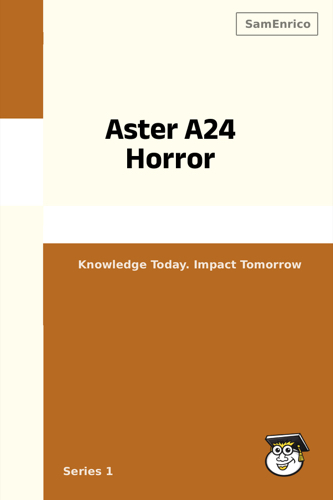
Aster A24 Horror eBook
Hereditary and Midsommar director's folk terror.
Hereditary and Midsommar director's folk terror.
Formats
Free sample
Chapter 1: The Unholy Inheritance--What is it about the mud?When film scholars speak of folk horror, they almost always begin with the mud. The wet, sucking, ancient earth of the British countryside. The mud that stains the white dress of the witchfinder’s daughter. The mud that clings to the bare feet of the pagan dancers. The mud that smells of peat and decay and something older than Christianity.
For fifty years, the critical consensus has been that folk horror is a genre of landscape—specifically, the rural landscape as a site of atavistic terror. The city has its slashers and its giallo killers, the argument goes, but the country has something worse: it has memory. The land remembers what was buried. And eventually, the land demands it back.But what happens when there is no mud?What happens when the horror takes place not in a remote Scottish island or a cursed English village, but in a suburban split-level home with a two-car garage and a therapist’s office on the ground floor? What happens when the pagan cult gathers not in a stone circle at midnight, but in a sun-drenched Swedish meadow at two in the afternoon, wearing flower crowns and smiling?
Ari Aster’s answer is as simple as it is devastating: the mud was never the point. The mud was always a metaphor. And the metaphor has finally caught up with us.This chapter establishes the genealogical foundation for everything that follows. Before we can understand how Aster rewrites the rules of folk terror, we must first understand the rules he inherited. The "Unholy Trinity" of 1970s British folk horror—Michael Reeves’ Witchfinder General (1968), Piers Haggard’s The Blood on Satan’s Claw (1971), and Robin Hardy’s The Wicker Man (1973)—did not simply invent a genre.
They diagnosed a cultural anxiety that has only intensified in the half-century since. And Ari Aster, whether he knows it or not, is their American heir.But here is the crucial distinction that will govern this entire book. Traditional folk horror—the Unholy Trinity and its descendants—is defined by three coordinates: rural isolation, the clash between Christian order and pagan survival, and the horrifying suggestion that the "monsters" may be happier than the protagonists. Aster’s folk terror shares the DNA but transplants it into new soil: the suffocating suburban home (Hereditary) and the sun-drenched European commune (Midsommar). The Christian/pagan binary is replaced by a new conflict between secular modernity and ritualistic belonging.
The mud becomes wall-to-wall carpeting. The stone circle becomes a model living room. And the question is no longer "Will Christianity survive the old gods?" but "Was there ever anything there to begin with?"Let us begin in the mud.The Unholy Trinity: A Refresher Course in Dread Before Hereditary made audiences too afraid to look at a telephone pole, before Midsommar made flower crowns synonymous with emotional manipulation, there was a peculiar cluster of British films in the late 1960s and early 1970s that seemed to emerge from the same psychic wound. These films were not a formal movement—their directors did not exchange manifestos or share production companies—but they shared an unmistakable sensibility. Critics would later retroactively baptize them as the "Unholy Trinity," and the name stuck because it captured something essential about their effect.
These were not horror films that merely scared you. They were horror films that converted you, or at least made you worry that conversion might be preferable to the alternative.Michael Reeves’ Witchfinder General (1968) is the darkest of the three, and in many ways the most difficult to watch. Set during the English Civil War, it follows Matthew Hopkins, a real historical figure who styled himself the "Witchfinder General" and traveled from town to town, extracting confessions through torture and sending hundreds of women to the gallows. The film is not supernatural. There are no demons, no possession sequences, no levitating beds.
The horror is entirely human: a petty, sadistic bureaucrat with a legal loophole and a talent for cruelty. Reeves films the torture scenes with a documentary flatness that makes them almost unwatchable. When the witchfinder drives a spike into a woman’s leg to test for the "devil’s mark," the camera does not flinch. The audience flinches for it.But Witchfinder General is folk horror because of what it does with landscape. The film is shot in the Suffolk countryside, and Reeves makes the mud and the mist and the endless grey skies into active participants in the terror.
This is not the picturesque England of tourist brochures. This is the England of enclosures and poverty and desperate superstition. When the villagers accuse each other of witchcraft, they are not simply being irrational. They are responding to a world that offers them no other framework for understanding their suffering. The film’s most chilling line comes from Hopkins himself, speaking to a priest who protests the executions: "You have your Bible.
I have my act of Parliament." The old magic of faith has been replaced by the new magic of the law. Both, the film suggests, are equally capable of burning you alive.Piers Haggard’s The Blood on Satan’s Claw (1971) takes the opposite approach. Where Witchfinder General is grim and procedural, The Blood on Satan’s Claw is delirious and dreamlike. The plot, such as it is, concerns a rural English village in the 18th century where teenagers begin unearthing the remains of a demonic creature—a "thing" with fur and claws and one remaining eye. The creature does not so much possess the teenagers as inspire them.
They form a cult, perform rituals, and gradually transform into something no longer fully human. The film is famous for its imagery: a girl growing a fur pelt on her shoulder, a boy’s hand mutating into a claw, a Satanic mass conducted in a ruined chapel by candlelight.What makes The Blood on Satan’s Claw essential to the folk horror canon is its treatment of youth. The adults in the film are useless—skeptical, distracted, too busy with their own concerns to notice that their children are worshipping a demon in the woods. This will become a recurring theme in the genre, and Ari Aster will update it brutally in Hereditary’s portrayal of the therapist father who cannot see what is happening in his own home. The horror of The Blood on Satan’s Claw is that the cult is not forced on the teenagers.
They choose it. They find something in the demon’s worship—community, ecstasy, purpose—that their mundane village lives cannot provide. The film never quite decides whether this is tragic or liberating. That ambiguity is its greatest inheritance to Aster.Robin Hardy’s The Wicker Man (1973) is the masterpiece of the three, and the film to which Midsommar is most obviously indebted. A devout Christian policeman, Sergeant Howie, travels to the remote Scottish island of Summerisle to investigate a report of a missing girl.
He finds a community that has abandoned Christianity in favor of a reconstructed pagan fertility cult. They dance around maypoles, engage in ritualized sex, and sing bawdy songs in the pub. Howie…
This is the end of the free sample. Get the eBook to keep going. Buy now
About this book
Details
- Author
- Horner Erlene
- Publisher
- SamEnrico
- Language
- English
- Genre
- Non-Fiction, Biography, A24
- Released
- 2026-06-08
- Pages (approx.)
- 145
- Available as
- eBook, Audiobook

Read better in the ZLOADR app
Your eBooks on your phone or tablet. Sign in with your SamEnrico account and start reading.
More by Horner Erlene
 Housing Insecurity Sleep GuideHorner Erlene$11.99
 Manager Burnout PreventionHorner Erlene$11.99
 Workaholism in PharmacyHorner Erlene$11.99
 Emergency Oxygen and CPR KitHorner Erlene$11.99
 Deep Sea Cave Escape ManualHorner Erlene$11.99
 Anger Management for Temp WorkersHorner Erlene$11.99
 Red Pyramid GuideHorner Erlene$11.99
 Seniors Memory PalaceHorner Erlene$11.99
 Prometheus Unbound: The Titan’s Last DefianceHorner Erlene$11.99
 Pillars of Power: The Untold Story of Eli Lilly’s Rise to DominanceHorner Erlene$11.99
 Crowns & Crosses: The Scandal That Split a DynastyHorner Erlene$11.99
 Next-Generation Crypto AI Prompt SystemsHorner Erlene$11.99
You may also like
 Hong Kong Handover 1997Dunn Johnnie$11.99
 Zumba For Postnatal Recovery CourseNeal Christian$11.99
 Zumba for BeginnersLadner Nikia$11.99
 YouTube Comment Mining GuideHumes Pandora$12.99
 Worry Box MeditationCarlin Rudy$11.99
 Workplace Stress MeditationNguyen Lynn$11.99
 Workplace Stress and Sleep RepairHawley Ivory$11.99
 Workplace Perfectionism CureDelaney Jeffry$11.99
 Workplace Injustice Anger GuideWallen Isabelle$11.99
 Work Addiction and Burnout LinkGreenwood Ester$11.99
 Women in Yoga and WellnessBeattie Galina$11.99
 Women in Stand Up ComedyChun Evangeline$11.99