
Non-FictionSelf-HelpRisk Mitigation
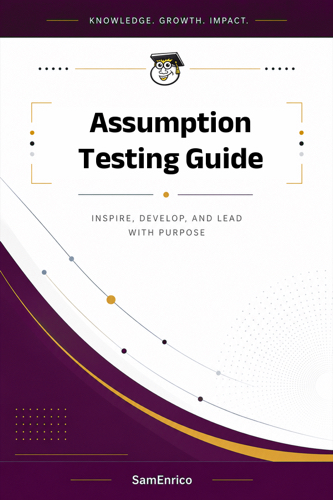
Assumption Testing Guide eBook
Identify and validate risky assumptions using this
by Rupp Antione
Identify and validate risky assumptions using this design thinking workbook.
Formats
Free sample
Chapter 1: The Billion-Dollar Blindspot--–- On a rainy Wednesday in November 2014, a forty-three-year-old engineer named Alex stood in front of a whiteboard in a San Francisco loft and drew a simple graph. On the vertical axis, he wrote “Customer Interest.” On the horizontal axis, he wrote “Time.” Then he drew a steep, jagged line that climbed dramatically before plummeting off a cliff.“This,” he said to his three co-founders, “is the next six months of our lives if we don’t figure out what we’re actually assuming.”His team had just raised two million dollars in seed funding. They had a prototype. They had a waiting list of three hundred potential users. They had a term sheet for another five million.
And they had no idea whether any of it would work, because they had never stopped to ask the most basic question of all: What do we believe to be true that might actually be false?That graph on the whiteboard became the unlikely origin story of a methodology that would eventually save not just their company, but hundreds of others. The startup, which I will call Verge, went on to a successful acquisition. The engineer became a venture capitalist. And the whiteboard drawing evolved into the framework you are about to learn. But the lesson of that rainy Wednesday remains unchanged: the difference between a product that soars and a product that sinks is almost never execution, talent, or funding.
It is the invisible web of assumptions that every team weaves around their idea, often without even realizing they are doing it.The Most Expensive Word in Business Let me tell you about the most expensive word in business. It is not “layoff.” It is not “lawsuit.” It is not even “failure.” The most expensive word in business is a simple, four-letter word that appears in every pitch deck, every strategy document, and every product roadmap: “assume.”As in, “We assume customers will pay for this.” “We assume the technology is ready.” “We assume the competition won’t respond.” “We assume the market will grow.” “We assume users will figure it out.”Each time that word appears, it represents a bet. And most bets are being placed without anyone examining the odds. In fact, the situation is worse than that. Most teams are not even aware they are betting.
They mistake their assumptions for facts. They confuse their beliefs with reality. And by the time they discover the difference, the money is gone.Here is a thought experiment. Think about the project you are currently working on, or the project you are about to start. Write down everything you believe to be true about it.
Your customers. Their problems. Their willingness to pay. Your ability to deliver. The competition.
The timing. Write it all down. Now look at that list and ask yourself: Which of these statements have you actually verified with evidence? Which are just things you believe because you want them to be true?If you are like ninety percent of the people who do this exercise, less than twenty percent of your beliefs are backed by direct, recent, behavioral evidence. The rest are assumptions.
And some of those assumptions, if you are unlucky, are the kind that can kill your entire project.The Three Graveyards I have spent the last decade studying product failures. Not the high-profile disasters that make the front page of Tech Crunch, but the quiet, ordinary failures that happen every day in companies of every size. The enterprise software project that gets cancelled after two years of development. The consumer app that never breaks a thousand downloads. The internal tool that nobody uses.
The feature that took six months to build and was turned off after six weeks.In every single case, the root cause traces back to an assumption. And those assumptions almost always fall into one of three categories. I call them the Three Graveyards.Graveyard One: The Desire Assumption This is the assumption that someone actually wants what you are building. It sounds obvious, but it is violated more than any other. Teams assume desirability based on their own preferences, based on a few friendly conversations, based on a competitor’s existence, or based on nothing at all.The Desire Assumption is particularly dangerous because it feels true.
Of course people want a better way to do X. Of course they want a cheaper alternative to Y. Of course they want a solution to the problem that annoys you every day. But “of course” is not data. “Obviously” is not evidence.
And “everyone knows” is the battle cry of the bankrupt.Here is the brutal truth: most problems are not problems that people will pay to solve. Most annoyances are not annoyances that people will change their behavior to fix. Most “pain points” are not painful enough to overcome the inertia of existing habits. And the only way to know the difference is to test your Desire Assumption directly, with real customers, using real behavior as your metric.Graveyard Two: The Build Assumption Once a team decides that people want something, they immediately jump to the Build Assumption: the belief that they can actually deliver what people want, with their resources, on their timeline, within their constraints.The Build Assumption has many faces. “We can build that in three months.” “We have the engineering talent to handle the scale.” “The regulatory environment will not change.” “Our supply chain will hold up.” “The API will stay available.” “The platform will approve our app.”Each of these is a bet about the physical, technical, or organizational world.
And each one can fail in spectacular ways. The team that assumes they can build something in three months often takes nine. The team that assumes their database can handle a thousand concurrent users often crashes at five hundred. The team that assumes their partner will keep their API free often discovers a price increase the week before launch.The Build Assumption is seductive because it is about things you control. You can hire more engineers.
You can buy more servers. You can negotiate with partners. But control is not certainty. And the gap between “we can probably do this” and “we have done this” is where projects go to die.Graveyard Three: The Value Assumption The most sophisticated and dangerous graveyard is the Value Assumption. This is the belief that even if people want your product and even if you can build it, they will value it enough to give you something in return—money, time, attention, data, or loyalty.The Value Assumption is where business models collapse.
Customers might want your product. They might even use it. But will they pay for it? Will they pay enough to cover your costs? Will they pay repeatedly?
Will they refer others? Will they choose you over a free alternative? Will they stay when a competitor offers a better deal?These are not questions you can answer with a survey. People say they will pay far more than they actually will. People say they love a product and then never open it again.
People say they would never switch and then switch within a week. The Value Assumption requires behavioral evidence: actual transactions…
This is the end of the free sample. Get the eBook to keep going. Buy now
About this book
Details
- Author
- Rupp Antione
- Publisher
- SamEnrico
- Language
- English
- Genre
- Non-Fiction, Self-Help, Risk Mitigation
- Released
- 2026-06-06
- Pages (approx.)
- 129
- Available as
- eBook, Audiobook

Read better in the ZLOADR app
Your eBooks on your phone or tablet. Sign in with your SamEnrico account and start reading.
More by Rupp Antione
 Leftover Reinvention GuideRupp Antione$11.99
 Social Security Caregiver GuideRupp Antione$11.99
 Loneliness in Accessible HousingRupp Antione$11.99
 The Immigrant Gaming StudioRupp Antione$11.99
 SAD Versus Depression DiagnosisRupp Antione$11.99
 Grit for AccountantsRupp Antione$11.99
 Distraction Free Morning RoutineRupp Antione$11.99
 The Iron Fists of Pentridge: Australia's First Prison WarsRupp Antione$11.99
 Ragnarok’s Whisper: Odin’s Forgotten Lessons from the BifrostRupp Antione$11.99
 Service Providers Guide to Direct SalesRupp Antione$11.99
 How to Start a Agricultural Machinery Hire (without Operator) Business (Beginners Guide)Rupp Antione$11.99
 How to Produce Laundry BallsRupp Antione$11.99
You may also like
 Hong Kong Handover 1997Dunn Johnnie$11.99
 Zumba For Postnatal Recovery CourseNeal Christian$11.99
 Zumba for BeginnersLadner Nikia$11.99
 YouTube Comment Mining GuideHumes Pandora$12.99
 Worry Box MeditationCarlin Rudy$11.99
 Workplace Stress MeditationNguyen Lynn$11.99
 Workplace Stress and Sleep RepairHawley Ivory$11.99
 Workplace Perfectionism CureDelaney Jeffry$11.99
 Workplace Injustice Anger GuideWallen Isabelle$11.99
 Work Addiction and Burnout LinkGreenwood Ester$11.99
 Women in Yoga and WellnessBeattie Galina$11.99
 Women in Stand Up ComedyChun Evangeline$11.99