
Non-FictionInformativeEducational
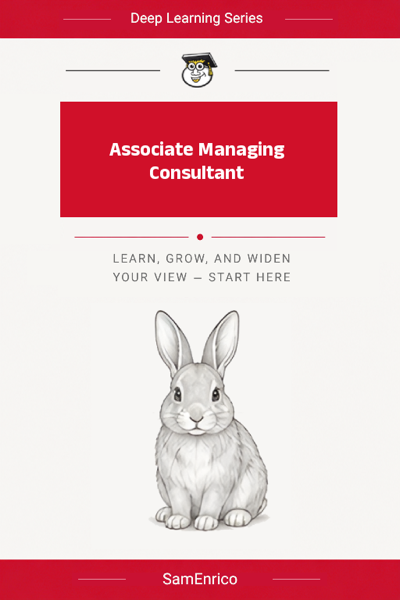
Associate Managing Consultant eBook
A Coursebook on Associate Managing Consultant
A Coursebook on Associate Managing Consultant
Formats
Free sample
Chapter 1: The Translator’s Curse...--–- The promotion that puts you in charge of nothing and accountable for everything.You just got promoted. Or maybe you were hired into this role from an MBA program. Or perhaps you are the high-performing senior analyst who finally got the nod. Whatever your path, you now hold a title that sounds important—Associate Managing Consultant—but feels suspiciously like being handed a map with no legend and a compass that points in three directions at once.Welcome to the Frozen Middle.Not the middle of the org chart, though you are there too. The Frozen Middle is a condition, not a position.
It is the suffocating space between two impossible forces: above you, a Partner who speaks in vague imperatives (“Fix operations,” “Look into churn,” “Drive growth”) and below you, an Analyst who needs specific instructions (“Which spreadsheet? Which date range? What do you actually want?”). You are the translator. The interpreter.
The person who absorbs ambiguity and outputs clarity. And you have to do it without a net, without a script, and without letting either side know that you are making up the bridge as you walk across it.This chapter is about that specific hell—and the specific skills that get you out of it alive.The core tension of the Associate role is not the hours, though the hours are brutal. It is not the travel, though the travel erodes your soul. It is the existential vertigo of being responsible for outcomes you cannot control. The Partner controls the relationship with the client.
The Analyst controls the accuracy of the data. You control... the translation between them. That is it. That is the job.And yet, when something goes wrong, who does the Partner call?
You. When something is unclear, who does the Analyst ask? You. You are the pressure point. The bottleneck.
The one person who cannot say “I don’t know” because if you don’t know, the whole machine stops.Most new Associates respond to this pressure in one of two ways, both of which fail spectacularly.The Two Failed Paths The first failed path is over-specification. You become a control freak. You write every email as if it were a legal contract. You assign tasks with 17 bullet points, three attachments, and a deadline measured in hours. Your Analysts hate you because you treat them like children.
Your Partner is confused because you keep asking for clarification on things that “should be obvious.” You burn out because you are doing the work of three people—thinking like the Partner, executing like the Analyst, and managing like a drill sergeant.The second failed path is under-specification. You become a people-pleaser. You nod when the Partner speaks, even when you have no idea what they mean. You tell your Analysts “just explore” because you do not want to limit their creativity. Your Analysts boil the ocean and return with 200 charts and no conclusion.
Your Partner asks “Why isn’t this done?” You have no answer. You burn out because you are constantly cleaning up messes that could have been prevented with five minutes of clarity up front.There is a third path. It is narrow, uncomfortable, and requires a specific kind of discipline. But it works.The Russian Doll Method of Scoping You cannot eliminate ambiguity. Ambiguity is the raw material of consulting—the Partner does not know the answer, which is why they hired you.
But you can contain ambiguity. You can take a vague statement like “Fix operations” and turn it into a structured work plan without knowing the answer yourself.The Russian Doll Method works like this. Imagine a set of nested dolls. The outermost doll is the Partner’s intent—big, vague, and frustrating. Your job is to open that doll, look inside, and find the next layer.
Then open that one. Then the next. Until you reach the smallest doll, which is a task that an Analyst can execute without asking you a single clarifying question.Outer doll (Partner’s intent): “Fix operations.” This is unusable. It is not a task. It is a prayer.Middle doll (Your translation): “We will diagnose three operational bottlenecks: procurement, logistics, and staffing.” This is still vague, but it is directional.
It gives the team a hunting ground.Inner doll (Analyst’s task, calibrated by experience): Now you make a judgment call. How experienced is your Analyst?If the Analyst is new—less than three months in the role—you go all the way to the smallest doll: “Pull last twelve months of supplier lead times for the top ten SKUs. Use the procurement database. Sort by month. Send me the table by 3 PM.” This Analyst cannot handle ambiguity yet.
Do not give them any.If the Analyst is experienced—more than three months, proven track record—you stop one layer higher: “Test whether procurement lead times are the primary bottleneck. Here is the data source. Come back with a yes/no and supporting evidence by 3 PM.” This Analyst can handle a hypothesis. Let them.The mistake most new Associates make is treating all Analysts the same. They do not.
A new Analyst needs a recipe. An experienced Analyst needs a mission. Learn the difference or watch your team fail.The Five-Question Test Before Every Assignment Before you assign any task, ask yourself five questions. Write them on a sticky note and put it on your monitor until the habit becomes automatic.“If my Analyst does exactly what I say, will the Partner get the answer they need?” If the answer is no, you have not scoped deeply enough. Keep breaking it down.“Is this Analyst new or experienced?” If new, go to the smallest doll.
If experienced, stop at the hypothesis layer.“What is the earliest moment I can check their work without micromanaging?” For a new Analyst, check after two hours. For an experienced Analyst, check at the end of the day. The goal is to catch errors early without hovering.“What would success look like in one sentence?” If you cannot answer this, you do not understand your own assignment. Write that sentence down and give it to the Analyst.“What is the one thing that could go wrong that I am not seeing?” This is not paranoia. This is risk management.
Name the risk. Plan for it. Then assign the task.The Real-World Example That Will Save Your Weekend Let me tell you about my second week as an Associate. I was twenty-six years old, freshly promoted, and desperate to prove myself. The Partner—a fifty-three-year-old former Marine with zero patience for ambiguity—called me into his office.“Look into customer churn,” he said.That was it.
Three words. No context. No data source. No definition of “churn.” No timeline.I walked out of his office, heart pounding, and found my Analyst. She was twenty-three, brilliant, and had been with the firm for eight months.
I said: “The Partner wants us to look into customer churn. Go run a regression on all the customer data and see what you find.”She looked at me like I had just asked her to build a rocket…
This is the end of the free sample. Get the eBook to keep going. Buy now
About this book
Details
- Author
- Winkler Edgardo
- Publisher
- SamEnrico
- Language
- English
- Genre
- Non-Fiction, Informative, Educational
- Released
- 2026-06-03
- Pages (approx.)
- 135
- Available as
- eBook, Audiobook

Read better in the ZLOADR app
Your eBooks on your phone or tablet. Sign in with your SamEnrico account and start reading.
More by Winkler Edgardo
 The Workaholic's Exercise PrescriptionWinkler Edgardo$11.99
 Lester Flatt G Run GuideWinkler Edgardo$11.99
 Emotional Intelligence In MentoringWinkler Edgardo$11.99
 The Anger Pattern RecognitionWinkler Edgardo$11.99
 Creative Warm Ups for TeamsWinkler Edgardo$11.99
 The Great British Tea Strike: How a 1977 Walkout Brewed a RevolutionWinkler Edgardo$11.99
 Rhythm of the Sun God: The Untold Story of the Aztec Musician Who Defied EmpiresWinkler Edgardo$11.99
 Government Grant Tracker GuideWinkler Edgardo$12.99
 Automation Investment GuideWinkler Edgardo$12.99
 Understanding Fructosemia, HereditaryWinkler Edgardo$17.99
 How to Start a Site Preparation Contractor BusinessWinkler Edgardo$11.99
You may also like
 Hong Kong Handover 1997Dunn Johnnie$11.99
 Zumba For Postnatal Recovery CourseNeal Christian$11.99
 Zumba for BeginnersLadner Nikia$11.99
 YouTube Comment Mining GuideHumes Pandora$12.99
 Worry Box MeditationCarlin Rudy$11.99
 Workplace Stress MeditationNguyen Lynn$11.99
 Workplace Stress and Sleep RepairHawley Ivory$11.99
 Workplace Perfectionism CureDelaney Jeffry$11.99
 Workplace Injustice Anger GuideWallen Isabelle$11.99
 Work Addiction and Burnout LinkGreenwood Ester$11.99
 Women in Yoga and WellnessBeattie Galina$11.99
 Women in Stand Up ComedyChun Evangeline$11.99