
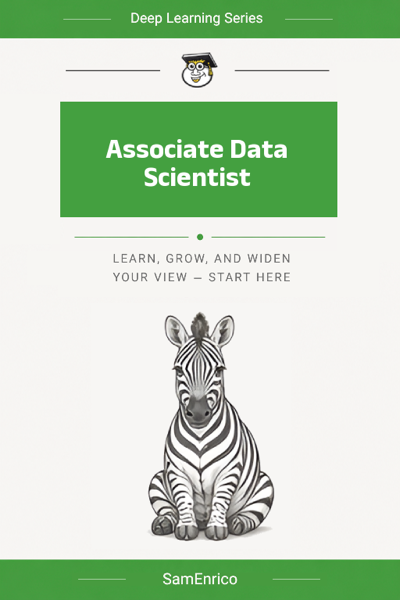
Non-FictionInformativeEducational
Associate Data Scientist eBook
A Coursebook on Associate Data Scientist
by Cone Logan
A Coursebook on Associate Data Scientist
Formats
Free sample
Chapter 1: The Question Habit...--–- The email arrived at 11:47 PM on a Tuesday. Sarah, a newly hired Associate Data Scientist at a mid-sized retail company, stared at her screen. Her manager had written just two sentences: “Sales are down 8% this quarter. Please analyze by Friday.” Sarah’s first instinct was to open a Jupyter notebook, import Pandas, and start plotting sales trends by region, by product, by month. She was fast—her Python skills were sharp, and she could generate a dozen charts in an hour.
But something stopped her. She remembered a line from her training: “The best data scientists are not the ones who write code fastest. They are the ones who ask better questions before writing a single line.” She closed the notebook and opened a blank document instead. At the top, she wrote: “What do I actually need to know?” Below that, she listed: “Compared to what time period? Which customer segments?
Which product categories? Is 8% statistically significant, or is it normal quarterly variation? What actions can the business take based on different answers?” By morning, she had reframed her manager’s vague panic into five concrete, answerable data questions. She spent the next two days answering exactly those questions—not exploring tangents, not building unnecessary models. Her final report was three pages, not thirty.
Her manager called it “the most useful analysis I have received in years.” Sarah was promoted six months later. Her colleague, who had spent the same two days building an elaborate neural network that predicted sales with 92% accuracy but couldn’t explain why sales dropped, was not.This chapter is about becoming Sarah—not the fastest coder in the room, but the most valuable thinker. Before you write a pip install command, before you import a single library, before you split your first train-test set, you need to master the most important skill in data science: framing. Framing is the art of turning a vague business problem into a specific, answerable data question. It is the difference between busy work and impactful work.
It is what separates an Associate Data Scientist who gets promoted from one who gets more tickets in Jira.In this chapter, you will learn why technical skill without business context is worthless. You will learn the Data Science Lifecycle—a five-phase roadmap that keeps you from wandering into dead ends. You will learn to spot ethical pitfalls like sampling bias and proxy discrimination before they poison your analysis. And you will learn the single most valuable habit of effective data scientists: the question habit—the discipline of asking “why?” five times before you write any code.By the end of this chapter, you will understand that your primary value as an Associate Data Scientist is not building models faster than anyone else. It is asking better questions than anyone else.The Cost of Asking the Wrong Question Let’s start with a story about the opposite of Sarah.
A large hospital system hired a team of data scientists to build a predictive model. The business problem, as stated by the executives, was: “Patients keep missing appointments. Build a model to predict which patients will no-show so we can send reminders.” The team built a sophisticated gradient-boosted tree model. It achieved 85% accuracy. They deployed it to production.
It was useless.Why? Because the executives had asked the wrong question. The real problem was not “which patients will no-show?” but “why do patients no-show, and what interventions can we change?” The model predicted no-shows with high accuracy, but it predicted them using features the hospital could not change: age, chronic conditions, distance from the hospital, previous no-show history. The model told the hospital that a 72-year-old diabetic who lived 15 miles away had an 87% chance of no-show. The hospital already knew that.
What they needed was a model that helped them intervene: “If we send a text reminder 48 hours before versus 24 hours, does it change the probability? If we offer a telehealth option, does it change the probability? If we schedule at 10 AM instead of 2 PM, does it change the probability?” The team had built a descriptive model when they needed a prescriptive one. They had answered a question no one asked.This is the cost of asking the wrong question: wasted time, wasted money, and lost trust. According to a 2020 survey of data scientists, the single biggest cause of project failure (cited by 62% of respondents) was not technical—it was “poor problem definition at the start.” You can have the most elegant code in the world.
You can achieve 99% accuracy. If you are solving the wrong problem, none of it matters.The opposite is also true. A mid-sized logistics company asked their data team to “optimize delivery routes.” Most analysts immediately started building a traveling salesman solver. But one Associate asked: “What does ‘optimize’ mean to the business?” She learned that “optimize” meant different things to different stakeholders: to the operations team, it meant minimize fuel costs; to the customer service team, it meant minimize late deliveries; to the finance team, it meant maximize deliveries per driver. These goals were in conflict.
The Associate reframed the question: “What is the trade-off between fuel costs, on-time delivery, and driver utilization that maximizes customer retention?” That question led to a simple Pareto frontier analysis, not a complex solver. The solution was implemented in two weeks, not six months. It saved the company $4 million in the first year.The difference between the hospital team and the logistics Associate was not technical skill. It was the discipline of framing. The hospital team accepted the problem as given.
The logistics Associate questioned the problem itself.The Data Science Lifecycle: A Map for the Lost If framing is the most important skill, the Data Science Lifecycle is the tool that operationalizes it. The lifecycle is a five-phase roadmap that guides you from a vague business problem to a deployed solution. It prevents the most common failure mode: jumping straight to modeling before understanding the problem or the data.There are many versions of the lifecycle (CRISP-DM, TDSP, AWS’s lifecycle, Google’s lifecycle), but they all share the same core phases. This book uses a simplified five-phase version:Phase 1: Discovery (Framing)Phase 2: Data Acquisition & Preparation Phase 3: Modeling Phase 4: Evaluation & Interpretation Phase 5: Deployment & Monitoring Here is what each phase actually looks like in practice.Phase 1: Discovery (Framing)Discovery is where you ask the questions that prevent you from building the wrong thing. It typically takes 1-2 days for a small project, 1-2 weeks for a large one.
The output of Discovery is a project charter that answers: What problem are we solving? For whom? How will we measure success? What constraints do we have?Discovery involves four specific activities:Activity 1: Translate business problems into data questions. Every business problem can be translated into a data question, but not every data question is worth answering.
A good data question is specific, measurable, actionable, and relevant. “Sales are down” is not a data question. “Which customer segments have reduced purchase frequency in the last 90 days compared to the same period last year?” is a data question. “How can we improve retention?” is not a data question.…
This is the end of the free sample. Get the eBook to keep going. Buy now
About this book
Details
- Author
- Cone Logan
- Publisher
- SamEnrico
- Language
- English
- Genre
- Non-Fiction, Informative, Educational
- Released
- 2026-06-02
- Pages (approx.)
- 158
- Available as
- eBook, Audiobook

Read better in the ZLOADR app
Your eBooks on your phone or tablet. Sign in with your SamEnrico account and start reading.
More by Cone Logan
 The Steipler GaonCone Logan$11.99
 Emotional Regulation for Disappointment GuideCone Logan$11.99
 Bali Bombing HostageCone Logan$11.99
 Murdoch Harvard Business LessonsCone Logan$11.99
 Prison Twelve Step Program GuideCone Logan$11.99
 The Comeback Kid: The Unlikely Rise of the 1992 Dream Team's BenchwarmerCone Logan$11.99
 Blood and Blossoms: The Forbidden Romance of a Mughal PrinceCone Logan$11.99
 10 Ways to Use Cranberry Juice (Recipe Book)Cone Logan$11.99
 Salesforce Remote Work InternshipCone Logan$12.99
 Remote Hiring Background Checks GuideCone Logan$12.99
 Understanding Booth– Haworth–dilling SyndromeCone Logan$17.99
You may also like
 Hong Kong Handover 1997Dunn Johnnie$11.99
 Zumba For Postnatal Recovery CourseNeal Christian$11.99
 Zumba for BeginnersLadner Nikia$11.99
 YouTube Comment Mining GuideHumes Pandora$12.99
 Worry Box MeditationCarlin Rudy$11.99
 Workplace Stress MeditationNguyen Lynn$11.99
 Workplace Stress and Sleep RepairHawley Ivory$11.99
 Workplace Perfectionism CureDelaney Jeffry$11.99
 Workplace Injustice Anger GuideWallen Isabelle$11.99
 Work Addiction and Burnout LinkGreenwood Ester$11.99
 Women in Yoga and WellnessBeattie Galina$11.99
 Women in Stand Up ComedyChun Evangeline$11.99