
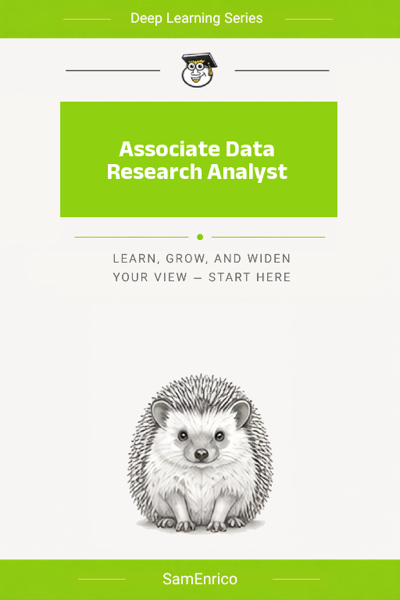
researchInformativeEducational
Associate Data Research Analyst eBook
A Coursebook on Associate Data Research Analyst
A Coursebook on Associate Data Research Analyst
Formats
Free sample
Chapter 1: The Data Detective’s Origin...--You are about to learn a secret that most junior analysts spend two years discovering the hard way: data analysis is not about math, and it is not about software. It is about curiosity structured as a method.If you have ever felt intimidated by spreadsheets, confused by statistics, or convinced that you “aren’t a numbers person,” this chapter is your permission to unlearn everything you thought stood between you and a career in data. The most successful Associate Data Research Analysts I have worked with came from backgrounds as diverse as English literature, retail management, military service, and high school teaching. What they shared was not an Ivy League degree in econometrics. They shared a willingness to ask “Why?” and a system for finding answers.This chapter will redefine what it means to work with data.
You will discover why the Associate Data Research Analyst role is the single best entry point into the modern data economy. You will learn to see yourself not as a technician who runs reports, but as a detective who solves mysteries. And you will complete a self-assessment that reveals you already possess more than half the skills you think you are missing.By the end of this chapter, you will know exactly where this role sits in the data landscape, how it differs from data scientists and business analysts, and why companies are desperate to hire people with your specific profile. More importantly, you will understand the one mindset shift that separates analysts who get promoted from analysts who get stuck.Let us begin with a story.The Analyst Who Didn’t Know Math In 2017, a thirty-two-year-old former bookstore manager named Elena accepted a job as a junior data analyst at a regional bank. She had no degree in computer science.
She had never written a line of SQL. Her last encounter with statistics was a required psychology course ten years earlier, which she barely passed.What Elena had was seven years of experience managing inventory, scheduling staff, and figuring out why certain books sold better in some stores than others. She had learned to notice patterns: romance novels sold more in stores near train stations, business books sold weekdays before 9 a.m., and children’s books spiked every Saturday before noon. She had never called this “data analysis,” but that is exactly what it was.On her first day at the bank, her manager handed her a spreadsheet of customer complaints and said, “Tell me why people are leaving us.”Elena did not run a regression. She did not build a machine learning model.
She printed the spreadsheet, took a red pen, and started grouping complaints into categories: wait times, mobile app crashes, rude tellers, confusing fees. Within two hours, she had identified that sixty percent of complaints about wait times came from three specific branches between 4 and 5 p.m. on Fridays.She walked back to her manager and said, “I think we are understaffing those branches during peak hours. Can we look at staffing schedules?”The manager looked at her red-penned printout, then at her face, and said, “You just did more analysis than my last hire did in three months.”Elena was not a math prodigy. She was a detective.
She asked a clear question, organized messy information, looked for patterns, and proposed an actionable hypothesis. That is data analysis.The rest of this book will teach you the technical tools—SQL, spreadsheets, statistics, visualization—so that you can do at scale what Elena did on paper. But the mindset comes first. Without it, the tools are useless. With it, you can learn everything else.Defining the Role: Where You Fit in the Data Landscape Before you can become an elite analyst, you must understand how the role of Associate Data Research Analyst fits into the broader data ecosystem.
This is not an academic exercise. Knowing your place on the team helps you set career expectations, communicate your value, and avoid the trap of trying to do everyone else’s job.The modern data team typically includes three entry-to-mid-level roles that outsiders frequently confuse. Let us distinguish them clearly.The Data Scientist builds complex models and algorithms. They work with messy, high-volume data and often hold advanced degrees in statistics, computer science, or physics. Their tools include machine learning libraries like Tensor Flow or Py Torch, and they spend their days optimizing for prediction accuracy, sometimes at the expense of interpretability.
A data scientist might build a recommendation engine that suggests products to millions of users. Their work is powerful but often opaque—even to them.The Business Analyst focuses on key performance indicators and existing business processes. They work closely with operations and finance teams, building dashboards in tools like Tableau or Power BI that track metrics like customer acquisition cost, monthly recurring revenue, or inventory turnover. A business analyst answers the question “How are we doing?” Their work is essential but rarely exploratory. They monitor the present more than they investigate the unknown.The Associate Data Research Analyst sits at the intersection.
You are not expected to build deep learning models from scratch, nor are you limited to monitoring dashboards. Your job is to translate ambiguous business questions into structured research projects, collect or extract the necessary data, clean and explore it, apply appropriate statistical methods, and communicate findings clearly to non-technical stakeholders. You are the detective. You answer the question “Why is this happening?” and “What should we do about it?”Here is a concrete comparison. Suppose a subscription company notices that monthly cancellations have increased by fifteen percent.The Business Analyst updates the churn dashboard, adds a note to the weekly report, and highlights the trend.The Data Scientist builds a survival model to predict which customers are most likely to churn in the next thirty days.The Associate Data Research Analyst interviews the customer support team, pulls transaction logs for the affected customers, runs a t-test comparing usage patterns between churned and retained customers, identifies that the increase coincides with a recent pricing change, and presents a recommendation to grandfather existing customers into the old price.All three roles are valuable.
But the Associate role is the one that most directly drives action. You are the translator between raw data and business decisions.According to the Bureau of Labor Statistics, employment of operations research analysts—a category that includes this role—is projected to grow twenty-five percent over the next decade, much faster than the average for all occupations. The median annual wage for entry-level positions in this category exceeds seventy thousand dollars, with rapid advancement for those who demonstrate the detective mindset.The Data Ecosystem: A Five-Stage Model To be effective, you must understand not only your role but also the larger system in which you operate. Data does not magically appear in a clean spreadsheet. It flows through a pipeline—often creaky, sometimes broken, always improvable.
I call this the Data Ecosystem, and it consists of five stages.Stage One: Sources. Data originates somewhere. Common sources include customer relationship management systems like Salesforce, Internet of Things sensors, web server logs, transaction databases, survey responses, social media APIs…
This is the end of the free sample. Get the eBook to keep going. Buy now
About this book
Details
- Author
- Voss Julienne
- Publisher
- SamEnrico
- Language
- English
- Genre
- research, Informative, Educational
- Released
- 2026-05-08
- Pages (approx.)
- 151
- Available as
- eBook, Audiobook

Read better in the ZLOADR app
Your eBooks on your phone or tablet. Sign in with your SamEnrico account and start reading.
More by Voss Julienne
 Empathy for Employees GuideVoss Julienne$11.99
 Work Addiction in Tech CultureVoss Julienne$11.99
 Blücher Prussian Field MarshalVoss Julienne$11.99
 Stress and Stroke RiskVoss Julienne$11.99
 The Clown Who Vanished: Australia's Witness Protection MysteryVoss Julienne$11.99
 German Works Council Raise GuideVoss Julienne$12.99
 How to Produce Ball PumpsVoss Julienne$11.99
 How to Start a Bells for Telephones Business (Beginners Guide)Voss Julienne$11.99
You may also like
 Scientific Research On TM GuideMartens Nathanial$11.99
 Research Proposal Methodology Section MasteryPauley Debroah$11.99
 Research Proposal Appendix CompilationRaines Tyisha$11.99
 Academic Researcher Distraction GuideFord Virgil$11.99
 TM Research and ScienceCovert Nicki$11.99
 Social Anxiety Research ReviewRoberge Cole$11.99
 Research Proposal Significance Section GuideBock Tory$12.99
 Research Proposal Reviewer PsychologyLugo Tawanda$11.99
 Research Proposal Research Questions DesignLara Robbi$11.99
 Research Proposal References and CitationsPatten Shanice$11.99
 Research Proposal Mixed Methods DesignCameron Omega$11.99
 Research Proposal Data Management PlanAnderson Roberto$12.99