
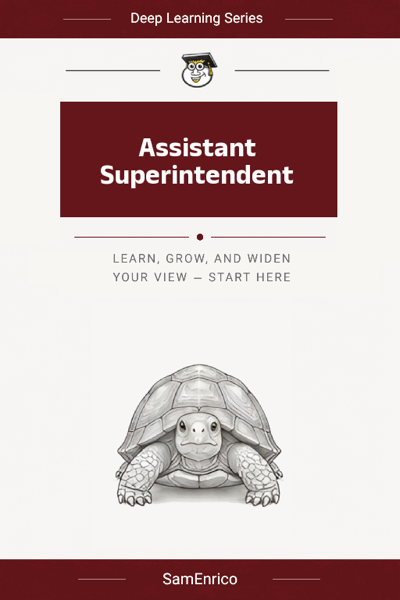
Assistant Superintendent eBook
A Coursebook on Assistant Superintendent
A Coursebook on Assistant Superintendent
Formats
Free sample
Chapter 1: The Assistant‘s Trap--–- On my third day as an Assistant Superintendent, the Superintendent left for a two-week conference in Florida. By the end of the first week, a school bus had flipped on black ice, a parent had threatened a federal lawsuit over a special education placement, and a board member had demanded—by 4 PM on a Friday—that I fire a popular principal because her nephew didn‘t make the varsity basketball team. I had no idea what I was actually allowed to do. I had the title. I had the office.
I had the responsibility. What I didn‘t have was clarity on where my authority began and where it ended. That week taught me something no graduate program ever mentions: the Assistant Superintendent is the most powerful person in the district—and simultaneously the most vulnerable. This book is what I wish I had read the night before that bus flipped.The Myth of the Number Two Ask most educators what an Assistant Superintendent does, and you will get a blank stare followed by a vague answer: “They help the Superintendent.” Ask a Superintendent, and you will hear something like: “They run the things I don‘t have time for.” Ask an Assistant Superintendent, and you will get a long pause, a careful glance around the room, and then a whispered list of twenty-seven job responsibilities that somehow include everything from curriculum design to bus routing to board relations to crisis management.The truth is that the Assistant Superintendent role is the least understood, most poorly defined, and potentially most influential position in American public education. Unlike the Superintendency—which has been studied, documented, and written about in hundreds of books—the number two role exists in a shadowy middle ground.
You are senior leadership, but you are not the leader. You have significant responsibility, but your authority is borrowed from someone else. You are expected to solve problems, but you are rarely in the room when the decisions that create those problems are made.This chapter introduces the central tension that defines the Assistant Superintendent‘s existence: what I call the Assistant‘s Trap. The Trap is simple to describe but brutal to experience. You have all the responsibility for district outcomes and none of the ultimate authority that should accompany that responsibility.
The Superintendent sets the vision; you implement it. The Board approves the budget; you balance it. The state mandates new standards; you figure out how to make them work in thirty different classrooms across twelve different schools. And when something goes wrong? The responsibility flows downhill.
It lands on your desk.But here is the secret that separates successful Assistants from those who burn out or wash out: the Trap is not a flaw in the system. It is the system. And once you understand that, you can stop fighting it and start working it.The Chameleon Role: How the Job Changes by District Size Before we go any further, we need to acknowledge an uncomfortable truth: there is no single Assistant Superintendent job. The role varies so dramatically by district size, structure, and local culture that two people with the same title may have nothing in common beyond their business cards.Small Districts (Under 2,500 Students)In a small district, you are likely the only Assistant Superintendent. You oversee everything that is not the Superintendent‘s direct purview—which is to say, almost everything.
Curriculum, instruction, assessment, special education, human resources, transportation, food services, facilities, technology, safety, and community relations may all fall under your umbrella. You are a generalist by necessity. Your Zone of Indifference—the set of decisions you can make without checking with the Superintendent—is probably quite large, because the Superintendent is too busy with board relations, legislative advocacy, and community politics to second-guess your operational choices.However, your large Zone of Indifference comes with a catch: there is no one else to absorb the workload. When the bus company goes on strike, you are the one negotiating. When the roof leaks in three classrooms, you are the one finding emergency funds.
When a teacher is accused of misconduct, you are the one managing the investigation. Small district Assistants often report working sixty to seventy hours per week, not because they are inefficient, but because there is literally no one else to do the work.The District Size Modifier for Small Districts: Your Zone of Indifference is wide, but your margin for error is thin. One major mistake—a lawsuit, a budget overrun, a scandal—can end your career because there is no buffer between you and the Superintendent.Medium Districts (2,500 to 10,000 Students)In a medium-sized district, you may have one or two fellow Assistant Superintendents. The role often splits by function: one Assistant for Teaching and Learning (curriculum, instruction, assessment, professional development), one for Business and Operations (finance, facilities, transportation, food services), and sometimes one for Human Resources (staffing, labor relations, employee relations). You have more specialization, which means you can go deeper in your area of expertise.
But you also have more coordination overhead. Every decision that crosses functional boundaries requires negotiation with your peers.The District Size Modifier for Medium Districts: Your Zone of Indifference is moderate. You can make most decisions within your functional area without checking with the Superintendent, but any decision that impacts another Assistant‘s area requires collaboration. The biggest risk is siloization—becoming so focused on your domain that you lose sight of the district as a whole.Large Districts (Over 10,000 Students)In a large district, you are one of many Assistant Superintendents, each with a narrow portfolio. There may be an Assistant for Elementary Education, another for Secondary Education, another for Special Populations, another for Human Resources, another for Business Services, another for Technology, and another for Operations.
Your Zone of Indifference may actually be quite small, because every decision must be coordinated across multiple departments and cleared through layers of protocol.However, large district Assistants have something their counterparts in smaller districts lack: depth of resources. You have a team of directors, coordinators, and specialists who report to you. Your job is less about doing the work and more about leading the people who do the work. This requires a different skill set—delegation, systems thinking, political navigation—than the generalist role in a small district.The District Size Modifier for Large Districts: Your Zone of Indifference is narrow but deep. You can make significant decisions within your narrow portfolio, but any decision that crosses portfolio boundaries requires extensive coordination.
The biggest risk is becoming a bureaucratic bottleneck rather than a leader.The Zone of Indifference: Your Most Important Concept Now let us talk about the single most practical concept in this book: the Zone of Indifference. I did not invent this term. It comes from organizational theory, specifically from the work of Chester Barnard, who studied how executives actually make decisions. But I have adapted it for the Assistant Superintendent role because nothing else captures the daily reality of your job.The Zone of Indifference is the set of decisions you can make without checking with the Superintendent. Every decision falls into one of three zones:The Zone…
This is the end of the free sample. Get the eBook to keep going. Buy now
About this book
Details
- Author
- Baugh Asuncion
- Publisher
- SamEnrico
- Language
- English
- Genre
- Non-Fiction, Informative, Educational
- Released
- 2026-06-02
- Pages (approx.)
- 150
- Available as
- eBook, Audiobook

Read better in the ZLOADR app
Your eBooks on your phone or tablet. Sign in with your SamEnrico account and start reading.
More by Baugh Asuncion
 The Poverty of AbundanceBaugh Asuncion$11.99
 Cuddling MeditationBaugh Asuncion$11.99
 Synthesis Essay AI PromptsBaugh Asuncion$11.99
 Uncontested Divorce RecoveryBaugh Asuncion$11.99
 The Alcohol and Sleep Memory GuideBaugh Asuncion$11.99
 Keri Hulme: The Bone People’s Quiet RevolutionBaugh Asuncion$11.99
 QuickBooks vs Wave Comparison GuideBaugh Asuncion$12.99
 JEE Alternative Career Path GuideBaugh Asuncion$12.99JEE Alternative Career Path GuideBaugh Asuncion$12.99
 Understanding PintaBaugh Asuncion$17.99
 How to Start a Cheese Making Machines Business (Beginners Guide)Baugh Asuncion$11.99