
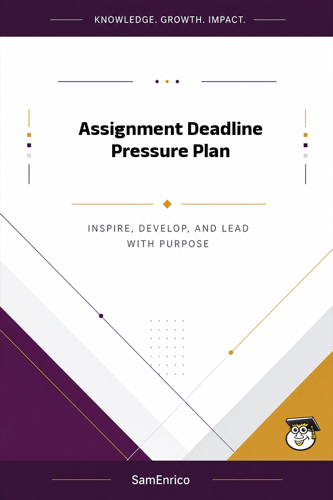
Non-FictionSelf-HelpTime Management
Assignment Deadline Pressure Plan eBook
Break large projects into manageable steps to prev
by Whelan Magen
Break large projects into manageable steps to prevent last-minute panic and all-nighters.
Formats
Free sample
Chapter 1: The All-Nighter Lie--–- The first all-nighter I ever pulled felt like a rite of passage. I was nineteen, fueled by three Monster energy drinks and the kind of naive confidence that only exists before 2 a.m. I told myself I was being heroic. I told myself this was what dedicated students did. I finished the paper at 5:47 a.m., printed it with trembling hands, and stumbled to class in yesterday's clothes.
I got a B. Not an A. Not even a B-plus. A solid, unremarkable B. And I felt like I had conquered the world.That was the trap.The all-nighter didn't work.
It never worked. But I didn't know that yet. All I knew was that I had survived, and survival, in the twisted logic of deadline culture, felt like victory. I spent the next three years of college repeating that exact pattern. I told myself I worked best under pressure.
I told myself that panic unlocked some hidden reservoir of brilliance. I told myself that the all-nighter was a tool, not a symptom.I was lying to myself. And if you're reading this book, chances are good that you've told yourself the same lies.The Mythology of Panic Let's name the enemy. The belief that panic produces your best work is not just incorrect — it is actively destructive. It is a myth perpetuated by survivor bias, Hollywood montages, and the fact that sometimes, under extreme duress, a person can produce something that is barely acceptable and mistake that for excellence.Here is what actually happens when you pull an all-nighter.
Your prefrontal cortex — the part of your brain responsible for planning, reasoning, and impulse control — begins to shut down after approximately 16 hours of wakefulness. By hour 20, your cognitive performance is equivalent to someone with a blood alcohol concentration of 0.08 percent. That is legally drunk in every state. You are quite literally trying to write a paper while impaired.By hour 24, your reaction time slows by 50 percent. Your working memory — the ability to hold information in your mind while manipulating it — degrades by nearly 40 percent.
The quality of your writing declines not because you aren't trying hard enough, but because your brain is physically incapable of performing at its normal level.And yet, we celebrate the all-nighter. We wear it like a badge of honor. We compare war stories about how little sleep we got, as if suffering were the same thing as productivity.The Emotional Cost No One Talks About The damage is not just cognitive. The emotional toll of last-minute panic creates a cycle that is almost impossible to break without understanding how it works.Anxiety is the first visitor. It arrives days or even weeks before the deadline, a low hum of dread that starts in your chest and spreads outward.
You know you should start. You tell yourself you will start tomorrow. Tomorrow comes, and the dread is still there, so you push it to the next day. The project sits untouched, growing larger in your mind with each passing hour.Shame arrives next. You look at classmates who seem to have their lives together.
You wonder what is wrong with you. You promise yourself that this time will be different, that the next project will be the one where you finally get organized. But you don't have a system. You have only willpower, and willpower is a finite resource that runs out by Tuesday afternoon.Physical exhaustion follows. When you finally do start — usually within 48 hours of the deadline — you work in a frenzy of caffeine and guilt.
Your eyes burn. Your back aches from hunching over a laptop. Your hands shake from the third cup of coffee. You tell yourself that the pain means you are working hard, as if discomfort were the currency of achievement.Then comes the completion. You submit the assignment.
You collapse. You sleep for twelve hours. And in the relief of being done, you forget the misery. You remember only the adrenaline rush of the finish line. This is the most dangerous part of the cycle.
Because relief feels like success, and success feels like validation of the method.So you repeat.The Case Study: Two Students, One Deadline Let me show you exactly what this cycle looks like in real life. Meet Sarah and James. Both are juniors in college. Both have the same three-week deadline for a twenty-page research paper in the same sociology class. Both start with the same level of knowledge and the same grade point average.Sarah is an all-nighter veteran.
She has pulled at least one late-night session for every major assignment since high school. She tells herself she works best under pressure. When the professor announces the paper, Sarah feels the familiar hum of anxiety. She tells herself she has plenty of time. She will start next week.Week one passes.
Sarah opens the assignment document once, reads the prompt, and closes it. The task feels enormous, like a mountain she cannot see the top of. She tells herself she needs to "get in the right mindset" before starting. She reorganizes her desk. She watches three You Tube videos about productivity.
She does not write a single word.Week two arrives. Sarah's anxiety has sharpened into something more specific. She is not just worried about the paper anymore; she is worried about herself. Why can't she start? What is wrong with her?
She spends four hours "researching" — which means opening twenty browser tabs, reading two abstracts, and falling down a rabbit hole of vaguely related articles. She does not take a single note.The final week. Seven days left. Sarah's panic is now a physical presence in her chest. She calculates that she needs to write approximately three pages per day to finish on time.
She writes one paragraph on Monday. She writes nothing on Tuesday because the paragraph was bad and she feels defeated. By Wednesday, with four days left, she knows she is in trouble.Thursday night. Three days left. Sarah starts the paper in earnest at 8 p.m.
She writes until 3 a.m. She sleeps for four hours, then writes again from 7 a.m. to noon. She repeats this pattern for the next two nights. By the time she submits the paper, she has slept approximately twelve hours over three days.
She has consumed enough caffeine to make her heart race. Her writing is disjointed. Her arguments are underdeveloped. Her citations contain three errors.She gets a C-minus.Now let me tell you about James. James has the same three weeks.
But James has a system — the system you will learn in this book. On the day the paper is assigned, James spends twenty minutes reverse-engineering the deadline. He works backward from the due date, identifying every major milestone: topic selection, research, outline, first draft, revision, final polish. He gives each milestone a realistic time block, building in slack for the unexpected.James then chunks each milestone into micro-tasks. Research is broken into "find five sources," "read one source and take notes," "summarize each source in one paragraph." Each chunk takes between thirty and ninety minutes — short enough to feel achievable, long enough to make…
This is the end of the free sample. Get the eBook to keep going. Buy now
About this book
Details
- Author
- Whelan Magen
- Publisher
- SamEnrico
- Language
- English
- Genre
- Non-Fiction, Self-Help, Time Management
- Released
- 2026-06-09
- Pages (approx.)
- 116
- Available as
- eBook, Audiobook

Read better in the ZLOADR app
Your eBooks on your phone or tablet. Sign in with your SamEnrico account and start reading.
More by Whelan Magen
 Research Proposal Secondary Data AnalysisWhelan Magen$11.99
 Tax Accountant April Stress GuideWhelan Magen$11.99
 Panic Phobia ComorbidityWhelan Magen$11.99
 Normal vs Inferior GoodsWhelan Magen$11.99
 Metaphor Scripting GuideWhelan Magen$11.99
 Surfing Wave Reading HypnosisWhelan Magen$11.99
 JoJo Siwa BowWhelan Magen$11.99
 The Silent Revolution: How a 12-Year-Old Girl Sparked a Global MovementWhelan Magen$11.99
 The Sky Serpents of Baalbek: The First Aerial Onslaught (1200 BC)Whelan Magen$11.99
 The Mineral Guide to BytowniteWhelan Magen$11.99
 Growing DipeltaWhelan Magen$11.99
 Digital Billboard AdvertisingWhelan Magen$11.99
You may also like
 Hong Kong Handover 1997Dunn Johnnie$11.99
 Zumba For Postnatal Recovery CourseNeal Christian$11.99
 Zumba for BeginnersLadner Nikia$11.99
 YouTube Comment Mining GuideHumes Pandora$12.99
 Worry Box MeditationCarlin Rudy$11.99
 Workplace Stress MeditationNguyen Lynn$11.99
 Workplace Stress and Sleep RepairHawley Ivory$11.99
 Workplace Perfectionism CureDelaney Jeffry$11.99
 Workplace Injustice Anger GuideWallen Isabelle$11.99
 Work Addiction and Burnout LinkGreenwood Ester$11.99
 Women in Yoga and WellnessBeattie Galina$11.99
 Women in Stand Up ComedyChun Evangeline$11.99