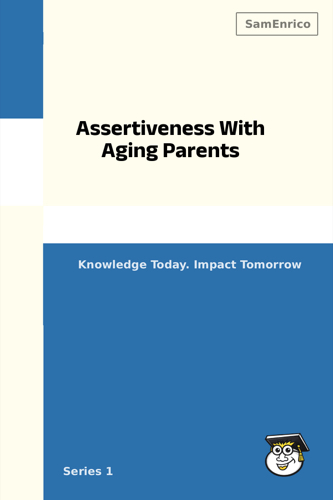
Assertiveness With Aging Parents eBook
Discuss care, driving, and living arrangements com
Discuss care, driving, and living arrangements compassionately.
Formats
Free sample
Chapter 1: The Kindness Lie--–- On a Tuesday afternoon in February, a woman named Carol sat in the emergency room hallway while her eighty-three-year-old mother lay behind a curtain with a fractured hip. The fall had happened in the bathroom—a wet tile floor, a reaching hand that found nothing, a body that crumpled like laundry. Carol had known for eighteen months that her mother shouldn't be living alone. She had seen the unpaid bills stacked on the kitchen table. She had noticed the half-empty wine bottles and the full ashtrays and the way her mother had stopped cooking because "nothing tastes right anymore." She had seen the bruise on her mother's forearm last Thanksgiving, the one her mother explained away as "bumped the door frame." Carol had said nothing.
She had told herself she was being kind.–- The orthopedic surgeon came out to speak with her. "Your mother is stable," he said, "but the recovery from a hip fracture at this age is complicated. We need to talk about where she'll go after discharge. She cannot return to her current living situation." Carol nodded, but inside she was screaming. She had known.
She had known for eighteen months. And now her mother had no choice. The decision about where to live, what to sell, how to pay for care—all of it would be made in the chaos of a hospital discharge, with a social worker's clipboard and a list of facilities that had beds available, not necessarily the ones that were good. Carol's kindness had not protected her mother. It had trapped her.–- This chapter is about the lie you have been told—the lie that silence is kindness, that avoiding conflict is love, that waiting for the right moment is wisdom.
It is not. Silence is risk transfer. You are offloading the danger onto your parent so you do not have to feel uncomfortable. And the evidence is clear: waiting for a crisis does not protect anyone. It removes everyone's choice.The Painful Role Reversal–- Every adult child of an aging parent will eventually face a moment of reckoning.
It arrives differently for everyone—a phone call from a neighbor, a concerning lab report, a car accident that could have been worse, a bank statement that reveals months of unpaid bills, a holiday visit that shows a parent has lost twenty pounds. But the reckoning always asks the same question: What do I do now?–- The answer most adult children give, at least at first, is nothing. They wait. They hope. They tell themselves that things will get better, that it was just a bad week, that Mom is still sharp most of the time, that Dad would never drive after dark anyway.
They tell themselves they are being kind by not bringing up difficult topics. They tell themselves they are preserving their parent's dignity by not asking about the pills or the bills or the bruises.–- This is the role reversal. For your entire life, your parent protected you. They made decisions you did not understand. They kept information from you to spare you worry—the financial struggles, the marital fights, the health scares.
That was appropriate then, when you were a child. But now you are an adult, and your parent is aging, and the instinct to shield them from worry has become a trap. You are still playing the role of the child who does not need to know. But the situation has changed. Your parent needs you to see clearly.–- The psychologist John Friel, who spent decades studying family systems, coined a phrase for this dynamic: the "unspoken contract." Adult children and aging parents often operate under an unspoken agreement: I won't bring up hard topics if you won't make me.
The adult child does not mention the concerning driving. The parent does not mention the upcoming surgery. Both parties pretend everything is fine. The contract feels like kindness. It is actually collusion.The Top Ten Fears That Keep You Silent–- Why do we wait?
Why do we see the evidence and say nothing? The answer lies in a cluster of fears that are so universal they can be named, studied, and overcome. In interviews and clinical research across thousands of families, ten fears emerge again and again.–- The first fear is fear of conflict. You were raised to respect your parents, not argue with them. The thought of confronting your mother about her driving or your father about his finances triggers a visceral response—racing heart, shallow breathing, the urge to flee.
This is not weakness; it is conditioning. You have spent decades avoiding conflict with your parents. Unlearning that pattern is hard work.–- The second fear is fear of being disowned or disinherited. For some, this is literal: a parent has threatened to cut them out of the will. For others, it is symbolic: the fear that a difficult conversation will permanently damage the relationship.
Money and inheritance are rarely the real issue; what you fear losing is your parent's love and approval. The thought is: If I make them angry, they will stop loving me.–- The third fear is fear of hurting their feelings. Your parent has given you so much. How can you be the one to make them sad? How can you tell them they cannot drive, cannot live alone, cannot manage their money?
You imagine their face crumpling, their tears, their quiet "I never thought my child would treat me this way." The anticipation of their pain stops you cold.–- The fourth fear is fear of being wrong. What if your parent is fine? What if you are overreacting? What if the dent in the garage door was just a mistake, and you are turning it into a federal case? The fear of false accusation—of being the overbearing child who took away freedom unnecessarily—paralyzes many adult children.
They would rather risk a real crisis than risk being wrong.–- The fifth fear is fear of your own anger. Underneath the worry and the guilt, many adult children are furious. They are angry at their parent for not planning better, at siblings for not helping more, at the situation for being impossible. And they are afraid that if they start the conversation, that anger will spill out. They will say something unforgivable.
They will become the monster they fear they already are.–- The sixth fear is fear of sibling retaliation. In families with multiple children, the silent adult child is often waiting for a sibling to take the lead. "I'll support whatever you decide," they say, which is a polite way of saying "You take the risk and I'll stand behind you." When no one steps forward, resentment builds. The local child resents the distant child. The daughter resents the son.
Everyone waits, and nothing happens.–- The seventh fear is fear of the system. Nursing homes, assisted living facilities, home health agencies, Medicare, Medicaid, long-term care insurance—the system is bewildering. Many adult children avoid starting the conversation because they do not know what the options even are. They fear that once they open the…
This is the end of the free sample. Get the eBook to keep going. Buy now
About this book
Details
- Author
- Knudsen Melodi
- Publisher
- SamEnrico
- Language
- English
- Genre
- Non-Fiction, Self-Help, Aging Parents
- Released
- 2026-06-06
- Pages (approx.)
- 145
- Available as
- eBook, Audiobook

Read better in the ZLOADR app
Your eBooks on your phone or tablet. Sign in with your SamEnrico account and start reading.
More by Knudsen Melodi
 Immigrant Dance Studio Chain SuccessKnudsen Melodi$11.99
 Creative Block MythsKnudsen Melodi$11.99
 Active Listening For Grief SupportKnudsen Melodi$11.99
 Wholesaling Dialer SystemsKnudsen Melodi$11.99
 Triathlon Injury PreventionKnudsen Melodi$11.99
 The Car Ride HomeKnudsen Melodi$11.99
 Traffic Jam Patience GuideKnudsen Melodi$11.99
 Hollywood Family Master GuideKnudsen Melodi$11.99
 The Last Laugh: How a 19th-Century Joke Changed the WorldKnudsen Melodi$11.99
 Whispers from the Underworld: The Secret Burials of the Roman EliteKnudsen Melodi$11.99
 The Enlightenment: Seeds of Modern ReasonKnudsen Melodi$11.99
 The Mineral Guide to SantiteKnudsen Melodi$11.99