
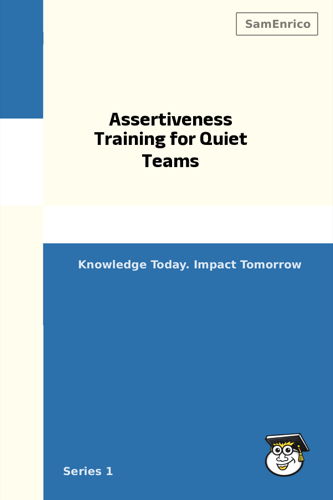
Non-FictionSelf-HelpAssertiveness
Assertiveness Training for Quiet Teams eBook
Practice speaking up in meetings, disagreeing resp
Practice speaking up in meetings, disagreeing respectfully, and asking for what you need clearly.
Formats
Free sample
Chapter 1: The Columbus Syndrome--–- The email arrived at 11:47 p.m. on a Tuesday. Maria Chen, a senior data analyst at a mid-sized fintech company, had spent the last three hours rewatching the same product launch meeting in her head. She had seen the flaw in the pricing model during the first five minutes of the discussion. She had the numbers in her notebook, the spreadsheet open on her laptop, and the exact counter-argument fully formed in her mind.
She had raised her hand twice. She had leaned forward three times. She had even started to speak once, only to be drowned out by Derek from sales, who was explaining—with great confidence and zero data—why the new pricing tier would “revolutionize their market position.”She never got her turn.The meeting ended. The team voted. The product launched six weeks later at the aggressive price point Derek had championed.
Within three months, the company had lost $2.3 million in unexpected churn, because the pricing model had quietly—predictably, mathematically—driven away their most profitable mid-tier customers.Maria’s email, sent after midnight, was brief: *“I saw this coming in the Q2 retention data. The cohorts above $500/month have negative price elasticity above the $620 threshold. We crossed that line. I should have said something louder. I’m sorry.”*Her manager replied the next morning: “Why didn’t you speak up in the meeting?”Maria stared at the screen for a long time.
She didn’t have a good answer. Or rather, she had too many answers, none of which sounded like legitimate excuses. I was waiting for a pause that never came. I assumed someone else would see it. I didn’t want to be the one who slows things down.
I was afraid of being wrong. I was afraid of being right and being disliked for it.She deleted her draft three times before finally writing: “I don’t know.”But she did know. She just didn’t have the language for it yet.This book is that language.The Cost of Silence Let us begin with a hard truth. The problem described above is not a story about a single quiet analyst on a single bad team. It is a story about a systemic failure that costs organizations billions of dollars annually—not because quiet people have nothing to say, but because our workplace culture has been built to reward speed over depth, volume over precision, and confidence over accuracy.Consider the research.
A multi-year study of over 1,000 teams found that the teams with the most vocal, dominant members made worse strategic decisions than teams with balanced participation—not because the dominant members were unintelligent, but because their dominance suppressed the contributions of quieter members who held critical, disconfirming information. Another study of corporate boardrooms found that the likelihood of a major strategic error increased by 47% when a single dominant voice controlled more than 50% of the speaking time. The pattern is so consistent that organizational psychologists have a name for it: the extrovert ideal fallacy—the mistaken belief that the best ideas belong to the people who speak most often.But the cost is not only financial. It is personal. The quiet team member who leaves a meeting with an unspoken insight carries that silence home.
It becomes a small grief, a quiet self-reproach, a story they tell themselves about their own inadequacy. I should have spoken up. What’s wrong with me? Why can’t I just be more like them?Here is the first and most important claim of this book: Nothing is wrong with you.The problem is not that quiet people need to become louder. The problem is that most teams are designed for a narrow, idealized version of human communication—one that privileges rapid, improvised, high-volume verbal performance over thoughtful, prepared, evidence-based contribution.
And until we change that design, no amount of individual assertiveness training will solve the underlying issue.This chapter introduces the core diagnostic framework for understanding why quiet teams stay silent. We will explore the difference between introversion and shyness, the structural biases of modern meeting culture, and the single most important distinction that will determine which strategies work for you and your team. By the end of this chapter, you will have a clear language for naming the silence you experience—and a roadmap for the rest of this book.The Biology of Quiet: Introversion Is Not Shyness Before we can fix the problem, we must name it accurately. And the first naming error that plagues most conversations about quiet people is the conflation of introversion with shyness.These are not the same thing. They have different biological mechanisms, different behavioral expressions, and—crucially—different solutions.Introversion, as popularized by psychologist and author Susan Cain in her landmark book Quiet, is primarily about sensitivity to stimulation.
Introverts have a nervous system that is more reactive to dopamine and external input. In high-stimulation environments—open offices, rapid-fire meetings, crowded rooms—introverts become overstimulated more quickly than extroverts. They do not necessarily fear these environments; they simply find them exhausting. The introvert’s optimal performance zone is lower in stimulation, quieter in sensory input, and slower in conversational tempo. This is not a defect.
It is a biological variation, like having blue eyes or being left-handed.Shyness, by contrast, is about fear. Specifically, shyness is the fear of negative social judgment. A shy person might have plenty of energy for a conversation but be paralyzed by the anticipation of criticism, rejection, or embarrassment. Shyness is not a biological variation in stimulation sensitivity; it is an anxiety response, often learned through experience, that can be modified with practice and psychological safety.Here is why the distinction matters. An introvert does not need to be “cured” of their introversion.
They need environments that respect their processing style—more time to think, fewer interruptions, the ability to prepare in writing before speaking. A shy person, by contrast, may benefit from graduated exposure to speaking situations, cognitive reframing of social threats, and the specific assertiveness scripts we will develop in later chapters.Many people are both introverted and shy. Many are one without the other. And crucially, some loud, talkative people are actually shy—using constant speech as a mask for social anxiety, filling every silence to avoid the possibility of judgment.The interventions in this book are designed to work for both groups, but the pathway matters. If you are primarily introverted (overstimulated, not afraid), your energy will go to preparing thoughtfully and managing your stimulation levels.
If you are primarily shy (afraid, not overstimulated), your energy will go to building courage through low-stakes practice and learning to tolerate the discomfort of being seen.The diagnostic exercise at the end of this chapter will help you determine which profile fits you best—and which chapters of this book will be most immediately useful.The Extrovert Ideal: How Workplaces Learned to Reward Volume over Value The modern workplace did not accidentally become hostile to quiet people. It was actively designed that way, drawing on a century of management theory that equated verbal dominance with leadership potential.Consider the origin story. In the early twentieth century, the rise of corporate…
This is the end of the free sample. Get the eBook to keep going. Buy now
About this book
Details
- Author
- Brower Nancee
- Publisher
- SamEnrico
- Language
- English
- Genre
- Non-Fiction, Self-Help, Assertiveness
- Released
- 2026-06-07
- Pages (approx.)
- 132
- Available as
- eBook, Audiobook

Read better in the ZLOADR app
Your eBooks on your phone or tablet. Sign in with your SamEnrico account and start reading.
More by Brower Nancee
 Active Recall Memory WorkbookBrower Nancee$11.99
 Cape Town B2B Sales PlaybookBrower Nancee$11.99
 Body Scan for Test TakingBrower Nancee$11.99
 Testosterone Therapy Cost GuideBrower Nancee$11.99
 The Last Transmission: How the Arecibo Telescope Fell SilentBrower Nancee$11.99
 The Last Patient of Dr. Barnard: A Heart Transplant RevolutionBrower Nancee$11.99
 How to Start a Motor Bike Taxi Service Business (Beginners Guide)Brower Nancee$11.99
 Finding PR Jobs In AustraliaBrower Nancee$12.99
 Dairy Cooperative Operations GuideBrower Nancee$12.99
 Understanding Charcot–Marie–tooth Disease, Intermediate FormBrower Nancee$17.99
 Fda Audit PreparationBrower Nancee$11.99
You may also like
 Hong Kong Handover 1997Dunn Johnnie$11.99
 Zumba For Postnatal Recovery CourseNeal Christian$11.99
 Zumba for BeginnersLadner Nikia$11.99
 YouTube Comment Mining GuideHumes Pandora$12.99
 Worry Box MeditationCarlin Rudy$11.99
 Workplace Stress MeditationNguyen Lynn$11.99
 Workplace Stress and Sleep RepairHawley Ivory$11.99
 Workplace Perfectionism CureDelaney Jeffry$11.99
 Workplace Injustice Anger GuideWallen Isabelle$11.99
 Work Addiction and Burnout LinkGreenwood Ester$11.99
 Women in Yoga and WellnessBeattie Galina$11.99
 Women in Stand Up ComedyChun Evangeline$11.99