
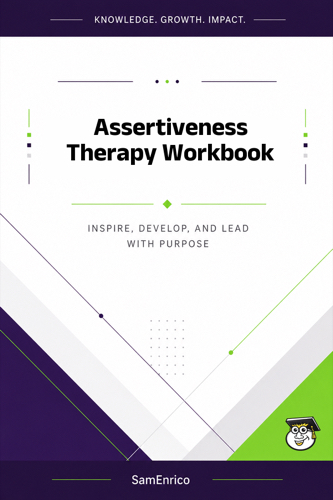
Assertiveness Therapy Workbook eBook
Complete cognitive behavioral exercises to overcom
Complete cognitive behavioral exercises to overcome social anxiety and fear.
Formats
Free sample
Chapter 1: The Silence Tax--–- You are about to discover something uncomfortable: your silence has been charging you interest, and the bill is long overdue.Every time you have bitten your tongue at a meeting, laughed at a joke that wasn't funny, agreed to plans you secretly dreaded, or apologized for something that wasn't your fault—you were not being polite. You were not being kind. You were not "keeping the peace."You were paying the Silence Tax.And like any tax, it comes due whether you want to pay it or not. The difference between this tax and the one the government collects is that the Silence Tax doesn't fund roads or schools. It funds resentment.
It funds invisibility. It funds the slow, quiet erosion of your right to take up space in your own life.This chapter will show you exactly how that tax works, why you have been willing to pay it for so long, and—most importantly—how to stop.The Brilliant, Destructive Strategy You Didn't Know You Had Let us begin with a confession that might feel uncomfortable: your silence is not a failure. It is not a character flaw. It is not evidence that you are "weak" or "broken."Your silence is a strategy. And it is a brilliantly effective one—at least in the short term.Think about the last time you wanted to say something but didn't.
Maybe you wanted to tell a coworker that their comment stung. Maybe you wanted to ask your partner to help with the dishes. Maybe you wanted to decline an invitation from a friend who drains your energy.What happened in the seconds after you chose silence?Go ahead. Really feel it.The argument you avoided. The awkwardness you sidestepped.
The lump in your throat that dissolved. The relief that washed over you when the moment passed and you were still safe, still liked, still accepted.That relief is real. It is powerful. And it is the reason you have been practicing silence for years, maybe decades.Your brain learned a simple equation: Silence = Safety. Every time you stayed quiet and nothing bad happened, your brain filed that away as evidence.
The neural pathway got a little deeper. The habit got a little stronger.But here is the catch that changes everything: that equation is a lie.Silence feels safe in the moment. But it is not safe in the long run. It is not safe for your relationships. It is not safe for your self-respect.
And it is certainly not safe for the quiet, growing certainty that you are disappearing from your own life.The Feedback Loop: How Fear and Silence Become Partners Let me introduce you to the central mechanism of this entire book. I call it the Feedback Loop of Fear and Silence, and once you see it, you will start noticing it everywhere—in your own behavior, in the behavior of people you love, and in the cultural messages that taught you to be "nice."Here is how the loop works.Step One: The Trigger. Something happens that asks something of you. A boss asks for a volunteer. A friend asks for a favor.
A partner raises a difficult topic. A stranger makes a comment. The trigger can be large or small; your nervous system does not discriminate.Step Two: The Anxiety Spike. In a fraction of a second, your body responds. Your heart rate increases.
Your palms might sweat. Your throat might tighten. Your stomach might drop. This is not a choice. This is your autonomic nervous system doing its job: detecting a potential threat and preparing you to fight, flee, or freeze.Step Three: The Automatic Thought.
Before you even know you are thinking it, a sentence appears in your mind. "If I say no, they will hate me." "If I speak up, everyone will think I am difficult." "If I ask for what I need, I will look selfish." These thoughts are automatic—they happen without your permission—and they are almost always catastrophic.Step Four: The Safety Behavior. You do something to reduce the threat. You say "yes" when you mean no. You laugh when you are not amused.
You stay silent when you have something to say. You change the subject. You check your phone. You agree too quickly. You leave early.
These are called safety behaviors because their purpose is to make you feel safe.Step Five: Temporary Relief. The threat passes. The anxiety drops. You are still liked. You are still employed.
You are still in the relationship. The relief is real, and it is immediate. This is the payoff.Step Six: Long-Term Cost. Hours or days later, the cost arrives. You feel resentment toward the person you said yes to.
You feel invisible because no one knows what you actually think. You feel shame because you know you abandoned yourself. You feel lonely because the connection you have is with a mask, not with you.Then the loop resets. The next trigger arrives. The anxiety spikes.
The automatic thought appears. The safety behavior activates. The relief comes. The cost accumulates.This is the Feedback Loop. And if you have social anxiety, if you struggle with assertiveness, if you identify as a people-pleaser—you have been running this loop thousands of times, for years, without ever knowing it had a name.Meet Sarah: A Case Study in the Silence Tax Let me show you how this loop plays out in a real life.
Sarah is a composite character—she represents dozens of people I have worked with—but her story is real enough to hurt.Sarah is thirty-four years old. She works as a marketing manager at a mid-sized company. She is married to a man named David, and they have two young children. By all external measures, Sarah has a good life.But Sarah is exhausted.Not the kind of exhausted that comes from lack of sleep. The kind of exhausted that comes from wearing a mask for sixteen hours a day.At work, Sarah is known as the "team player." She stays late to help colleagues who have not done their share.
She says "yes" to every project, even when her plate is already overflowing. When her boss asks for volunteers for the annual report—a tedious, thankless task that no one wants—Sarah raises her hand before anyone else can. She tells herself she is being helpful. But underneath, she is terrified that if she does not volunteer, her boss will think she is lazy.The loop runs like this: Trigger (boss asks for volunteers) → Anxiety spike (heart racing) → Automatic thought ("If I don't volunteer, he will think I am not committed") → Safety behavior (raising her hand) → Temporary relief (the moment passes, the boss smiles) → Long-term cost (resentment, exhaustion, and the quiet question: "Why does no one ever help me?")At home, the loop runs again, but with different content. David asks if she can pick up the kids from school because he has a late meeting.
Sarah wants to say no—she has her own late meeting—but instead she hears herself say, "Sure, no problem." The automatic thought: "If I say no…
This is the end of the free sample. Get the eBook to keep going. Buy now
About this book
Details
- Author
- Alfaro Harlan
- Publisher
- SamEnrico
- Language
- English
- Genre
- Non-Fiction, Self-Help, CBT
- Released
- 2026-06-10
- Pages (approx.)
- 123
- Available as
- eBook, Audiobook

Read better in the ZLOADR app
Your eBooks on your phone or tablet. Sign in with your SamEnrico account and start reading.
More by Alfaro Harlan
 Mendeleev Photography PassionAlfaro Harlan$11.99
 Emotional Overcontrol SkillsAlfaro Harlan$11.99
 Woodrow Wilson GuideAlfaro Harlan$11.99
 Jeff Gordon Youth SuccessAlfaro Harlan$11.99
 Motivational Interviewing Self TalkAlfaro Harlan$11.99
 Cloud Storage Subscription StickinessAlfaro Harlan$11.99
 Sales Team TrainingAlfaro Harlan$11.99
 The Iron Duke of the Seas: Sir Francis Drake and the Spanish Armada's Last StandAlfaro Harlan$11.99
 The Witness Who Wouldn't Be Silenced: The Case of Christine Dawson and the Sydney Serial KillerAlfaro Harlan$11.99
 How to Produce Shoe DryersAlfaro Harlan$11.99
 How to Produce Food WarmersAlfaro Harlan$11.99
 A Collector's Handbook to the Bond 875Alfaro Harlan$11.99
You may also like
 Work Addiction CBT WorkbookGilbert Elena$11.99
 The Gambling Thought LogRandall Johanne$11.99
 The Behavioral Smoking Cessation CourseBeeler Isis$11.99
 Cognitive Behavioral Therapy For GamblingMilliken Marylou$11.99
 Cognitive Behavioral Memory AnxietyHolm Harriett$11.99
 Cognitive Distortions in Sex AddictionBriggs Clint$11.99
 Cognitive Behavioral Dream InterpretationSimpson Ira$11.99
 Anger Trigger Cognitive DistortionsRiddle Nena$11.99
 Cognitive Reappraisal PracticeStarks Caryn$11.99
 The Social Media Comparison WorkbookVillegas Ashely$11.99
 Imposter Therapy WorkbookSchulte Chanelle$11.99
 Emotional Spending WorkbookSallee Bryanna$11.99