
Non-FictionSelf-HelpTeen Development
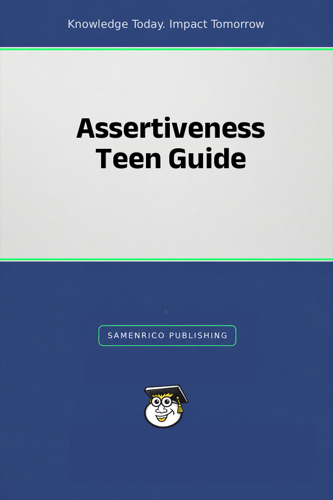
Assertiveness Teen Guide eBook
Help adolescents resist peer pressure and speak up
by Singer Lue
Help adolescents resist peer pressure and speak up to adults.
Formats
Free sample
Chapter 1: The Silent Scream--–- You know the feeling. Your heart is hammering against your ribs. Your palms are sweating. Your brain is screaming a sentence over and over—"I don't want to," "That's not fair," "Stop," "I need help"—but your mouth is frozen. The words are right there, on the tip of your tongue, but they won't come out.
So you nod. You shrug. You say "fine" or "whatever" or nothing at all. And later, alone in your room, you replay the moment and hate yourself for staying silent.This book is for every teen who has ever felt that lump in their throat. The one that appears just when you need your voice the most.
The one that makes you feel small, invisible, powerless. Here is the truth that no one told you: that feeling is not who you are. It is a habit. And habits can be broken.The Day Everything Changed Before we go any further, let me tell you about a teenager named Marcus. Marcus was a sophomore, quiet but not shy, the kind of kid who got along with everyone but never really stood out.
He had a group of friends he had known since middle school. They laughed together, played video games together, and mostly stayed out of trouble. Mostly.One Friday night, Marcus went to a party at a friend's house whose parents were out of town. He had told his mom he was sleeping over at a different friend's house—a small lie that made his stomach twist, but he told himself everyone did it. When he arrived, the party was bigger than he expected.
There were kids from other schools, older kids, and a lot of red Solo cups.About an hour in, his friend Jordan pulled him into the kitchen. "Hey, I want you to try something," Jordan said, holding out a small glass pipe. Marcus's brain went blank. He had never seen one up close before. He had always told himself he would say no if the moment ever came.
But now the moment was here, and his mouth was dry, and Jordan was looking at him expectantly, and three other guys were watching from the corner.Marcus tried to say no. Really, he did. But what came out was a weak, mumbled, "I don't know, man." Jordan laughed. "Come on, don't be a baby. It's just once." Someone behind them said, "Yeah, Marcus, live a little." Another person snickered.
And in that moment, Marcus felt something worse than fear. He felt the weight of everyone's eyes, the pressure of their expectations, the terrible certainty that if he said no, he would be the weird one, the loser, the guy who ruined the vibe.So he took the pipe. He didn't even inhale properly—he coughed and nearly dropped it—but that didn't matter. He had done it. He had said yes when every part of him wanted to say no.
And as he walked away from the kitchen, he felt a sickening mix of relief (the pressure was gone) and shame (he had betrayed himself).Marcus is not a bad kid. He is not weak or stupid or easily led. He is a normal teenager who got caught in a trap that catches millions of teens every single day. It is called the Nice Trap, and it has nothing to do with being nice.What This Book Is (And What It Is Not)Before we dive into the tools and techniques that will change how you communicate for the rest of your life, let me be clear about what you are holding.This is not a book about becoming aggressive. Some people hear "assertiveness" and think it means getting in people's faces, demanding what you want, and never backing down.
That is not assertiveness. That is aggression, and aggression destroys relationships. You will learn the difference in this chapter.This is not a book about becoming selfish. Standing up for yourself does not mean steamrolling over other people. It does not mean putting your needs above everyone else's at all costs.
True assertiveness respects your needs AND the needs of others. It is the middle path between being a doormat and being a bulldozer.This is not a book of magic words. No script in the world will work if you do not believe you deserve to be heard. That is why this book starts with the internal work—the mindset shifts, the self-awareness, the emotional tools—before it gives you the external scripts. You cannot fake confidence forever.
You have to build it from the inside out.This IS a book about finding your voice. Not the voice that shouts to be heard, but the voice that speaks clearly, calmly, and truthfully. The voice that can say "no" without guilt and "yes" without resentment. The voice that can ask for what you need, set boundaries that protect your peace, and disagree with someone without destroying the relationship.This is a book about becoming the person you actually want to be—not the person who goes along to get along, but the person who stands firm in who they are.The Three Ways People Communicate Every human being on this planet communicates in one of three ways. There is no fourth option.
You might shift between them depending on the situation or the person you are talking to, but your default style—the one you fall back on when you are stressed, scared, or pressured—falls into one of these three categories.Passive Communication: The Doormat Passive communication is what happens when you prioritize other people's needs, wants, and feelings above your own. You say "yes" when you mean "no." You apologize when you have done nothing wrong. You stay quiet when you have something important to say. You let others choose the movie, the restaurant, the plans. You laugh at jokes that hurt your feelings.
You lend money you cannot afford to lose.On the surface, passive communication looks "nice." Other people like you because you are easy to be around. You do not cause conflict. You do not make waves. You are the friend everyone wants because you never say no.But here is the hidden cost: passivity is not kindness. It is self-betrayal.Every time you say "yes" when you mean "no," you send yourself a message.
The message is: My feelings do not matter. My needs are not important. Keeping other people happy is more valuable than being true to myself.Over time, those messages build up like sediment in a river. They clog your self-esteem. They erode your ability to trust your own judgment.
And they create a slow, burning resentment that eventually has to go somewhere.The Passive Cycle:You suppress what you really think or feel You feel resentful (at them, but mostly at yourself)The resentment builds until you either explode or withdraw You feel guilty for exploding or withdrawing The guilt drives you back to being passive to "make up for it"Repeat.This is the cycle that keeps millions of teens trapped in friendships, family dynamics, and social situations that drain them. You will learn how to break this cycle in…
This is the end of the free sample. Get the eBook to keep going. Buy now
About this book
Details
- Author
- Singer Lue
- Publisher
- SamEnrico
- Language
- English
- Genre
- Non-Fiction, Self-Help, Teen Development
- Released
- 2026-06-10
- Pages (approx.)
- 140
- Available as
- eBook, Audiobook

Read better in the ZLOADR app
Your eBooks on your phone or tablet. Sign in with your SamEnrico account and start reading.
More by Singer Lue
 Niki Lauda Comeback StorySinger Lue$11.99
 DBT For Bipolar EmotionSinger Lue$11.99
 Nicotine Metabolite Testing GuideSinger Lue$11.99
 Cortisol Rhythm GuideSinger Lue$11.99
 Wine Club Membership ChurnSinger Lue$11.99
 Polydrug Dependency RecoverySinger Lue$11.99
 Inlaw Impact StatementSinger Lue$11.99
 The Phantom Key: How a European Police Hacking Unit Cracked the Luxury Car Theft RingSinger Lue$11.99
 The Maroons of the Deep: How Enslaved Africans Charted the Caribbean SeasSinger Lue$11.99
 How to Produce Food, Beverages and TobaccoSinger Lue$11.99
 How to Become a Hooking-machine OperatorSinger Lue$11.99
 Company Registration South AfricaSinger Lue$12.99
You may also like
 Hong Kong Handover 1997Dunn Johnnie$11.99
 Zumba For Postnatal Recovery CourseNeal Christian$11.99
 Zumba for BeginnersLadner Nikia$11.99
 YouTube Comment Mining GuideHumes Pandora$12.99
 Worry Box MeditationCarlin Rudy$11.99
 Workplace Stress MeditationNguyen Lynn$11.99
 Workplace Stress and Sleep RepairHawley Ivory$11.99
 Workplace Perfectionism CureDelaney Jeffry$11.99
 Workplace Injustice Anger GuideWallen Isabelle$11.99
 Work Addiction and Burnout LinkGreenwood Ester$11.99
 Women in Yoga and WellnessBeattie Galina$11.99
 Women in Stand Up ComedyChun Evangeline$11.99