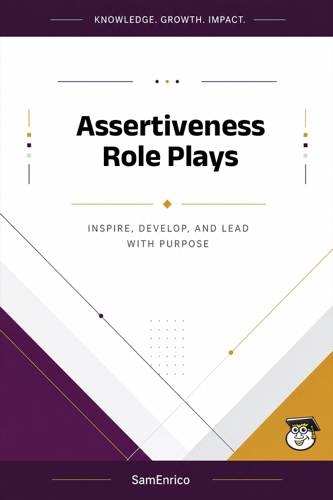
Assertiveness Role Plays eBook
Practice scenarios for rehearsing difficult conver
by Wolf Glayds
Practice scenarios for rehearsing difficult conversations.
Formats
Free sample
Chapter 1: The Silence Tax...--–- Every morning, Maria stared at the email for forty-seven minutes. It was a simple request to her manager: a correction to her job title that would unlock a five percent raise she had already earned. The words were written. The cursor blinked. And every morning, she closed her laptop and made coffee instead.
She was not lazy. She was not stupid. She was not afraid of her manager. What she was, without knowing the name for it, was a woman who had never rehearsed a difficult conversation in her life. Her silence cost her $2,300 that year.
Multiply that by the number of professionals who avoid similar conversations, and you are looking at billions of dollars left on the table, thousands of relationships left to fester, and an uncountable weight of resentment carried silently to bed each night. This book exists because Maria's story is not a failure of character. It is a failure of preparation. And preparation is the only thing this book will ask you to do.The Myth of the Natural Assertive Person We have all met someone who appears to be born assertive. They say no without flinching.
They ask for raises without trembling. They hang up on telemarketers without apology. We look at these people and think: They have something I do not have. This is the great lie of assertiveness. No one is born with it.
What looks like natural confidence is almost always a history of small, repeated rehearsals that happened so early or so privately that the person themselves has forgotten the practice. The child who learned to say "I don't like that" at age four rehearsed it with parents who allowed it. The teenager who asked for a later curfew rehearsed the argument with friends in the locker room. The adult who negotiates their salary rehearsed the numbers on a spreadsheet and then out loud in their car before walking into the office. What you see as a personality trait is actually a learned skill.
And like any learned skill, it can be taught, practiced, and mastered by anyone with a functioning nervous system and a willingness to feel awkward for a few weeks.This distinction between trait and skill is not merely philosophical. It is the difference between staying stuck and getting unstuck. If you believe assertiveness is a trait, you will read books like this one, nod along, feel inspired, and then close the book without changing a single thing. Why would you practice? You do not practice having blue eyes.
You either have them or you do not. But if you believe assertiveness is a skill, you will approach this book like a piano student approaches a keyboard. You will not expect to play a concerto on day one. You will accept that your first attempts will be clumsy, halting, and embarrassing. You will do them anyway.
And slowly, invisibly, the neural pathways that make assertiveness automatic will begin to grow.Why Willpower Is a Trap The self-help industry has sold us a dangerous fantasy. The fantasy goes like this: if you want something badly enough, if you visualize it clearly enough, if you set your intentions firmly enough, the words will come. This is called willpower. And it fails almost every time it is tested in high-stakes situations. Here is why.Willpower is a limited resource.
It operates out of your prefrontal cortex, the same part of your brain that handles complex decision-making, impulse control, and emotional regulation. When you are calm, well-rested, and unthreatened, your prefrontal cortex works beautifully. You can think clearly. You can plan. You can imagine saying the perfect assertive thing.
But the moment you enter a difficult conversation, three things happen simultaneously. First, your heart rate increases. Second, your body releases cortisol and adrenaline. Third, your prefrontal cortex begins to down-regulate, transferring control to your amygdala, the ancient fight-or-flight center of your brain. In this state, your willpower evaporates.
You cannot think of the perfect comeback because the part of your brain that generates perfect comebacks has gone offline. You revert to your most practiced, most automatic, most deeply grooved response pattern. For most people, that pattern is either passive compliance or aggressive explosion.This is why reading assertiveness books does not work. You are reading with a calm prefrontal cortex, imagining yourself in a calm state, practicing calm responses. But the real conversation will not happen in a calm state.
It will happen in a flooded state. And the only thing that works in a flooded state is automaticity – the ability to speak without thinking because you have spoken the same words so many times that they have moved from your prefrontal cortex to your basal ganglia, the part of your brain that runs automated sequences like riding a bike or tying your shoes.Neuroplasticity: How Practice Changes Your Brain For decades, neuroscientists believed that the adult brain was fixed. After a certain age, you had what you had. Then came the discovery of neuroplasticity: the brain's ability to reorganize itself by forming new neural connections throughout life. Every time you repeat a thought, a feeling, or a behavior, you strengthen the neural pathway that produces it.
This is why habits are hard to break. The pathway is a superhighway. The alternative behavior is a dirt road. Your brain will always choose the superhighway because it requires less energy.The good news is that you can build a new superhighway. It takes repetition.
Specifically, it takes dozens or hundreds of repetitions of the new behavior while your brain is in a state of focused attention. This is exactly what role-play provides. When you act out an assertive response – even alone, even in a mirror, even whispering to yourself – your brain activates the same neural circuits that would fire during the real conversation. But here is the crucial difference: during role-play, the negative outcome never comes. You do not get yelled at.
You are not rejected. You do not lose the relationship. Your amygdala experiences the beginning of a threat (the rehearsal of the conversation) and then... nothing. No attack.
No abandonment. No humiliation. Over time, your amygdala learns that the conversation is not dangerous. The fear response weakens. This is called fear extinction, and it is the same mechanism that underlies exposure therapy for phobias.You do not need to understand the neuroscience to benefit from it.
You only need to trust the process. Role-play works because your brain cannot tell the difference between a vividly rehearsed conversation and a real one, except that the rehearsed one has no negative consequences. You get the neural benefit of the conversation without the emotional cost. Over time, the assertive response becomes the superhighway, and the old passive or aggressive response becomes the dirt road.The Three Conversations You Are Actually Having Before you can practice assertiveness, you need to know what kind of conversation you are walking into. The Harvard Negotiation Project, after decades of research on conflict and communication, identified a crucial insight: most difficult conversations are actually three conversations happening at once.
If you try to solve the wrong one, you will fail.The first conversation is The "What Happened?" Conversation. This is…
This is the end of the free sample. Get the eBook to keep going. Buy now
About this book
Details
- Author
- Wolf Glayds
- Publisher
- SamEnrico
- Language
- English
- Genre
- Non-Fiction, Self-Help / Role Play
- Released
- 2026-06-10
- Pages (approx.)
- 140
- Available as
- eBook, Audiobook

Read better in the ZLOADR app
Your eBooks on your phone or tablet. Sign in with your SamEnrico account and start reading.
More by Wolf Glayds
 Networking Small Talk MasteryWolf Glayds$11.99
 Driving Safety Memory AgingWolf Glayds$11.99
 Nightmare Rescripting App GuideWolf Glayds$11.99
 Sibling Rivalry Self WorthWolf Glayds$11.99
 Search and Rescue FailuresWolf Glayds$11.99
 Research Skills For StudentsWolf Glayds$11.99
 Child Neglect and GamblingWolf Glayds$11.99
 The Golden Fleets: Portugal’s Renaissance of the SeasWolf Glayds$11.99
 The Ballad of the Lost Love Letters: A Reunion Across TimeWolf Glayds$11.99
 Understanding Von Hippel-lindau Disease (Vhl)Wolf Glayds$11.99
 How to Start a Anaesthetic Equipment Business (Beginners Guide)Wolf Glayds$11.99
 How to Produce GPS AccessoriesWolf Glayds$11.99