
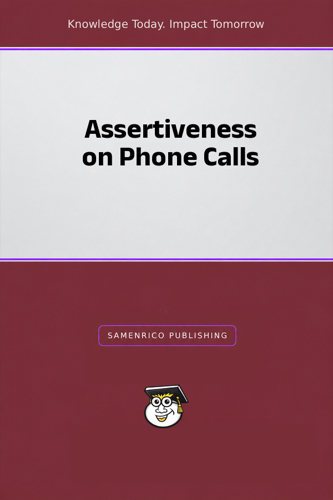
Assertiveness on Phone Calls eBook
Teaches handling telemarketers, customer service,
Teaches handling telemarketers, customer service, and difficult calls calmly.
Formats
Free sample
Chapter 1: The Three Pillars--–- You just hung up the phone, and your heart is pounding. Not because the conversation was heated, but because you did it again. You said “yes” when you meant “no.” You apologized for nothing. You stayed on the line for twelve minutes listening to a sales pitch for a product you will never buy. And now, sitting in the silence after the click, you feel a familiar cocktail of frustration at the caller and disappointment in yourself.If that scene feels personal, you are not broken.
You are normal. And you are exactly who this chapter was written for.Most people assume assertiveness is a personality trait—you either have it or you don’t. Some are born comfortable saying no, hanging up, and setting boundaries. The rest of us spend years apologizing for existing on the phone. But here is the truth that bestselling books on assertiveness, difficult conversations, and negotiation have proven across millions of readers: assertiveness is not a gift.
It is a structure. And like any structure, it rests on pillars.This chapter introduces the Three Pillars of Assertive Phone Communication. These are not abstract ideals or motivational phrases. They are teachable, repeatable, and immediately usable frameworks that will appear in every subsequent chapter of this book. Master these three pillars, and you will never again hang up wondering what happened to your voice.Before we build, however, we must diagnose.
The reason most phone calls go wrong is not that the other person is a master manipulator—though some are. The reason is that you have a default pattern, and that pattern is leaking through every word you speak. Without awareness, pattern runs the show. With awareness, you get to choose.Let us begin.The Four Default Patterns: Which One Are You?Every person falls into one of four communication patterns on the phone. These patterns were first described in assertiveness literature decades ago and have been validated across thousands of coaching sessions.
Read each description honestly. Do not choose the one you wish you were. Choose the one that shows up when you are tired, rushed, or caught off guard.Pattern One: Passive The passive caller speaks softly, adds qualifiers to every sentence, and uses phrases like “I’m sorry to bother you,” “This might be a bad time,” and “If it’s not too much trouble.” When a telemarketer calls, the passive person listens for several minutes before saying “I’m not really interested… but maybe another time.” When customer service offers an inadequate solution, the passive person says “Oh, okay… I guess that’s fine.” When a friend asks for a favor, the passive person says “Sure” while mentally screaming no.The passive pattern is driven by a core belief: Other people’s feelings are more important than my own needs. On the phone, where you cannot see the other person’s reaction, passivity becomes extreme. Your brain fills the silence with imagined disappointment, so you rush to fill the void with agreement.Pattern Two: Aggressive The aggressive caller speaks loudly, interrupts frequently, and uses phrases like “You need to,” “Listen to me,” and “That’s ridiculous.” When a telemarketer calls, the aggressive person yells “Take me off your list!” and slams down the phone.
When customer service offers an inadequate solution, the aggressive person demands a supervisor immediately, often with personal insults. When a friend asks for a favor, the aggressive person says “No, and stop asking.”The aggressive pattern is driven by a core belief: My needs are the only things that matter, and I must win every exchange. On the phone, where there is no body language to soften the blow, aggression sounds even harsher. The aggressive caller often regrets the tone after hanging up but feels powerless to modulate it in the moment.Pattern Three: Passive-Aggressive The passive-aggressive caller appears polite on the surface while leaking hostility underneath. They say “Sure, I can do that” in a tone that makes clear they absolutely cannot.
They agree to a solution, then sabotage it later. When a telemarketer calls, they say “I’ll listen to your pitch” and then waste the caller’s time before saying no. When customer service offers an inadequate solution, they say “Fine, whatever” and then call back to complain to a different agent. When a friend asks for a favor, they say “I guess so” and then bring it up resentfully for months.The passive-aggressive pattern is driven by a core belief: I cannot say no directly, so I will say yes and make you pay for it later. On the phone, passive-aggression is hard to detect because the words sound agreeable.
But the tone, the pauses, and the follow-up behavior reveal the truth.Pattern Four: Assertive The assertive caller speaks clearly and calmly, uses direct language without apology or attack, and states needs as facts rather than pleas. When a telemarketer calls, the assertive person says “No thank you. Please remove me from your list. Goodbye.” When customer service offers an inadequate solution, the assertive person says “That solution doesn’t work for me. What else can you offer?” When a friend asks for a favor, the assertive person says “I can’t help with that right now, but thanks for asking.”The assertive pattern is driven by a core belief: My needs matter, and so do yours.
We can solve problems without either of us losing dignity. On the phone, assertiveness sounds calm because it comes from a place of internal permission—the permission to speak without apology and to end the call without guilt.Take a moment. Which pattern is your default? If you are unsure, think about the last three phone calls that left you feeling bad afterward. What did you say?
What did you wish you had said? Your answer lives somewhere in those four descriptions.Here is the most important thing you will read in this chapter: The goal is not to never be passive or aggressive again. The goal is to recognize your pattern in real time and choose a different response. That is what the Three Pillars make possible.Pillar One: Clarity Without Apology The first pillar is the hardest for most people because it requires breaking a lifelong habit of softening your own words. Clarity without apology means stating what you want, need, or refuse in direct language, without adding “I’m sorry,” “I hate to ask,” “This might be a bad time,” or any other phrase that waters down your message.Why do we apologize on the phone?
Because silence feels dangerous. When you state a clear boundary—“I need you to stop calling me”—the other person might pause. That pause feels like judgment. To fill the silence, you add “I’m sorry” to reassure them that you are still a good person. But here is the paradox: apologizing for your boundary does not make you seem kinder.
It makes you seem uncertain. And uncertain people get run over on phone calls.Consider these two exchanges:Passive version: “Um, hi, I’m really sorry to bother you, but I was wondering if maybe you could stop calling me? I know you’re just…
This is the end of the free sample. Get the eBook to keep going. Buy now
About this book
Details
- Author
- Fortier Nenita
- Publisher
- SamEnrico
- Language
- English
- Genre
- Non-Fiction, Self-Help, Phone
- Released
- 2026-06-11
- Pages (approx.)
- 134
- Available as
- eBook, Audiobook

Read better in the ZLOADR app
Your eBooks on your phone or tablet. Sign in with your SamEnrico account and start reading.
More by Fortier Nenita
 Managing Interruption Fallout WorkbookFortier Nenita$11.99
 Living Abroad for BookkeepersFortier Nenita$11.99
 IBS Massage Therapy GuideFortier Nenita$11.99
 Scheduling for Neurotypical SpousesFortier Nenita$11.99
 The Freelance Reference DilemmaFortier Nenita$11.99
 Teen Self Esteem and AppearanceFortier Nenita$11.99
 Fog Driving Patience GuideFortier Nenita$11.99
 Adhesive Capsulitis Recovery ManualFortier Nenita$11.99
 Crowns and Calculators: The Financial Lessons of a Future KingFortier Nenita$11.99
 The Scholastic Flame: How Oxford Ignited the RenaissanceFortier Nenita$11.99
 The Frozen Odyssey: Shackleton’s Lost PhotographsFortier Nenita$11.99
 How to Start a Plywood Press Business (Beginners Guide)Fortier Nenita$11.99
You may also like
 Hong Kong Handover 1997Dunn Johnnie$11.99
 Zumba For Postnatal Recovery CourseNeal Christian$11.99
 Zumba for BeginnersLadner Nikia$11.99
 YouTube Comment Mining GuideHumes Pandora$12.99
 Worry Box MeditationCarlin Rudy$11.99
 Workplace Stress MeditationNguyen Lynn$11.99
 Workplace Stress and Sleep RepairHawley Ivory$11.99
 Workplace Perfectionism CureDelaney Jeffry$11.99
 Workplace Injustice Anger GuideWallen Isabelle$11.99
 Work Addiction and Burnout LinkGreenwood Ester$11.99
 Women in Yoga and WellnessBeattie Galina$11.99
 Women in Stand Up ComedyChun Evangeline$11.99