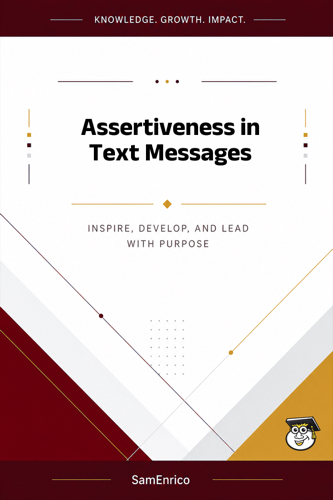
Assertiveness in Text Messages eBook
Teaches using clear language and avoiding over-apo
Teaches using clear language and avoiding over-apologizing in texts.
Formats
Free sample
Chapter 1: The Sorry Audit...--–- The average person types the word “sorry” into their phone 14 times a day. Not because they have done 14 things wrong. But because they have been trained to believe that existing in someone’s inbox is an inconvenience.Let that number land for a moment. Fourteen times. Every twenty-four hours.
Before coffee, between meetings, while lying in bed at night, thumbs hovering over a glowing screen. “Sorry for the delay.” “Sorry to bother you.” “Sorry if this is weird.” “Sorry, one more thing.” “Sorry, that was unclear.” “Sorry, I’m just following up.” The word has become a verbal tic, a punctuation mark, a reflexive flinch before every request, every opinion, every moment of taking up space.Here is what none of those apologies actually mean: “I have done something wrong and I regret it.”Here is what they actually mean: “I am afraid that you will be annoyed by my existence, so I am preemptively punishing myself to disarm you.”This chapter is called the Sorry Audit for a reason. You are going to audit every single apology that flows through your text messages. You are going to categorize them. You are going to learn which ones are real and which ones are habits of self-diminishment.
And then you are going to learn how to replace the fake ones with something far more powerful: gratitude, clarity, or silence.But first, we need to understand why you apologize when you have done nothing wrong.The Psychology of the Phantom Apology Text messaging creates a unique psychological trap. When you speak to someone face to face, you have access to their facial expressions, their tone of voice, their posture, their breathing. You can see if they are annoyed. You can hear if they are rushed. You can adjust in real time.
If you say something that lands wrong, you see the micro-flinch and you can immediately clarify.Texting removes all of that. You are typing into a void. You cannot see the other person’s face. You cannot hear their voice. You cannot know if they rolled their eyes at your question or smiled at your joke.
So your brain, desperate for social safety, does something predictable: it assumes the worst.Neuroscientists call this “negativity bias in low-bandwidth communication.” Psychologists call it “the politeness trap.” But you probably call it “the reason I just wrote ‘sorry’ three times in a single text.”Here is how the trap works. You need something from someone. A response, a favor, an answer, a confirmation. You type out a perfectly reasonable request. Then you pause.
You imagine them receiving the message. You imagine them being busy. You imagine them sighing. You imagine them thinking, “Ugh, another message from this person.” And because you cannot see that they are NOT thinking that, your brain fills in the blank with the worst possible scenario.To protect yourself from their imagined annoyance, you add a preemptive apology. “Sorry to bother you, but…” You believe this will soften the request.
You believe it will make you seem polite rather than demanding. You believe it will lower their resistance.It does none of those things.What it actually does is train the other person to see you as a burden. Every time you apologize for existing, you remind them that your existence might be annoying. Every time you say “sorry to bother you,” you suggest that your message is, in fact, a bother. Every time you write “sorry if this is weird,” you plant the idea that it might be weird.You are not disarming them.
You are handing them a weapon and showing them where to strike.The Great Sorry Audit: Identifying the Fake Apologies Before we can fix the problem, we need to measure it. Open your text messaging app right now. Scroll back through the last seven days. Count every single message that contains the word “sorry.” Not the ones where you genuinely wronged someone. Just the ones where you apologized for existing, asking, or taking up space.I will wait.If you are like most people, you found between ten and twenty.
Some of you found more. One beta reader for this book found forty-seven in a single week. Forty-seven times she typed “sorry” when she had done absolutely nothing wrong.Now let us categorize those apologies. There are three types of fake apologies that appear constantly in text messages. Learn to recognize them.The Delay Apology This is the most common offender.
You receive a message. You do not respond immediately because you are working, sleeping, showering, parenting, or simply not glued to your phone. When you finally respond, you lead with “Sorry for the delay.”Pause. Was there actually a delay? Did you promise to respond within a certain timeframe?
Did the other person express urgency? Or did you simply take a normal, human amount of time to reply to a non-urgent message?In almost every case, the “delay” exists only in your head. You have internalized the expectation of immediate availability. You believe that anyone who texts you expects an instant response. But that is not true.
Most people send messages into the void and expect nothing. They will respond when they respond. They do not even notice your “delay” until you point it out.By apologizing for the delay, you are doing two damaging things. First, you are implying that your time is less valuable than theirs. Second, you are drawing attention to the very thing you are worried about.
They might not have noticed the fifteen-minute gap. But now they have. And you have framed it as a problem.The Space-Taking Apology“Sorry to bother you.” “Sorry to interrupt.” “Sorry to ask.” “Sorry, one more thing.” These are apologies for taking up space. You are apologizing for having a need, a question, or a presence.Consider the absurdity. You are texting someone.
They are not doing surgery. They are not in a job interview. They are not running from a bear. They are, in all likelihood, sitting somewhere with their phone in their hand, scrolling through social media or watching a video. You are not bothering them.
You are giving them something to look at. Most people are secretly grateful for the distraction.But even if they are busy, your apology does not help. It does not make you take less time. It does not make your request smaller. It just makes you sound insecure.
It signals that you believe your need is less important than whatever they might be doing.The Preemptive Invalidation Apology“Sorry if this is weird.” “Sorry if I am overstepping.” “Sorry if this is too much.” This is the most damaging category because it invalidates your own message before the other person has even read it.You are essentially saying, “I have already decided that this message might be bad, so please disregard it if it is.” You are asking the recipient to join you in dismissing your own words. You are training them to look for the weirdness, the overstepping, the excess.Here is a hard truth: if your message is actually weird, they will notice without your help. And if it is not…
This is the end of the free sample. Get the eBook to keep going. Buy now
About this book
Details
- Author
- Jacoby Cherelle
- Publisher
- SamEnrico
- Language
- English
- Genre
- Non-Fiction, Self-Help, Texting
- Released
- 2026-06-09
- Pages (approx.)
- 139
- Available as
- eBook, Audiobook

Read better in the ZLOADR app
Your eBooks on your phone or tablet. Sign in with your SamEnrico account and start reading.
More by Jacoby Cherelle
 The Freelance Skill Crossover GuideJacoby Cherelle$11.99
 First Week After Job Loss GuideJacoby Cherelle$11.99
 IBS Support Group GuideJacoby Cherelle$11.99
 Conner Peterson Legal LegacyJacoby Cherelle$11.99
 The Distraction Free Phone Setup WorkbookJacoby Cherelle$11.99
 Scripting RecordingsJacoby Cherelle$11.99Scripting RecordingsJacoby Cherelle$11.99
 Cervical Radiculopathy Pain ExercisesJacoby Cherelle$11.99
 Buffett PartnershipJacoby Cherelle$11.99
 Hellfighters' Last Stand: The Forgotten Battle of Chateau-ThierryJacoby Cherelle$11.99
 The Silent Coup: How a 1973 Typo Changed the WorldJacoby Cherelle$11.99
 The Bloodhound and the Billionaire: How a Dog Solved the Case of the Missing MasterpieceJacoby Cherelle$11.99