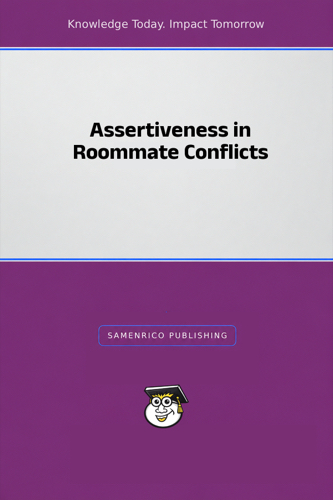
Assertiveness in Roommate Conflicts eBook
Discuss dishes, noise, and guests without passive
by Enos Sherita
Discuss dishes, noise, and guests without passive notes or yelling matches.
Formats
Free sample
Chapter 1: The Spoon That Ended Everything--–- It started, as most roommate wars do, with a spoon.Not a family heirloom. Not a collectible. A standard, dented, slightly discolored spoon from a four-piece set bought at a discount store. It had no business ending a friendship. And yet, when Jenna moved out three months before the lease ended, leaving behind a half-empty bedroom and a note that simply said “I can’t do this anymore,” that spoon sat in the drying rack like a tiny, silver tombstone.The spoon had been left in the sink overnight.
Then through the next day. Then through a second night. By the morning of day three, Jenna’s roommate, Marcus, had washed it, dried it, and placed it on Jenna’s pillow with a sticky note that read: “You missed one.”Jenna came home from work, saw the spoon on her pillow, and felt something snap. Not because of the spoon. Because of the three passive-aggressive notes that had come before it.
Because of the text message argument about who finished the coffee creamer. Because of the six months of silent treatments, slammed cabinets, and the slow, grinding erosion of two people who had once been friends.She didn’t yell. She didn’t leave a note in return. She simply started packing.That is the power of unaddressed conflict. It doesn’t explode in a single, dramatic fight—at least, not at first.
It corrodes. It seeps into the cracks of a shared living situation like water into drywall, and by the time you notice the damage, the structure is already compromised.If you are reading this book, you already know this feeling. You have felt it in your chest when you hear your roommate’s key turn in the lock and you tense up before they even walk through the door. You have felt it when you texted a friend a four-paragraph rant about the dishes, then smiled and said “hey” when your roommate appeared. You have felt it when you lay in bed at night, unable to sleep, rehearsing conversations you will never have, imagining apologies that will never come, calculating the exact cost of breaking your lease versus the cost of your sanity.Welcome to the unique hell of roommate conflict.
And welcome to the way out.The Friendship Trap: Why We Avoid Conflict with People We Live With Here is the paradox that destroys more roommate relationships than any single dirty dish or late-night noise complaint: the closer you are to someone, the harder it is to complain about small things. But the longer you live with someone, the more those small things become big things.Call this The Friendship Trap. It works like this.When you live with a stranger—someone you found on a roommate matching app, someone you share no social connections with, someone you will likely never see again after the lease ends—the cost of speaking up is low. You can say, “Hey, can you keep it down after 10 PM?” without worrying about holiday dinners or mutual friends or the awkwardness of running into them at a party. The relationship is transactional.
Conflict is just negotiation.But when you live with a friend—or even with someone you liked enough to sign a lease with—the stakes feel infinitely higher. You tell yourself: If I say something about the dishes, they’ll think I’m controlling. If I mention the noise, they’ll think I’m uptight. If I bring up their partner who basically lives here, they’ll think I’m jealous or lonely or just difficult to live with.So you say nothing. And nothing.
And nothing.And then one day, you find yourself crying in your car because they left a spoon in the sink.That is not an exaggeration. That is not hyperbole. That is the lived experience of thousands of roommates who have written to advice columns, posted on Reddit threads, and whispered to therapists about the slow, invisible toll of unspoken resentment. The spoon is never the spoon. The spoon is the 147th thing you didn’t say.
The spoon is the accumulated weight of every time you chose silence over conflict, every time you washed their dish instead of asking them to wash it, every time you put on headphones instead of asking them to turn down the volume.The Friendship Trap convinces you that speaking up will destroy the relationship. But here is the truth that this book will spend the next eleven chapters proving: silence destroys relationships far more efficiently than assertiveness ever could.Jenna and Marcus were not destroyed by a spoon. They were destroyed by the six months of silence that preceded it. The spoon was just the final straw. And by the time the spoon appeared on the pillow, there was no relationship left to save.The Power Dynamics You Didn’t Know Were There If the Friendship Trap explains why we stay silent, power dynamics explain why we feel so anxious when we finally consider speaking up.Every roommate situation contains hidden power imbalances that make assertiveness feel risky.
Some of these are obvious. Some are invisible until you know where to look.The Leaseholder versus the Subletter. If your name is on the lease and your roommate’s is not, you hold the legal power. You can theoretically ask them to leave (with proper notice, depending on local laws). But that power often backfires emotionally—you may feel guilty about your advantage, or you may worry that any complaint will sound like a threat.
Conversely, if you are the subletter, you may feel like a guest in your own home, afraid that any complaint will get you kicked out.The Original Tenant versus the New Arrival. There is a world of difference between moving into someone else’s established home and moving in with a new roommate in a neutral apartment. The original tenant has already arranged the kitchen, claimed the good closet, and established routines. The new arrival often feels like they are intruding—and may hesitate to ask for changes because “this is how it was before I got here.”The Higher Earner versus the Tighter Budget. When one roommate makes significantly more money, small requests take on different meanings.
Asking a higher-earning roommate to contribute more to utilities might feel reasonable. Asking a tighter-budget roommate to pay for a noise-canceling machine might feel cruel. But these dynamics are rarely discussed openly, which means they fester in the dark.The Closer Friend versus the Acquaintance. In shared houses with multiple roommates, alliances form. The person who is closer to the rest of the house has social power.
The person who is newer or more peripheral may feel that any complaint will be dismissed or ridiculed.The Romantic Couple versus the Single Roommate. This is perhaps the most volatile dynamic of all. When two roommates are dating, they automatically outvote the third. They share a bedroom, which means they have private space that the single roommate lacks. They may default to defending each other in conflicts.
The single roommate often feels like a perpetual guest in the couple’s home—and that feeling breeds resentment that is rarely…
This is the end of the free sample. Get the eBook to keep going. Buy now
About this book
Details
- Author
- Enos Sherita
- Publisher
- SamEnrico
- Language
- English
- Genre
- Non-Fiction, Self-Help, Shared Living
- Released
- 2026-06-10
- Pages (approx.)
- 140
- Available as
- eBook, Audiobook

Read better in the ZLOADR app
Your eBooks on your phone or tablet. Sign in with your SamEnrico account and start reading.
More by Enos Sherita
 Step Nine Amends Action PlanEnos Sherita$11.99
 Pharmacology Drug GuideEnos Sherita$11.99
 Air Force Pilot MemoirEnos Sherita$11.99
 Grade Pressure Relief GuideEnos Sherita$11.99
 Anhedonia Treatment GuideEnos Sherita$11.99
 Abandoned Child Healing JourneyEnos Sherita$11.99
 Disappointment In ChurchEnos Sherita$11.99
 British 17-pounder Anti-Tank GunEnos Sherita$11.99
 The Last Stand of the Bletchley Codebreakers: Alan Turing's Unfinished FightEnos Sherita$11.99
 The Last Oracle: How a Forgotten Seer Predicted the Fall of RomeEnos Sherita$11.99
 Frozen Horizons: The Secret Antarctic Expedition That Redefined ExplorationEnos Sherita$11.99
 The Complete Guide to Responsive DietingEnos Sherita$11.99