
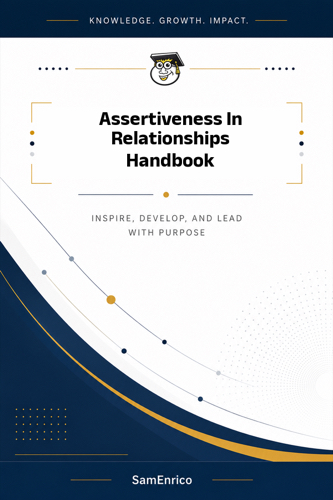
Non-FictionSelf-HelpRelationship Skills
Assertiveness In Relationships Handbook eBook
Sets boundaries with partners, family, and friends
Sets boundaries with partners, family, and friends without damaging bonds.
Formats
Free sample
Chapter 1: The Assertiveness Compass--–- Megan had spent forty-five minutes staring at her phone. Her mother had texted: "Coming for Sunday dinner. Bring your famous brownies. Love you!" The problem was that Megan had already told her mother three times this month that Sundays were now her only day to rest. Each previous attempt to set the boundary had ended the same way: her mother crying, Megan apologizing, and the boundary dissolving like sugar in rain.
Now, staring at the message, Megan felt the familiar twin weights of dread and self-contempt. She would say yes again. She would resent it. And she would spend Monday exhausted, wondering why she couldn't just speak up.If you recognize yourself in Megan, you are not weak. You are not broken.
And you are certainly not alone.The inability to set boundaries without guilt is not a character flaw. It is a survival strategy you learned—and it worked, for a while. But survival strategies eventually become prisons. This chapter gives you the map to walk out.Before you can set a single boundary with a partner, parent, or friend, you must understand the internal landscape where boundary-setting lives or dies: your sense of rights, your definition of respect, and your default communication style. This chapter builds what we call the Assertiveness Compass—a set of four directional tools that will guide every conversation in this book.Why Rights Matter More Than Rules Most people who struggle with assertiveness have never been told, explicitly and without apology, what they are actually allowed to want.
You have likely absorbed a set of silent prohibitions: I am not allowed to disappoint people. I am not allowed to prioritize myself if someone else has a need. I am not allowed to change my mind after saying yes. I am not allowed to have feelings that make others uncomfortable.These prohibitions are not laws. They are ghosts.The first task of the Assertiveness Compass is to replace those ghosts with a written charter of your fundamental interpersonal rights.
These are not permissions you must earn. They are not contingent on being "nice enough" or "reasonable enough." They are simply true.Your Fundamental Assertive Rights The right to say no without providing a jury-ready explanation. "No" is a complete sentence, though in practice you will often choose to add warmth. The point is that you do not owe a deposition.The right to change your mind. Consent and agreement are not cement.
New information, new feelings, or simple fatigue are valid reasons to revise a previous yes.The right to have feelings—including anger, sadness, disappointment, and frustration—without being required to justify their existence.The right to make mistakes and to apologize for them without that apology becoming an admission that you are fundamentally bad.The right to prioritize your own well-being, even when others have needs. Their needs do not automatically override yours.The right to ask for what you want, knowing that the other person also has the right to say no.The right to have privacy—physical, digital, and emotional—without being accused of hiding something.The right to take time to respond. You do not need to answer a text, a request, or a question immediately.The right to spend time alone without that being interpreted as rejection of others.The right to end relationships that consistently disrespect your boundaries, without that being a "failure."Read that list again. Notice where your body tenses. Those points of tension are not evidence that the right is wrong.
They are evidence that someone, somewhere, taught you that you did not deserve that right. That teaching was the problem, not the solution.The Other Person's Rights: Assertiveness Is Not Domination There is a caricature of assertiveness that floats through popular culture: the person who "tells it like it is," who "doesn't care what anyone thinks," who steamrolls others in the name of "being real." That is not assertiveness. That is aggression dressed in costume.Assertiveness is built on a symmetrical recognition: you have rights, and so does the other person. Their rights do not cancel yours, and yours do not cancel theirs. The goal is never to win.
The goal is to be clear.The other person's fundamental rights include:The right to say no to your requests The right to have feelings about your boundaries (including disappointment or anger)The right to ask for clarification The right to take time to respond The right to end the relationship if they find your boundaries unacceptable Notice what is not on that list. The other person does not have the right to punish you for your boundaries. They do not have the right to yell, threaten, guilt-trip, or give you the silent treatment as a tool of coercion. Those are not expressions of rights; they are violations of yours.The Assertiveness Compass points true north only when you hold both sets of rights simultaneously. If you focus only on your rights, you become aggressive.
If you focus only on theirs, you become passive. The middle path—assertiveness—is the constant, conscious balancing of both.Identifying Your Default Style: The Four Directions Most of us do not arrive at assertiveness naturally. We have default settings—autopilot responses that activate under stress. The Assertiveness Compass helps you identify which direction your autopilot takes, because you cannot change a pattern you cannot see.Take out a journal or open a notes app. As you read through the four styles below, do not judge yourself.
Simply notice which descriptions land with a painful familiarity.The Passive Style Passive individuals consistently prioritize others' needs over their own, not from generosity but from fear. They say yes when they mean no. They apologize for having needs. They assume that conflict is always their fault. Their typical statements include: "It's fine" (when it is not fine), "I don't really need anything" (when they do), "Whatever you want" (when they have a preference), and "Sorry, sorry, sorry" (when no apology is due).Physically, passivity shows up as averted eyes, hunched shoulders, a soft voice that trails off, and hands that fidget or hide.
Internally, the passive person experiences resentment that they feel too guilty to express, exhaustion from constant self-monitoring, and a quiet fury at themselves for never speaking up.The cost of passivity is not just personal burnout. It is relational dishonesty. When you say "It's fine" and it is not fine, you are lying to protect the other person from discomfort. That lie erodes trust over time—not because you are malicious, but because the other person eventually senses that they cannot believe your yes.The Aggressive Style Aggressive individuals prioritize their own needs over others' rights. They confuse assertiveness with winning.
They may yell, interrupt, insult, or use sarcasm as a weapon. Their typical statements include: "You always…" "You never…" "That's stupid" "I don't care what you think" and the classic aggressive non-apology: "I'm sorry you feel that way."Physically, aggression shows up as pointing fingers, invading personal space, loud volume, fast pace, and a forward-leaning posture that signals threat. Internally, aggressive individuals often feel justified ("They needed to hear it") but also lonely—because…
This is the end of the free sample. Get the eBook to keep going. Buy now
About this book
Details
- Author
- Wertz Filomena
- Publisher
- SamEnrico
- Language
- English
- Genre
- Non-Fiction, Self-Help, Relationship Skills
- Released
- 2026-06-08
- Pages (approx.)
- 97
- Available as
- eBook, Audiobook

Read better in the ZLOADR app
Your eBooks on your phone or tablet. Sign in with your SamEnrico account and start reading.
More by Wertz Filomena
 Self Hypnosis for Past Life RegressionWertz Filomena$11.99
 The Parent Social Life ReclamationWertz Filomena$11.99
 Homesourcing Customer SupportWertz Filomena$11.99
 Sunflower Field VisualizationWertz Filomena$11.99
 The Last Letter of Cleopatra SeleneWertz Filomena$11.99
 Designated Regional Areas ExplainedWertz Filomena$12.99
 Currency and Payment SettlementsWertz Filomena$12.99
 Understanding Renal Genital Middle Ear AnomaliesWertz Filomena$17.99
 IT Security SpecialistWertz Filomena$11.99
 How to Start a National Fundraising and Engagement Business (Beginners Guide)Wertz Filomena$11.99
You may also like
 Hong Kong Handover 1997Dunn Johnnie$11.99
 Zumba For Postnatal Recovery CourseNeal Christian$11.99
 Zumba for BeginnersLadner Nikia$11.99
 YouTube Comment Mining GuideHumes Pandora$12.99
 Worry Box MeditationCarlin Rudy$11.99
 Workplace Stress MeditationNguyen Lynn$11.99
 Workplace Stress and Sleep RepairHawley Ivory$11.99
 Workplace Perfectionism CureDelaney Jeffry$11.99
 Workplace Injustice Anger GuideWallen Isabelle$11.99
 Work Addiction and Burnout LinkGreenwood Ester$11.99
 Women in Yoga and WellnessBeattie Galina$11.99
 Women in Stand Up ComedyChun Evangeline$11.99