
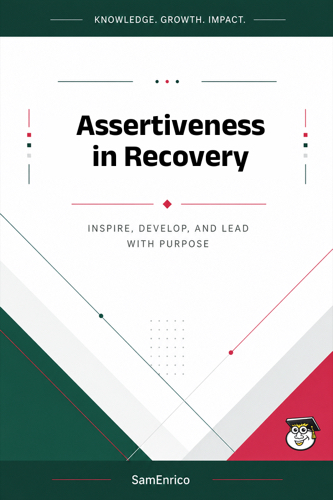
Assertiveness in Recovery eBook
Set sobriety boundaries with friends and family wi
Set sobriety boundaries with friends and family without aggression.
Formats
Free sample
Chapter 1: The Three Masks--–- The first time someone in recovery tries to say “no,” their hands usually shake. Not because the request is dangerous. Not because the person asking is threatening. But because their body has been trained, over years or decades, to believe that compliance equals survival. This chapter is about unlearning that training.Before we can build assertive sobriety, we have to name the problem.
And the problem is not that you don’t know how to set boundaries. The problem is that you have already learned how to set boundaries—badly. Addiction and dysfunctional family systems are master teachers. They do not leave you empty-handed. They hand you three masks, three scripts, three ways of surviving that feel like protection but are actually poison.
These are the three toxic communication styles that every person in recovery must recognize before they can replace them with something real.The School of Hard No’s Think back to the first time you wanted to say “no” but didn’t. You were probably young. Someone asked you for something you did not want to give—your time, your attention, your silence, your agreement. And you said “yes” because saying “no” felt too expensive. Maybe the person would get angry.
Maybe they would withdraw their love. Maybe they would leave. So you learned a lesson that no one spoke aloud but everyone understood: Your value comes from what you give, not from who you are.Active addiction doubles down on this lesson. When you are using, every boundary is a threat. If you say “no” to a dealer, you might lose access.
If you say “no” to a using buddy, you might be alone. If you say “no” to a family member who enables you, you might lose housing, money, or the fragile illusion that someone cares. So you adapt. You survive. And the survival strategies you develop become the very walls you will later have to tear down.This chapter introduces three specific survival masks.
You may wear one predominantly. You may switch between all three depending on who is in the room. Most people in recovery recognize themselves in at least two of them. There is no shame in this. The shame would be staying in the mask once you know it is a mask.Mask One: The Martyr (Passive Style)The Martyr says “yes” to everything and resents everyone.
This is the person who never refuses a request—from a friend needing money, from a family member needing a ride, from a boss needing overtime, from a stranger needing directions. On the outside, the Martyr looks generous, selfless, patient. On the inside, the Martyr is a simmering pot of rage, exhaustion, and secret contempt.How the Martyr learns this style: In a dysfunctional family, the Martyr was often the peacekeeper. They learned early that conflict was dangerous. If Dad came home drunk and angry, the Martyr learned to make themselves small, agreeable, invisible.
They learned that their job was to absorb discomfort so that others did not have to. As adults, they bring this same logic into every relationship: If I just give enough, no one will get angry. If I just say yes enough, no one will leave.What the Martyr sounds like: “Sure, I can drive you to the airport at 5 AM even though I have a meeting at 8.” “No problem, I’ll cover your shift again.” “I don’t mind watching the kids all weekend even though I’m exhausted.” The Martyr says these things with a smile. Later, alone, they mutter under their breath: No one ever helps me. No one ever asks how I’m doing.
I do everything for everyone and I get nothing.Why the Martyr is dangerous in recovery: The Martyr’s “yes” is a lie. And lies are the currency of addiction. When a Martyr says “yes” to being around alcohol to avoid disappointing a friend, they are not protecting the relationship. They are protecting their own fear of conflict. That fear is exactly what leads to relapse—not because the Martyr wanted to drink, but because they could not tolerate the discomfort of saying “no” and watching someone’s face fall.The Martyr’s core belief: If I am useful, I am safe.The Martyr’s blind spot: Resentment is not generosity.
A yes that costs you your sobriety is not kindness. It is self-abandonment.Mask Two: The Prosecutor (Aggressive Style)The Prosecutor says “no” with anger, blame, or intimidation. This is the person who has learned that volume equals conviction, that the loudest voice wins, and that the best defense is a good offense. The Prosecutor does not have trouble saying “no.” They have trouble saying “no” without burning the house down.How the Prosecutor learns this style: In a dysfunctional family, the Prosecutor was often the one who learned that passivity led to being hurt. Maybe they had a parent who only listened when you yelled.
Maybe they grew up in an environment where softness was punished and aggression was rewarded. Maybe they learned, through painful experience, that the only way to protect yourself is to strike first. The Prosecutor’s aggression is not born from cruelty. It is born from fear—the fear that if they do not dominate the interaction, they will be dominated.What the Prosecutor sounds like: “Absolutely not. And don’t ask me again.” “You’ve got some nerve even suggesting that.” “Are you seriously going to stand there and try to guilt me?” The Prosecutor’s voice rises.
Their body language becomes sharp—pointing fingers, crossed arms, leaning into the other person’s space. They confuse intensity with honesty.Why the Prosecutor is dangerous in recovery: The Prosecutor’s “no” is correct in content but wrong in delivery. They are right to refuse the drink. They are right to leave the bar. But the way they say it creates isolation.
Friends stop inviting them anywhere. Family members walk on eggshells. The Prosecutor tells themselves, Good. I don’t need them anyway. But isolation is the predator of recovery.
A person with no one to call at midnight is a person at high risk of relapse.The Prosecutor’s core belief: If I am intimidating, I am safe.The Prosecutor’s blind spot: Aggression is not assertiveness. A no that drives everyone away is not strength. It is fear dressed up as armor.Mask Three: The Fixer (Passive-Aggressive Style)The Fixer says “yes” to someone’s face and then sabotages, withdraws, or gossips behind their back. This is the most confusing mask because it looks like kindness on the surface and feels like betrayal underneath. The Fixer avoids direct conflict at all costs—but they do not let go of their anger.
They just redirect it.How the Fixer learns this style: In a dysfunctional family, the Fixer learned that direct confrontation was punished but indirect resistance was safe. Maybe they had a parent who would explode if you said “no” but would barely notice if you “forgot” to do the chore. Maybe they learned that silence was survival but that silent anger was a form of control. The Fixer becomes an…
This is the end of the free sample. Get the eBook to keep going. Buy now
About this book
Details
- Author
- Rooney Theressa
- Publisher
- SamEnrico
- Language
- English
- Genre
- Non-Fiction, Self-Help, Addiction
- Released
- 2026-06-07
- Pages (approx.)
- 128
- Available as
- eBook, Audiobook

Read better in the ZLOADR app
Your eBooks on your phone or tablet. Sign in with your SamEnrico account and start reading.
More by Rooney Theressa
 Pharma Logistics Growth OutlookRooney Theressa$11.99
 NVC Self Empathy Practice WorkbookRooney Theressa$11.99
 Holdco PIK Toggle NoteRooney Theressa$11.99
 The Financial Harm of GamblingRooney Theressa$11.99
 The Sultan's Illusion: The Great Ottoman Heist of 1789Rooney Theressa$11.99
 Understanding Simpson–golabi–behmel SyndromeRooney Theressa$17.99
 Stock ClerkRooney Theressa$11.99
 WhatsApp Business Sales GuideRooney Theressa$12.99
 Tiered Pricing Without OverwhelmRooney Theressa$12.99
 How to Become a Level-glass-forming-machine OperatorRooney Theressa$11.99
You may also like
 Hong Kong Handover 1997Dunn Johnnie$11.99
 Zumba For Postnatal Recovery CourseNeal Christian$11.99
 Zumba for BeginnersLadner Nikia$11.99
 YouTube Comment Mining GuideHumes Pandora$12.99
 Worry Box MeditationCarlin Rudy$11.99
 Workplace Stress MeditationNguyen Lynn$11.99
 Workplace Stress and Sleep RepairHawley Ivory$11.99
 Workplace Perfectionism CureDelaney Jeffry$11.99
 Workplace Injustice Anger GuideWallen Isabelle$11.99
 Work Addiction and Burnout LinkGreenwood Ester$11.99
 Women in Yoga and WellnessBeattie Galina$11.99
 Women in Stand Up ComedyChun Evangeline$11.99