
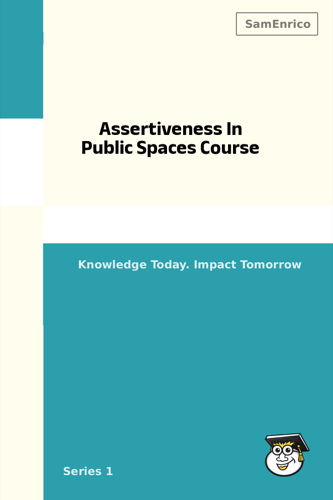
Non-FictionSelf-HelpPublic Interaction
Assertiveness In Public Spaces Course eBook
Responds to street harassment, line-cutting, and p
Responds to street harassment, line-cutting, and public rudeness.
Formats
Free sample
Chapter 1: The Freeze Frame--–- It happens in a split second. One moment you are walking down the street, standing in line, or sitting on a train, minding your own business. The next moment, someone violates the unspoken social contract that makes public life possible. A man's voice slides across your shoulder: "Smile, baby, it's not that bad." A body presses past you in the queue with a muttered "Yeah, I'm in a hurry." A backpack smacks your arm for the third time as its owner scrolls their phone, oblivious. And then something strange happens inside you.Your brain goes blank.Not metaphorically blank.
Neurologically blank. The witty comeback you rehearsed in the shower? Gone. The calm "Excuse me, I was here first" you promised yourself you would say next time? Your mouth cannot find it.
Instead, you feel a hot flush across your chest, a strange numbness in your fingers, and a voice in your head that sounds nothing like you—it sounds like a scared child asking, "Did I do something wrong?"You haven't done anything wrong. But in that frozen moment, you cannot remember that. All you can remember is the overwhelming urge to look down, move away, and become very, very small.This book is about what happens in that split second. More importantly, this book is about what happens after that split second—when you learn to recognize the freeze, understand why it happens, and replace it with something that is neither passive silence nor aggressive explosion. That something is assertiveness.
And despite what you may have been told, it is not a personality trait you are born with. It is a skill. And like any skill, it can be learned, practiced, and mastered.But first, you need to understand the enemy. And the enemy is not the catcaller, the line-cutter, or the manspreader. The enemy is the story you tell yourself about why you froze.The Story You Tell Yourself After the incident—after you have walked away, found a bathroom stall or a quiet corner, and let the adrenaline crash wash over you—the real suffering begins.
It is not the rudeness that haunts you. It is the voice in your head that says: Why didn't you say anything? Why are you like this? What is wrong with you?You replay the moment like a film director trapped in an editing bay. You imagine the perfect response.
You see yourself turning slowly, making calm eye contact, and delivering a line so devastating that the harasser apologizes and the crowd applauds. Then you snap back to reality—the reality where you said nothing, where you looked at your shoes, where you hurried away with your heart pounding in your ears.That voice is lying to you. Not because it is malicious, but because it does not understand the biology of what just happened. It does not understand that you did not freeze because you are weak. You froze because you are human.
And human beings, when confronted with unexpected social conflict, do not have access to the clever parts of their brain. They have access to the ancient parts—the parts designed to detect predators on the savanna, not rude strangers on the subway.The 30 Percent Rule Let me tell you about a finding that will change how you think about every future moment of public rudeness. Researchers studying the effects of incivility have discovered something remarkable: witnessing or experiencing rude behavior lowers cognitive function by up to 30 percent. Let me say that again. When someone cuts in front of you, your IQ drops by nearly a third.
You do not feel dumber. You are dumber. Temporarily, but measurably.Think about what that means. The moment you need your brain the most—the moment you need to summon the perfect combination of calm, clarity, and boundary-setting—your brain is operating at a significant disadvantage. Your working memory is compromised.
Your verbal fluency is impaired. Your ability to assess risk and predict consequences is degraded. You are, in the most literal sense, not yourself.This is not a character flaw. This is biology.When you experience incivility, your body releases cortisol and adrenaline. These hormones are designed for physical threat: running from a predator, fighting off an attacker, lifting a car off a trapped child.
They are not designed for social negotiation. They flood your system, redirect blood flow away from your prefrontal cortex (the rational, planning part of your brain) and toward your limbs and core. Your body is preparing to fight or flee. It is not preparing to say, "Excuse me, I believe the line ends back there."The freeze you experience—that terrifying moment when your mind goes blank and your mouth won't move—is not a failure of character. It is a success of evolution.
Your body correctly identified a potential threat and diverted resources accordingly. The problem is not your biology. The problem is that modern public life presents social threats that your ancient biology does not know how to handle.The Spectrum of Rudeness Not all public rudeness is the same. In fact, what we call "rudeness" covers a wide range of behaviors, from the mildly annoying to the genuinely dangerous. Understanding this spectrum is the first step toward knowing how to respond—and, just as importantly, knowing when not to respond.At the mild end of the spectrum is what we might call unfocused rudeness.
This is the person on their phone who accidentally blocks the grocery aisle. The teenager whose music leaks from their headphones. The tourist who stops suddenly in the middle of a crowded sidewalk. These people are not trying to hurt you or assert dominance. They are simply oblivious.
They are living in their own bubble, and you happen to be in the way.Unfocused rudeness requires a gentle response, if any response at all. A simple "Excuse me" is usually enough. If it is not enough, the best strategy is often to go around them—literally and metaphorically. These are not battles worth fighting.In the middle of the spectrum lies micro-aggressions and social violations. This is the clerk who ignores you while finishing a personal conversation.
The person who cuts in line with a muttered "I'm in a hurry." The passenger who manspreads across two seats. These behaviors are not accidental. They are choices—small choices that prioritize one person's comfort over another's dignity. They are often gendered, racialized, or class-based. A woman is ignored at a counter while a man behind her is served.
A person of color is followed through a store while white shoppers are left alone. A person in a wheelchair is spoken to as if they are a child.These are the situations where assertiveness is most useful. The person is not dangerous—likely just entitled or thoughtless. But their behavior has real impact. And your response can change not only that interaction but also the thousands of future interactions that person will have with other people.At the far end of the spectrum lies targeted harassment.
This is the catcall that follows you down the street. The person who invades your physical space despite your clear…
This is the end of the free sample. Get the eBook to keep going. Buy now
About this book
Details
- Author
- Holder Maxwell
- Publisher
- SamEnrico
- Language
- English
- Genre
- Non-Fiction, Self-Help, Public Interaction
- Released
- 2026-06-11
- Pages (approx.)
- 129
- Available as
- eBook, Audiobook

Read better in the ZLOADR app
Your eBooks on your phone or tablet. Sign in with your SamEnrico account and start reading.
More by Holder Maxwell
 The Workplace Walking BreakHolder Maxwell$11.99
 E Limitation MethodHolder Maxwell$11.99
 ABCDE For PerfectionistsHolder Maxwell$11.99
 The Rheumatoid Arthritis Medication GuideHolder Maxwell$11.99
 The Silicon Pioneers: Black Engineers Who Built the Modern WorldHolder Maxwell$11.99
 How to Become a Plug SorterHolder Maxwell$11.99
 Understanding Richieri–Costa–guion–Almeida DwarfismHolder Maxwell$17.99
 Rwanda Student Safety GuideHolder Maxwell$12.99
 Nigeria Zero Rated VAT GuideHolder Maxwell$12.99
 Mechanical AssemblerHolder Maxwell$11.99
You may also like
 Hong Kong Handover 1997Dunn Johnnie$11.99
 Zumba For Postnatal Recovery CourseNeal Christian$11.99
 Zumba for BeginnersLadner Nikia$11.99
 YouTube Comment Mining GuideHumes Pandora$12.99
 Worry Box MeditationCarlin Rudy$11.99
 Workplace Stress MeditationNguyen Lynn$11.99
 Workplace Stress and Sleep RepairHawley Ivory$11.99
 Workplace Perfectionism CureDelaney Jeffry$11.99
 Workplace Injustice Anger GuideWallen Isabelle$11.99
 Work Addiction and Burnout LinkGreenwood Ester$11.99
 Women in Yoga and WellnessBeattie Galina$11.99
 Women in Stand Up ComedyChun Evangeline$11.99