
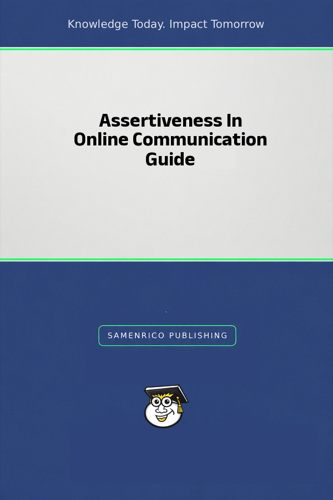
Non-FictionSelf-HelpDigital Communication
Assertiveness In Online Communication Guide eBook
Sets boundaries on social media, group chats, and
Sets boundaries on social media, group chats, and text threads.
Formats
Free sample
Chapter 1: The Silent Roar--–- You just sent a text that felt perfectly clear in your head. Three minutes later, your phone buzzes with a reply that makes your stomach drop: "Wow. Rude." You re-read what you wrote. It wasn't rude. It was honest, direct, and—you thought—kind.
But somewhere between your intention and their interpretation, the message broke. This is the silent roar of digital communication: the experience of speaking at a normal volume online, only to discover that no one heard what you actually said. Instead, they heard a version filtered through their own exhaustion, their own past disappointments, their own assumption that you meant harm. And now you are left apologizing for something you never said, defending a tone you never used, and wondering why something as simple as setting a boundary has become so impossibly hard.The Hidden Crisis of Online Assertiveness Let us name what almost everyone feels but few articulate: the gap between who you are in person and who you become on a screen. In face-to-face conversations, you know how to be firm but fair.
You know how to say "no" without losing a friend. You know how to disagree without destroying a relationship. You have a lifetime of practice reading faces, hearing vocal inflections, and adjusting your message in real time based on the tiny micro-expressions that tell you whether you are being understood. That is your superpower as a social animal. Now remove all of it.
Remove the warm smile that softens a refusal. Remove the gentle hand gesture that signals "I'm on your side." Remove the ability to hear the wobble in someone's voice that tells you they are hurt rather than angry. Remove the immediate feedback loop that allows you to say, "Wait, that came out wrong—let me rephrase." What remains is text. Just text. And text, as we will see throughout this book, is the most dangerous medium for assertiveness precisely because it looks so safe.This book exists because a quiet epidemic is sweeping through modern life.
The epidemic is not anxiety or depression, though those are its close cousins. The epidemic is the slow erosion of the ability to say "no" online. Every day, millions of people agree to things they do not want to do because saying "no" over text feels too harsh. They attend events they despise because declining a calendar invitation feels like an act of war. They lend money they cannot afford because the request arrived in a direct message where the absence of body language made the asker seem more vulnerable than they actually were.
They stay in group chats that drain their energy because leaving feels like a public performance of rejection. They type "haha" when they are not amused. They type "sounds good" when they mean "absolutely not." And then they wonder why they feel so exhausted by phones that were supposed to make life easier.This chapter begins where all meaningful change begins: with a clear-eyed diagnosis of the problem. Why does assertiveness fail online? What is different about a screen that turns confident people into chronic over-apologizers or, conversely, into rage-typing monsters they would never be in person?
And most importantly, how can you begin to identify your own default patterns so that you can start rewriting them?The Missing Body: Why Your Good Intentions Get Buried Let us start with a simple but profound truth: human beings did not evolve to communicate through text. For the vast majority of our species' history, every single interaction happened face to face. We developed an exquisitely sensitive system for reading each other's internal states through external signals. When someone's pupils dilate, you unconsciously register interest. When their voice drops slightly at the end of a sentence, you register uncertainty.
When their shoulders rise toward their ears, you register anxiety. These signals happen in milliseconds, below the level of conscious thought, and they serve as the invisible scaffolding that holds every conversation together. You are not aware of this scaffolding when it is present. You only notice it when it is gone.Online, the scaffolding collapses. Your message arrives alone.
No pupils. No voice. No shoulders. Nothing but flat, uniform pixels arranged into letters. The recipient has no choice but to guess your emotional state based on the only information available: word choice, punctuation, and timing.
And here is where psychology delivers its cruelest blow. Research on what is called "hostile attribution bias" shows that when humans lack information about someone's intent, they do not guess randomly. They guess negatively. In the absence of clear signals that you mean well, the default assumption is that you mean ill. A neutral statement like "We need to talk about the project" becomes a threat.
A brief reply like "Okay" becomes passive-aggressive dismissal. A delayed response becomes evidence that you are angry. Your friendly, well-intentioned message arrives like a guest at a party where everyone has already decided they do not like them.This is the first great asymmetry of digital communication: your intention is invisible, but their interpretation is immediate. You spend three minutes carefully crafting a message that is honest but not harsh. They spend three seconds reading it through the lens of their own bad day, their own previous disappointments with you or with someone who looks like you, and their own assumption that if something could be read negatively, it should be.
By the time you realize the gap, you are already on the defensive, typing out apologies for a crime you did not commit.The Keyboard Effect: Why You Become Either a Mouse or a Monster If the absence of body language explains why others misunderstand you, something else explains why you misunderstand yourself. The "Keyboard Effect" is a term we will use throughout this book to describe a specific psychological shift: the moment your fingers touch a keyboard or screen, your sense of consequence changes. In person, you feel the weight of another human being's presence. You see their face. You hear their breath.
You know, viscerally, that your words will land on a living person who will carry them home, replay them in bed, and maybe cry. That weight keeps you in the middle range of behavior. You are not perfect, but you are not cruel. You are, in most cases, reasonably kind.Behind a screen, that weight vanishes. The other person becomes a profile picture, a username, a string of blue bubbles.
They become abstract. And when someone becomes abstract, two things happen, one at each extreme. The first is passivity: the complete collapse of assertiveness into accommodation, avoidance, or disappearance. You become the person who says "sorry" five times in a single message. You become the person who types out a boundary, stares at it for ten minutes, and then deletes it, replacing it with "sure, no problem." You become the person who ghosts—not because you are cruel, but because the thought of typing a direct "no" produces so much anxiety that your brain chooses disappearance as the only tolerable option.
Ghosting, when used to avoid mild discomfort, is the ultimate form of digital passivity: you are so afraid of the…
This is the end of the free sample. Get the eBook to keep going. Buy now
About this book
Details
- Author
- Cowan Chrystal
- Publisher
- SamEnrico
- Language
- English
- Genre
- Non-Fiction, Self-Help, Digital Communication
- Released
- 2026-06-09
- Pages (approx.)
- 112
- Available as
- eBook, Audiobook

Read better in the ZLOADR app
Your eBooks on your phone or tablet. Sign in with your SamEnrico account and start reading.
More by Cowan Chrystal
 Eliminate Quadrant TasksCowan Chrystal$11.99
 Morning Walking RitualsCowan Chrystal$11.99
 Schedule Quadrant Two TimeCowan Chrystal$11.99
 The Black Dahlia Crime Scene PhotographyCowan Chrystal$11.99
 The Silent Strategist: How Japan's 'Father of Baseball' Built a National ObsessionCowan Chrystal$11.99
 Understanding RhypophobiaCowan Chrystal$17.99
 How to Become a Lens-mold SetterCowan Chrystal$11.99
 MaskmakerCowan Chrystal$11.99
 Rwanda Tuition and Living CostsCowan Chrystal$12.99
 EU VAT Rates ComparisonCowan Chrystal$12.99
You may also like
 Hong Kong Handover 1997Dunn Johnnie$11.99
 Zumba For Postnatal Recovery CourseNeal Christian$11.99
 Zumba for BeginnersLadner Nikia$11.99
 YouTube Comment Mining GuideHumes Pandora$12.99
 Worry Box MeditationCarlin Rudy$11.99
 Workplace Stress MeditationNguyen Lynn$11.99
 Workplace Stress and Sleep RepairHawley Ivory$11.99
 Workplace Perfectionism CureDelaney Jeffry$11.99
 Workplace Injustice Anger GuideWallen Isabelle$11.99
 Work Addiction and Burnout LinkGreenwood Ester$11.99
 Women in Yoga and WellnessBeattie Galina$11.99
 Women in Stand Up ComedyChun Evangeline$11.99