
Non-FictionSelf-Help / Marriage
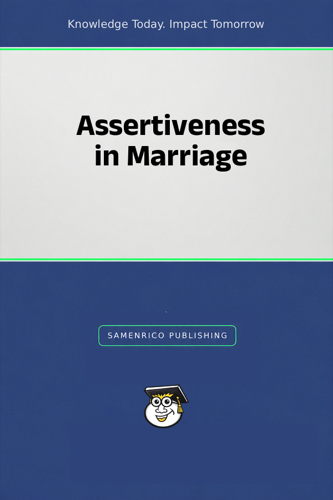
Assertiveness in Marriage eBook
Maintains individuality and voice within committed
by Binder Ronda
Maintains individuality and voice within committed partnership.
Formats
Free sample
Chapter 1: The Togetherness Trap--–- Every couple has a creation myth. The story they tell at dinner parties, the one that made their friends sigh at the wedding, the one they repeat to themselves in moments of doubt. For Mark and Jenna, the myth was this: We do everything together. We never need a break from each other. That’s how you know it’s real.They met in graduate school, married two years later, and spent the next decade building a life that looked, from the outside, like a masterclass in marital devotion.
They worked from home together, ran a small business together, vacationed together, socialized exclusively as a pair. Neither had a separate friend group. Neither had a hobby the other didn’t share. When well-meaning friends suggested time apart—“You should each take a weekend with your own friends”—Mark and Jenna would exchange a knowing smile and say, Why would we want that?For ten years, they believed they had won the marriage lottery.Then, without warning, the wheels came off. Not with a dramatic affair or a screaming fight.
The unraveling began with smaller symptoms. Jenna started staying at her desk an hour later than necessary, not because she had work, but because she couldn’t articulate why she didn’t want to come to the couch. Mark began scrolling his phone during their shared dinners, not because he cared about the news, but because he had run out of things to say to the person who had witnessed every single moment of his day. Their sex life, once vibrant, had dwindled to a perfunctory encounter every few weeks. When they did have sex, it felt less like desire and more like checking a box labeled Healthy Marriage.They came to therapy not because they were fighting, but because they had stopped fighting.
That was the thing that scared them both. Not the absence of peace—they had plenty of that—but the absence of anything. The silence between them was not comfortable. It was the silence of two people who had run out of things to say because they had run out of separate lives to report.“We do everything together,” Jenna told me, her voice flat. “Isn’t that supposed to be the goal?”That question, asked in a thousand variations across a thousand therapy sessions, is why this book exists.
Because the answer—the real answer, the one that contradicts nearly everything we are taught about love—is no. Doing everything together is not the goal. It is, in fact, a trap.The Myth of Two Becoming One Somewhere in the cultural water supply, we have swallowed a dangerous fantasy: that real love means erasing the boundaries between two people. The language of romance reinforces it daily. We speak of “finding our other half,” of “completing” each other, of becoming “one flesh.” Wedding vows often include the phrase “two become one” as if that were the highest aspiration of intimacy.It is not.
It is the highest aspiration of fusion—and fusion, despite its warm and fuzzy connotations, is a psychological state with a dark underbelly.The family systems pioneer Murray Bowen, who spent decades studying how families shape individual behavior, coined the term differentiation of self to describe the capacity to be emotionally close to another person while maintaining your own thoughts, feelings, and desires. Bowen found that the most resilient, functional, and satisfied individuals were not those who merged seamlessly with others. They were those who could say, with equal ease, “I need you close” and “I need my own space.” They could be separate without being isolated. They could be connected without being consumed.Bowen also identified the opposite state: fusion or enmeshment. In fused relationships, boundaries blur.
One person’s anxiety becomes the other’s anxiety. One person’s preference becomes the house rule. Over time, the individuals in a fused relationship stop knowing where they end and the other begins. They finish each other’s sentences, yes—but they also suppress each other’s differences. They avoid conflict not out of maturity, but out of terror that disagreement will shatter the fragile union.Mark and Jenna had built a masterpiece of fusion.
They didn’t argue because they had eliminated the raw materials of argument: separate opinions, separate desires, separate lives. In doing so, they had also eliminated the raw materials of desire itself: mystery, autonomy, and the thrill of being chosen by someone who could just as easily choose to walk away.The Three Relational States To understand where Mark and Jenna went wrong—and to assess where your own marriage might be leaning—it helps to visualize three distinct relational states. Most marriages move between these states depending on the domain (social life, finances, parenting, etc.), but every marriage has a default setting.State One: Enmeshment (Fusion)In enmeshment, the boundary between self and other is porous to the point of invisibility. Partners in enmeshed marriages often describe themselves as “soulmates” or “twins.” They share not only activities but also opinions, emotions, and identities. When asked what they think about a political issue, they answer for the couple, not for themselves.
When asked what they feel, they default to “We feel.”The seduction of enmeshment is safety. If you and your spouse are exactly the same, there is nothing to fight about. There is no risk of rejection because there is no separate self to reject. The cost, however, is staggering. Enmeshment suffocates individuality.
It kills curiosity (what is there to discover about someone who agrees with you on everything?). It breeds resentment that has no outlet because resentment requires a separate self to feel wronged. And it creates a peculiar form of loneliness: the loneliness of being unknown because you have refused to be a person worth knowing.Mark and Jenna had mastered enmeshment. They never fought. They also never desired each other.
The two facts were not unrelated.State Two: Isolation (Cutoff)At the opposite extreme lies isolation. In isolated marriages, partners have erected walls so thick that little emotion or information passes between them. They live parallel lives under the same roof. They have separate friends, separate hobbies, separate schedules—and separate emotional worlds. Unlike enmeshment, isolation preserves individuality.
You know exactly where you end and your spouse begins because the two of you rarely touch.The seduction of isolation is autonomy. No one tells you what to think, feel, or do. The cost, however, is intimacy. Isolation is a fortress that keeps out not only conflict but also connection. Couples in isolated marriages often describe themselves as “roommates” or “business partners.” They may co-parent efficiently and manage household logistics smoothly, but they have stopped knowing each other’s inner lives.
They have stopped mattering to each other in the way that distinguishes a marriage from a corporation.Most couples do not start in isolation. They drift there after years of unresolved conflict or repeated disappointment. Isolation is the marriage’s version of an emotional demilitarized zone—a truce that preserves peace at the expense of love.State Three: Assertive Intimacy The Goldilocks zone sits between enmeshment and isolation. Assertive intimacy is the capacity to be…
This is the end of the free sample. Get the eBook to keep going. Buy now
About this book
Details
- Author
- Binder Ronda
- Publisher
- SamEnrico
- Language
- English
- Genre
- Non-Fiction, Self-Help / Marriage
- Released
- 2026-06-07
- Pages (approx.)
- 138
- Available as
- eBook, Audiobook

Read better in the ZLOADR app
Your eBooks on your phone or tablet. Sign in with your SamEnrico account and start reading.
More by Binder Ronda
 Franchising Your Local Brand Across Borders Localization StrategyBinder Ronda$11.99
 Fat Child Self Esteem RecoveryBinder Ronda$11.99
 Thyroid and MiscarriageBinder Ronda$11.99
 Stimulant Sleep RecoveryBinder Ronda$11.99
 The Vulnerability Opener HandbookBinder Ronda$11.99
 Grief and GamblingBinder Ronda$11.99
 Cortisol Awakening ResponseBinder Ronda$11.99
 The Cursed Lyre of Orpheus: A Symphony of ShadowsBinder Ronda$11.99
 The Harp of Enki: Divine Music That Shaped the WorldBinder Ronda$11.99
 Loan Covenant Testing in Rate ShocksBinder Ronda$12.99
 Freemium Data Bundles IntegrationBinder Ronda$12.99
 How to Produce Graphic Design and Illustration SoftwareBinder Ronda$11.99
You may also like
 Hong Kong Handover 1997Dunn Johnnie$11.99
 Zumba For Postnatal Recovery CourseNeal Christian$11.99
 Zumba for BeginnersLadner Nikia$11.99
 YouTube Comment Mining GuideHumes Pandora$12.99
 Worry Box MeditationCarlin Rudy$11.99
 Workplace Stress MeditationNguyen Lynn$11.99
 Workplace Stress and Sleep RepairHawley Ivory$11.99
 Workplace Perfectionism CureDelaney Jeffry$11.99
 Workplace Injustice Anger GuideWallen Isabelle$11.99
 Work Addiction and Burnout LinkGreenwood Ester$11.99
 Women in Yoga and WellnessBeattie Galina$11.99
 Women in Stand Up ComedyChun Evangeline$11.99