
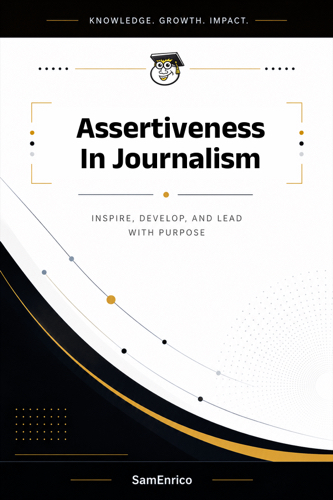
Non-FictionSelf-HelpJournalism
Assertiveness In Journalism eBook
Ask tough questions and pursue truth while maintai
Ask tough questions and pursue truth while maintaining professionalism.
Formats
Free sample
Chapter 1: The Quiet Damage...--–- The email arrived at 11:47 PM on a Tuesday. Sarah Chen, a metro reporter for a mid-sized daily, had spent eighteen months investigating a local chemical plant accused of dumping toxins near an elementary school. She had documents, whistleblower testimony, and soil samples. She had everything except the one question she had never asked the plant's spokesperson during their seven polite, carefully scheduled, professionally cordial interviews. She had never asked: "Why did your internal safety report from 2019 recommend a full shutdown, and why was it ignored?"She had seen the report.
It was buried on page forty-seven of a discovery dump. But every time she sat across from the spokesperson—a friendly, overworked woman named Diane who always remembered Sarah's birthday and once brought her homemade cookies—the question died in Sarah's throat. Diane seemed like a good person. Diane had a family. Diane was just doing her job.
So Sarah asked about timelines, about remediation efforts, about community outreach. She never asked the question that would have ended the investigation in one interview.Three months after publication, a competitor obtained the same report and asked the question. The resulting story won a state press award. Sarah's series, thorough as it was, was forgotten.This is not a story about cruelty, incompetence, or malice. Sarah Chen was not a bad journalist.
She was, by every conventional measure, an excellent one. She was thorough, fair, kind, and well-liked. She was also, in the moment that mattered most, unassertive. And unassertiveness, dressed up as politeness, cost her the story of her career.This book is for every journalist who has ever left an interview knowing they should have asked more. Who has watched a source smile their way out of an answer and felt powerless to stop them.
Who has confused civility with objectivity and silence with professionalism. This book is for Sarah Chen. And if you have ever been Sarah Chen—if you have ever felt the question rising in your throat and then swallowed it—this book is for you, too.The Lie We Tell Ourselves About Politeness The journalism industry has spent decades telling young reporters a soothing falsehood: that politeness is the same as objectivity, that being liked by sources is a measure of professional success, and that the journalist who never upsets anyone is the journalist who is doing their job correctly. This is a lie. And it is a dangerous lie, because it confuses two completely different things: civility (treating people with basic human decency) and passivity (avoiding conflict at the expense of truth).Let us be precise.
Civility means not shouting, not name-calling, not threatening, not humiliating. Civility is good. Civility is necessary. But civility is not the same as avoidance. The polite journalist who never asks a follow-up, who accepts the first answer as sufficient, who lets a source filibuster until the tape runs out—that journalist is not being civil.
That journalist is being unassertive. And unassertiveness serves no one except the powerful who would prefer not to be questioned.Consider the difference between two fictional interview transcripts, both covering a politician who has just been accused of campaign finance violations:Unassertive Interview (Polite but Passive):Journalist: "Senator, there are allegations that your campaign accepted illegal donations. Can you respond?"Senator: "Those allegations are completely false. My campaign has always followed the law. We've submitted all required disclosures, and I'm confident any review will show we did nothing wrong."Journalist: "Thank you, Senator.
Moving on to education policy..."Assertive Interview (Civil but Persistent):Journalist: "Senator, there are allegations that your campaign accepted illegal donations. Can you respond?"Senator: "Those allegations are completely false."Journalist: "Senator, I have a copy of a donation receipt showing a $50,000 contribution from a foreign national, which would be illegal. Can you explain this receipt?"Senator: "I'm not familiar with that document."Journalist: "Your name is on it, Senator. Right here. Can you tell our viewers whose signature this is?"Notice what the assertive journalist did: they did not shout.
They did not call the senator a liar. They did not engage in performative aggression. They simply refused to accept the first answer as sufficient. They had done their homework. They had the document.
And they asked the question that the public needed answered. That is not rudeness. That is evidentiary assertiveness. And it is the central skill this book will teach you.The Principle of Maximum Relevant Truth Let us begin with first principles. If you asked one hundred journalists to state their profession's highest value, most would say "the truth." But what does that mean in practice?
Does it mean reporting whatever anyone says? Does it mean presenting "both sides" even when one side has no evidence? Does it mean avoiding any question that might make a source uncomfortable?This book proposes a different formulation: the Principle of Maximum Relevant Truth. It works like this:A journalist's primary moral duty is to deliver the highest possible quantity of verified, context-rich, relevant truth to the public—limited only by the duty to minimize unnecessary harm.Each word in that sentence matters:Maximum means more is better, not less. It rejects the idea that withholding information is ever the default position.
The default is disclosure; withholding requires justification.Relevant means the truth must be useful to public decision-making. Not all truth is equally valuable. The fact that a politician prefers chocolate ice cream is truth, but it is not relevant truth. The fact that they accepted a bribe is.Verified means the truth must be confirmed through independent evidence. Rumor, innuendo, and unattributed claims are not truth; they are raw material.Context-rich means the truth must be presented with the surrounding facts that give it meaning.
A damning quote without context is not truth; it is manipulation.This principle has a direct implication for assertiveness: if your job is to deliver maximum relevant truth, then asking the hard question is not optional. It is the job. The journalist who fails to ask the question that would have revealed a relevant truth has failed their primary duty.This is a radical claim. It means that passivity is not just a stylistic choice or a personality quirk. It is an ethical failure.
If you had the evidence, if you had the opportunity, and you chose politeness over persistence, you are not being professional—you are being derelict.The Reasonable Reader Standard How do you know which questions are necessary and which are optional? This is a practical problem, not just a philosophical one. In any given interview, there are infinite possible questions. You cannot ask them all. So how do you decide?The Reasonable Reader Standard provides a simple, memorable test.
Before you enter any interview, ask yourself: What would a reasonable person need to know to make an informed decision about this issue?Not a journalist. Not an expert. Not an activist. A reasonable person—someone with ordinary intelligence, ordinary attention span, and ordinary access to information. What would that person need to understand the story well enough to form a reasoned opinion or take informed action?Now ask a second question: If I fail to ask this…
This is the end of the free sample. Get the eBook to keep going. Buy now
About this book
Details
- Author
- Vanover Lieselotte
- Publisher
- SamEnrico
- Language
- English
- Genre
- Non-Fiction, Self-Help, Journalism
- Released
- 2026-06-08
- Pages (approx.)
- 139
- Available as
- eBook, Audiobook

Read better in the ZLOADR app
Your eBooks on your phone or tablet. Sign in with your SamEnrico account and start reading.
More by Vanover Lieselotte
 DBT For Parental EmotionVanover Lieselotte$11.99
 Decompress Without DistanceVanover Lieselotte$11.99
 NASCAR Rivalry ManagementVanover Lieselotte$11.99
 Sleep Consolidation Memory GuideVanover Lieselotte$11.99
 Benzodiazepine Detox UseVanover Lieselotte$11.99
 Anger Communication GuideVanover Lieselotte$11.99
 Refugee Therapy Access ManualVanover Lieselotte$11.99
 The Plague Walls of Venice: Engineering a City Against the Black DeathVanover Lieselotte$11.99
 The Golden Stride: The Untold Story of Joana Coimbra's Olympic TriumphVanover Lieselotte$11.99
 How to Produce Football Face MasksVanover Lieselotte$11.99
 Understanding Cerebral Autosomal Dominant Arteriopathy With Subcortical Infarcts and Leukoencephalopathy (Cadasil)Vanover Lieselotte$11.99
 Stock Footage Channel Scalability PlanVanover Lieselotte$12.99
You may also like
 Hong Kong Handover 1997Dunn Johnnie$11.99
 Zumba For Postnatal Recovery CourseNeal Christian$11.99
 Zumba for BeginnersLadner Nikia$11.99
 YouTube Comment Mining GuideHumes Pandora$12.99
 Worry Box MeditationCarlin Rudy$11.99
 Workplace Stress MeditationNguyen Lynn$11.99
 Workplace Stress and Sleep RepairHawley Ivory$11.99
 Workplace Perfectionism CureDelaney Jeffry$11.99
 Workplace Injustice Anger GuideWallen Isabelle$11.99
 Work Addiction and Burnout LinkGreenwood Ester$11.99
 Women in Yoga and WellnessBeattie Galina$11.99
 Women in Stand Up ComedyChun Evangeline$11.99