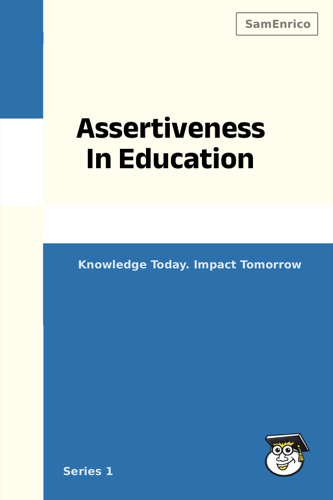
Assertiveness In Education eBook
Students advocating for accommodations and grades.
Students advocating for accommodations and grades.
Formats
Free sample
Chapter 1: The Silent Contract--Every semester, millions of students walk into classrooms and silently agree to a contract they never signed. The terms are never written down, never discussed, and never fair. You know this contract. It says: Do not be a problem. Do not ask for what you need.
If the system doesn't work for you, assume you are the one who is broken.This chapter dismantles that contract.If you are reading this book, something has already gone wrong in your education. Perhaps you received a grade that made no sense against the rubric. Perhaps you asked for extended time on a test and were met with a sigh of visible annoyance. Perhaps you have a diagnosis—ADHD, dyslexia, anxiety, a chronic illness—and you have learned to keep it quiet because the last time you mentioned it, a teacher said, "Everyone feels anxious about tests," as if your clinically documented condition were a matter of insufficient willpower. Or perhaps you have no diagnosis at all, only the sinking feeling that you are working twice as hard as your classmates for the same mediocre results, and you cannot figure out why.Here is the truth that the top ten best-selling books on education, psychology, and self-advocacy converge upon: The educational system was not designed for you.
It was designed for a mythical "normal" student who does not exist. That student arrives on time, submits perfect drafts, never experiences brain fog, never has a panic attack during an exam, and never needs to ask for clarification because the instructions were always clear to them. That student does not exist. And yet, the entire machinery of grades, policies, deadlines, and accommodations operates as if that student is the only one who matters.The result is a profound mismatch. And when a mismatch occurs, the people who run the system almost always blame the person who does not fit.
You are told you are "difficult" for asking. You are told you are "lazy" for needing extensions. You are told you are "entitled" for expecting the same access as everyone else. These labels are not diagnoses of your character. They are defenses of a brittle system.This chapter has three jobs.
First, it will help you recognize the difference between assertiveness and entitlement—because the world will constantly confuse them, and you need to know the difference for your own sanity. Second, it will name the primary emotional barrier that keeps students silent: internalized shame. Third, it will introduce the Emotional Arc of Advocacy, a framework that will guide the rest of this book. By the end of this chapter, you will have a new way of seeing yourself and your education. You are not a burden.
You are a stakeholder in a system that was not built for you—and stakeholders have the right to request changes.The Difference Between Assertiveness and Entitlement Let us begin with the confusion that causes more students to stay silent than any other. Somewhere along the way, you internalized a message: Asking for what you need makes you entitled. This message is wrong, but it is powerful because it contains a grain of truth. There is such a thing as entitlement. There is such a thing as demanding outcomes that you did not earn or that would unfairly disadvantage others.
But assertiveness is not entitlement. They are opposites.Entitlement demands a specific result regardless of process. The entitled student says, "I deserve an A because I tried hard" even when the rubric shows missing requirements. The entitled student says, "You have to give me extra time because I said so" without documentation or advance notice. Entitlement ignores the rules that apply to everyone else.
It asks for special treatment, not equal access.Assertiveness demands fair access to the process. The assertive student says, "The rubric requires three sources. I provided three sources. Please help me understand why my score does not reflect that." The assertive student says, "My documented disability allows extended time. I am requesting it 48 hours before the deadline, per your policy." Assertiveness works within the rules.
It asks for the same standards to be applied consistently, including to the student's own documented needs.Here is the test. If your request would harm another student's ability to learn or would require the teacher to ignore published criteria, you are likely in entitlement territory. If your request simply levels the playing field so that you can demonstrate what you actually know, you are in assertiveness territory.The world will not make this distinction for you. Many teachers, administrators, and even parents have been trained to see any request as a threat. They have been burned by truly entitled students, and they generalize that experience to everyone.
Your job is not to convince them that you are different. Your job is to show them, through the techniques in this book, that you are operating within the system, not against it.The Price of Silence Before we go further, let us name the cost of staying silent. This is not a guilt trip. This is an accounting. Every time you do not ask for the accommodation you are legally entitled to, every time you do not question a grade that seems factually wrong, every time you do not request an extension you clearly need, you pay a price.
That price is measured in GPA points, in sleepless nights, in the slow erosion of your belief that you belong in the room.Consider Maria, a first-year college student with dyslexia. She had been diagnosed at twelve, had a 504 Plan throughout high school, and knew she was entitled to extended time on exams and the use of text-to-speech software. But when her first college professor announced that all exams would be timed at fifty minutes and that "accommodations must be requested at least one week in advance," Maria froze. She did not want to be the difficult student on the first day. She did not want to walk up to the podium after class and hand over her documentation while other students watched.
She told herself she would just try harder. She took the first exam without accommodations. She finished forty percent of the questions. She received a forty-two percent. The professor did not ask why.
Maria did not explain. She spent the rest of the semester trying to claw back from that grade, exhausted and humiliated. At the end of the semester, she calculated that the single act of not speaking up had cost her two full letter grades.Maria's story is not unusual. It is, in fact, the most common story in education. Students suffer in silence because the act of asking feels more dangerous than the certainty of failure.
This is not a character flaw. It is a rational response to a system that has punished students for asking. Somewhere, at some point, you probably asked for something you needed and received a response that made you feel small. A teacher rolled their eyes. A parent said, "Why can't you just be like your sister?" A counselor said, "Everyone struggles with that." These moments accumulate.
They become a voice in your head that says, Don't ask. Don't be a problem. Just try harder.That voice is…
This is the end of the free sample. Get the eBook to keep going. Buy now
About this book
Details
- Author
- Godfrey Mikaela
- Publisher
- SamEnrico
- Language
- English
- Genre
- Non-Fiction, Self-Help, Student Skills
- Released
- 2026-06-07
- Pages (approx.)
- 139
- Available as
- eBook, Audiobook

Read better in the ZLOADR app
Your eBooks on your phone or tablet. Sign in with your SamEnrico account and start reading.
More by Godfrey Mikaela
 Strength Training Plateau BreakerGodfrey Mikaela$11.99
 Mismatched Libido Self EsteemGodfrey Mikaela$11.99
 The Laundry Mat ShowerGodfrey Mikaela$11.99
 Mindfulness of Body SensationsGodfrey Mikaela$11.99
 eBay Bidding Addiction GuideGodfrey Mikaela$11.99
 Oxalobacter FormigenesGodfrey Mikaela$11.99
 Returning to Work While GrievingGodfrey Mikaela$11.99
 AA Preamble ExplainedGodfrey Mikaela$11.99
 Hops & High Seas: The Untold Tale of the 1840s Beer Smugglers' WarGodfrey Mikaela$11.99
 The Storm from the Steppe: Subutai's March to the Black Sea (1237-1242)Godfrey Mikaela$11.99
 The Hammer and the Harp: Elijah Wood’s Industrial SymphonyGodfrey Mikaela$11.99
 Understanding Acquired SyphilisGodfrey Mikaela$17.99